
Two hornet species show up in Virginia yards: the bald-faced hornet and the European hornet. Both build paper nests, both sting when threatened, and both are regularly mistaken for yellow jackets, paper wasps, or the so-called murder hornet. Knowing which species you’re dealing with changes how you respond.
Key Takeaways
- Virginia is home to two true hornet species: the bald-faced hornet and the European hornet (Vespa crabro).
- The Asian giant hornet, also called the murder hornet, has never been confirmed in Virginia. All reported sightings have been misidentifications.
- Bald-faced hornets build football-shaped aerial nests; European hornets prefer hollow trees, wall voids, and eaves.
- Both species defend nests aggressively. Disturbing a nest triggers a coordinated mass-stinging response.
- Bald-faced hornets and yellow jackets are technically wasps, not true hornets. European hornets are the only true hornet native to this region.
- Nest removal near a home requires professional treatment. Same-day service is available throughout Virginia Beach.
Two Hornet Species You’ll Encounter in Virginia
Virginia’s stinging insect lineup causes a lot of confusion. Homeowners spot a large, intimidating insect and immediately wonder if it’s the murder hornet they heard about on the news. In nearly every case, the answer is no. The two species responsible for most hornet encounters in Virginia are the bald-faced hornet and the European hornet, and they look nothing like each other once you know what to look for.
Technically, only one of them is a true hornet. Bald-faced hornets belong to the genus Dolichovespula and are more closely related to yellow jackets than to true hornets. European hornets belong to genus Vespa, making them the only true hornet established in eastern North America. Both are aggressive stinging insects that build paper nests and defend their colonies with force, so the distinction matters less than knowing how to identify and avoid them.
Bald-Faced Hornets in Virginia: Aerial Nesters to Watch For
Bald-faced hornets are the large black-and-white stinging insects you’ve probably seen building a paper nest in a tree or under an overhang. They’re stocky insects with a mostly black body and distinctive white markings on the face and abdomen. Workers reach about three-quarters of an inch long. Queens are slightly larger.
Their nests are hard to miss. A species profile published in the Annals of Allergy, Asthma and Immunology documents bald-faced hornet colonies reaching 400 to 700 workers, with aerial paper nests growing up to three feet in length. Nests hang from tree branches, shrubs, eaves, and utility structures. The outer shell is a layered gray paper made from chewed wood fiber.
These insects are active from spring through fall. Only queens overwinter, surviving in protected spots like leaf litter or wall voids before founding new colonies the following spring. By late summer, a mature colony is at peak population and peak aggression. Getting close to the nest at that point carries real risk.
European Hornets in Virginia: The Night-Flying Giant to Know
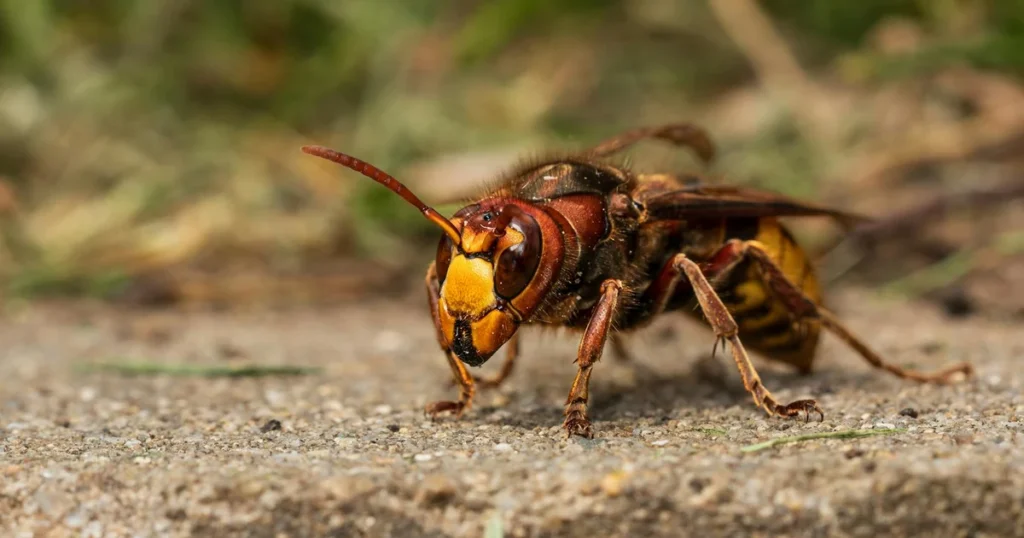
The European hornet (Vespa crabro) is the largest hornet species you’ll encounter in Virginia, reaching up to one and a half inches long. Its coloring differs from the bald-faced hornet: a reddish-brown head and thorax, a yellow-and-brown striped abdomen, and a larger, heavier build overall. It’s often described as looking like a very large yellow jacket.
Research published in Entomologica Americana documents Vespa crabro as widely established east of the Mississippi River, including throughout Virginia. Unlike most stinging insects, European hornets are active at night and are frequently attracted to lights. If you’ve seen a large, buzzing insect flying around porch lights after dark, a European hornet is a likely candidate.
European hornets prefer to nest in hollow trees, but they also build nests inside wall voids, attics, eaves, and old wood structures. Their nests are smaller than those of bald-faced hornets but enclosed in the same gray paper material. Finding a European hornet nest inside or attached to a structure is a sign to call a professional rather than investigate further.
What About the Giant Hornet and Murder Hornet in Virginia?
The Asian giant hornet (Vespa mandarinia), widely called the murder hornet, has not been confirmed in Virginia. It was detected in Washington State and British Columbia in 2019 and 2020, with eradication efforts following confirmed finds. According to the Virginia Tech Department of Entomology, what Virginia residents report as giant hornets or murder hornets are almost always European hornets or Eastern cicada killer wasps. Both insects are large and alarming at first glance, but neither is the Asian giant hornet.
The Asian giant hornet reaches nearly two inches and has a large orange head with prominent eyes. If you believe you’ve found one, the Virginia Tech Insect Identification Lab accepts specimens and photos for confirmation. For the overwhelming majority of Virginians, the large hornet in the yard is a European hornet, not a giant hornet from Asia.
How Hornets in Virginia Differ from Paper Wasps and Yellow Jackets
Most homeowners use “hornet,” “wasp,” and “yellow jacket” interchangeably. The insects are related, but their behavior and nesting habits differ in ways that affect how you respond to them. Paper wasps build small open-comb nests with visible cells, usually under eaves or porch ceilings. They’re slender insects with long legs that dangle during flight. They’re less aggressive than hornets and typically sting only when the nest is directly threatened.
Yellow jackets are compact, brightly banded insects. They nest in the ground, in wall voids, or in enclosed above-ground cavities. They’re highly aggressive in late summer and fall and will sting repeatedly. Hornets are larger than both, build fully enclosed paper nests, and defend their colonies with similar intensity. All three groups qualify as stinging insects and as social wasps, and all three are present across Virginia.
Why Hornets Sting and What Makes Nests in Virginia Dangerous
Hornets sting to defend their nest, not because they’re hunting people. A single foraging hornet away from the colony poses little threat. The danger comes from proximity to an active nest. When a nest is disturbed, the colony responds as a coordinated unit. Research on bald-faced hornets identified alarm pheromones that trigger rapid, mass defensive behavior when the nest is threatened. Workers mobilize within seconds. Multiple stings occur quickly.
People with known allergies to hymenoptera venom face serious risk from any nest encounter. Even for those without known allergies, multiple stings from a large colony can produce systemic reactions. If a nest is located near a door, playground, or frequently used outdoor area, it’s a treatment priority, not something to monitor and hope resolves itself.
Hornets are also beneficial insects when they’re not nesting against your house. They prey on caterpillars, garden pests, flies, and other insects, making them useful for natural pest control in outdoor areas where they aren’t a safety concern. The goal isn’t to push them to extinction; it’s to keep active nests away from areas where people encounter them regularly.
How to Handle a Hornet Nest in Virginia
Do not attempt to remove an active hornet nest yourself. Knocking down a nest or spraying it with a store-bought product at close range puts you directly in the path of an aggressive colony response. Wasps and hornets can pursue for significant distances when they perceive a threat. Professional treatment applies targeted products from a working distance and at the appropriate time of day, typically at dusk when foragers have returned and the colony is less active.
Sage Pest Control covers stinging insects as part of its standard pest control service, with bald-faced hornets and yellow jackets noted as pests requiring specialized treatment programs. Same-day service is available throughout Virginia Beach for active nest situations. Technicians inspect the nest location, confirm the species, and apply treatment appropriate for the nest type and location.
The EPA’s integrated pest management framework recommends targeted, precise treatment over broad-spectrum approaches. For hornet nests in or adjacent to structures, that means treating the nest directly rather than applying product broadly around the yard.
Preventing Hornet Nests in Virginia: What Homeowners Can Do
Early spring is the best time to reduce hornet nesting opportunities because overwintered queens are just beginning to scout nesting sites before colonies have established. A few adjustments to your property can make it less attractive to nesting insects without requiring any treatment at all.
Seal gaps in eaves, soffits, and exterior walls. European hornets in particular target wall voids and hollow trees as nest sites, and closing entry points before spring removes those options. Turn off or redirect exterior lights at night if European hornets are a recurring problem. They’re drawn to lit surfaces, and reducing that attraction cuts down on nighttime encounters.
Remove old nests from prior seasons. Empty paper nests do not get reused by the same colony, but their presence near an area doesn’t deter new queens from building nearby. Take them down when they’re clearly inactive in late fall or winter. Keep wood piles, hollow logs, and structural debris away from the house. These materials attract European hornets as nest sites.
If you’ve had an active nest treated, a follow-up inspection the next spring can catch new activity before a colony establishes. Sage’s tri-annual service schedule covers exterior perimeter inspections and nest removal as part of the standard visit, so recurring hornet activity near the home gets addressed as part of the regular service cycle rather than requiring a separate call each time.
Frequently Asked Questions
Are hornets in Virginia dangerous to people?
Yes, active nests near high-traffic areas pose real risk. A single hornet away from the nest rarely stings without direct provocation. An active nest disturbed at close range triggers a fast, coordinated defense involving many workers. People with venom allergies face the highest risk, but multiple stings can cause systemic reactions in anyone. Nests near doors, decks, or play areas should be treated promptly.
Is the murder hornet actually in Virginia?
No confirmed sightings of the Asian giant hornet (Vespa mandarinia) have been documented in Virginia. The Virginia Tech Department of Entomology reports that virtually all local murder hornet reports turn out to be European hornets or Eastern cicada killer wasps on closer inspection. If you genuinely believe you’ve found one, contact the Virginia Tech Insect Identification Lab with a photo or specimen.
What time of year are hornets most active in Virginia?
Hornet colonies are most active from late spring through early fall, with peak populations in late summer. By August and September, colonies have reached maximum size and are most defensive. European hornets remain active later into fall than bald-faced hornets. Queens of both species overwinter alone and begin founding new colonies the following spring.
Can I treat a hornet nest myself?
Store-bought sprays can treat very small nests at significant distance, but professional treatment is the better option for any established colony near a structure. Hornets respond to disturbance aggressively and quickly. A professional applies treatment at the right time of day from the correct distance, reducing the risk of a defensive response and ensuring the nest is fully treated rather than partially disturbed.
How do I tell a bald-faced hornet from a yellow jacket in Virginia?
Bald-faced hornets are larger, black and white, and build large enclosed paper nests above ground. Yellow jackets are smaller, yellow and black, and typically nest in the ground or inside enclosed cavities. Both species are aggressive near the nest. If you see a large, football-shaped gray paper nest hanging from a tree or overhang, that’s a bald-faced hornet colony, not yellow jackets.
