
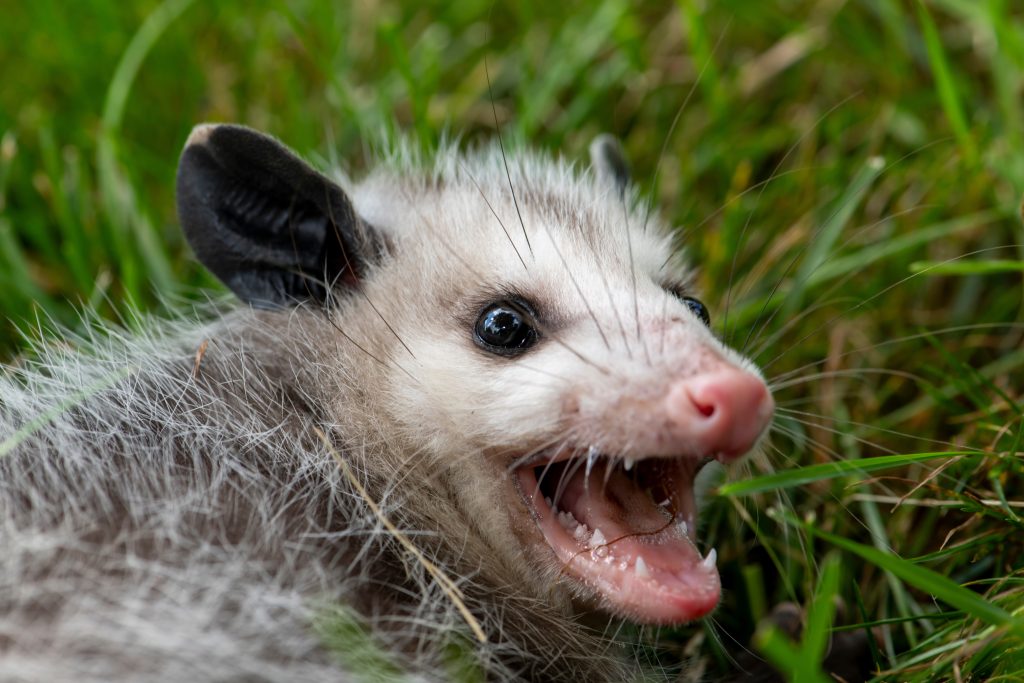
The Virginia opossum is North America’s only native marsupial, and it’s the animal most homeowners spot rooting through a trash can or waddling across a yard at night without realizing what they’re actually looking at. It’s easy to mistake for an oversized rat at a glance, but the naked ears, hairless tail, and pointed white face set it apart from any rodent, and it’s just as often confused with a young raccoon in poor lighting. Opossums show up around homes because food and shelter are easy to find there, not because anything is wrong. This guide covers how to identify one, how it actually lives, and whether it’s worth doing anything about.
Key Takeaways
- Virginia opossums are North America’s only native marsupial, easily told apart from rodents by their naked ears, hairless prehensile tail, and pointed white face.
- “Playing possum” is an involuntary response to a serious threat, not a choice, and the resulting trance-like state can last anywhere from minutes to hours.
- Opossums pose little direct risk to people or pets and rarely cause real property damage, though one denning under a porch or in a crawlspace is still worth discouraging.
What a Virginia Opossum Actually Looks Like
An adult is roughly the size of a housecat but built differently, with a stockier body, shorter legs, and a slow, waddling gait that’s easy to spot even from a distance.
Fur, Face, and Tail
The fur is grizzled, long white hairs layered over black-tipped underfur, which gives the coat a frosted look rather than a solid color. The face is white with a pink nose and small black eyes, and the ears are large, rounded, and completely hairless. The tail is the giveaway most people remember once they’ve seen it: long, scaly, and hairless, and prehensile enough that an opossum can use it almost like a fifth limb while climbing.
Teeth and Feet
Virginia’s Department of Wildlife Resources notes that opossums have 50 teeth, more than any other mammal in the state, though the mouthful is mostly for show since they aren’t an aggressive species. Each hind foot has an opposable “thumb” with no claw, which works with the grip of the tail to make them surprisingly capable climbers despite their bulk. Adults typically weigh nine to thirteen pounds, with males running larger than females.
Virginia Opossum vs. Rat vs. Raccoon: Telling Them Apart at a Glance
A quick look at the ears, tail, and face settles most mix-ups before anyone gets close enough to check anything else.
- Virginia opossum: Naked, rounded ears; a long, hairless, scaly tail; a pointed white face with a pink nose; a slow, low-to-the-ground walk.
- Rat: Much smaller overall, with a thinner hairless tail, a pointed brown or gray face, and quick, darting movement rather than a waddle.
- Raccoon: Distinctive black facial mask and ringed tail, both covered in fur, with a bushier build and a more agile, higher gait than an opossum’s shuffle.
Habits: How Virginia Opossums Actually Live
Opossums are solitary, nocturnal, and somewhat nomadic, often shifting shelter every few months rather than settling permanently in one spot. They rarely dig their own dens, instead taking over burrows other animals have abandoned, tree hollows, brush piles, or rock crevices, and they’ll just as readily move into an attic, shed, or crawlspace if there’s an easy way in. They’re found throughout Virginia, from the coastal plain to the mountains, and adapt to suburban and urban yards about as easily as to wooded areas.
Diet and Foraging
Diet is about as flexible as their choice of shelter. Opossums are true omnivores, eating insects, small rodents, snails, slugs, fruit, and carrion, along with whatever turns up in an unsecured trash can or pet food bowl left outside overnight. That range includes ticks, and opossums also show some natural resistance to the venom of pit vipers like copperheads and rattlesnakes, which occasionally puts snakes on the menu as well as insects.
“Playing Possum” Is a Reflex, Not a Choice
When a threat doesn’t back off after hissing, baring teeth, or emitting a foul-smelling secretion, an opossum’s next response isn’t a decision at all. Its body goes into an involuntary catatonic state, stiff, unresponsive, and often drooling, that can last anywhere from a few minutes to several hours depending on how long the animal perceives the danger to be present. It’s a reflex triggered by extreme stress, not a trick the opossum is choosing to perform.
Reproduction and Lifespan
Breeding and Litters
Opossums breed multiple times a year, generally from late winter through fall, with litters typically running from about six to a dozen young. Pregnancy lasts only around 13 days, one of the shortest gestation periods of any mammal, after which the tiny newborns crawl into the mother’s pouch to continue developing outside the womb.
Growing Up in the Pouch
Newborns stay in the pouch for roughly two months, nursing and developing further before they’re large enough to leave it. From there, they ride on the mother’s back for several more weeks while still depending on her for food and shelter, and they’re fully weaned by around three to four months old, at which point they disperse on their own.
A Short Life in the Wild
Few opossums live past their first couple of years in the wild, since predators, vehicles, and harsh weather all take a steady toll on a species that isn’t built for a long lifespan to begin with. That short life cycle is part of why populations can rebound quickly even in areas with heavy predation or road mortality.
Are Virginia Opossums Dangerous to Have Around?
Not really. Opossums aren’t aggressive toward people or pets and go out of their way to avoid confrontation, relying on bluffing and, as a last resort, playing dead rather than fighting.
Rabies and Disease Risk
Opossums are less likely than many mammals to carry rabies, likely related to their low body temperature, though they aren’t entirely immune to it. Normal caution around any wild animal, avoiding direct contact and keeping pets away from a denning site, still applies regardless of the lower relative risk.
Their Role as Accidental Pest Control
Their varied diet does real work in the background: insects and ticks make up a meaningful part of what an opossum eats over the course of a season, along with the occasional small rodent. An opossum passing through a yard is arguably doing a bit of unpaid pest control rather than causing a problem, even if the exact impact on local tick numbers isn’t something research has pinned down precisely.
What to Do If an Opossum Is Denning on Your Property
Seeing an opossum in the yard isn’t, on its own, a reason for concern. If one has settled into a crawlspace, attic, or the space under a deck and you’d rather it move along, start by removing what’s drawing it in: secure trash cans, bring pet food in at night, and seal any gaps large enough for it to squeeze through once it’s gone. Local animal control handles some nuisance wildlife calls, but capacity varies by jurisdiction, so Virginia’s Wildlife Conflict Helpline (1-855-571-9003, Monday through Friday, 8:00 a.m. to 4:30 p.m.) is a reliable next call, along with the Virginia Department of Wildlife Resources’ list of licensed nuisance wildlife trappers for hands-on removal.
Get Help With the Pests an Opossum Leaves Behind
Sage Pest Control doesn’t trap or relocate wildlife, so an opossum itself is a job for a licensed wildlife trapper or the state helpline above. What Sage does handle is everything that can show up alongside one: fleas and ticks an opossum may have carried into a crawlspace, or other pests drawn to the same food and shelter that attracted it in the first place. Sage is GreenPro certified and ranked in the Top 1% of pest control companies nationally, with technicians who text back in under a minute. Contact Sage Pest Control if fleas, ticks, or other pests have moved in around a denning site, or check out flea control and tick control directly.
Frequently Asked Questions
Are Virginia opossums dangerous?
Less than most people assume. An opossum will flee or bluff before it ever considers fighting, and bites tied to unprovoked encounters are rare. The bigger question is usually whether one has moved into a crawlspace, not whether it poses a direct threat.
Why do opossums carry a lower rabies risk than other mammals?
Their body temperature runs lower than the range the rabies virus needs to thrive, which makes opossums an inefficient host. That’s a relative risk reduction, not immunity, so avoiding direct contact with any wild animal is still the right default.
Is “playing dead” something an opossum controls, or does it just happen?
It just happens. Once hissing and bluffing fail to scare off a threat, the nervous system triggers an involuntary shutdown the animal can’t consciously end, which is why the same opossum might stay frozen for two minutes in one encounter and two hours in another.
What actually gets an opossum to leave a crawlspace on its own?
Cutting off food and easy access usually does it within a few nights, since opossums move on quickly once a spot stops paying off. If it doesn’t, that’s the point to call a licensed nuisance wildlife trapper rather than trying to force the issue.
Is the “opossums eat thousands of ticks” claim actually true?
The exact number gets exaggerated online, but the underlying fact holds: ticks are a real part of an opossum’s diet alongside rodents, snails, and fruit. Treat it as a genuine, minor upside of having one pass through, not a pest-control strategy to count on.
