
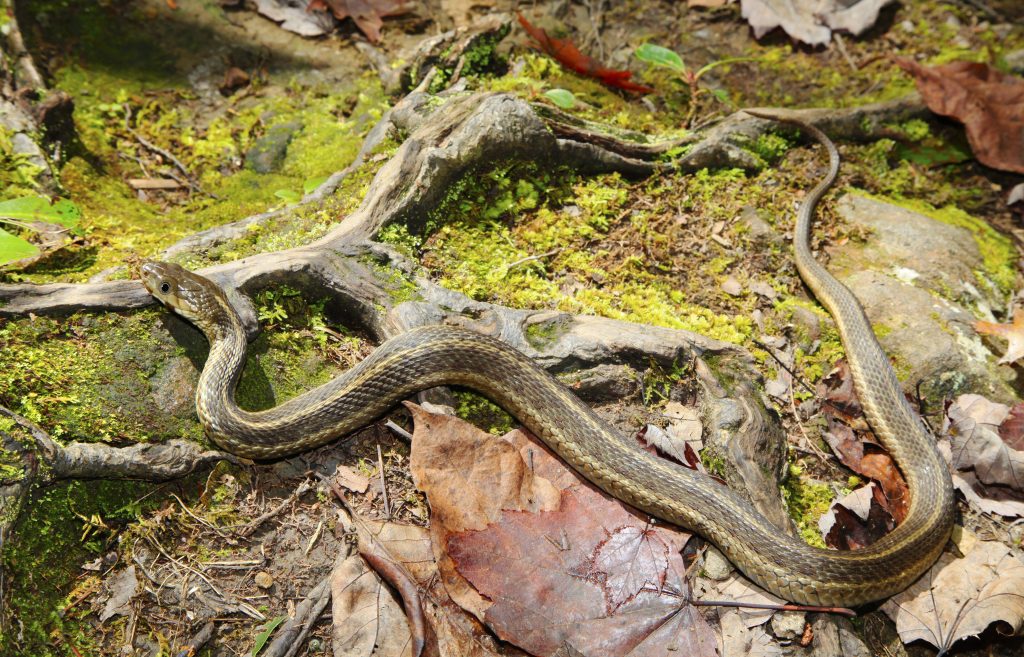
Garter snakes in North Carolina, sometimes called garden snakes, are among the most common snakes found around homes statewide, and they’re completely non-venomous. Most of the alarm around finding one traces back to simple surprise rather than any real risk, since a garter snake’s only defenses are a harmless musk and a bite that feels like little more than a scratch. This guide covers how to identify a garter snake, where it actually lives, and how it behaves when it turns up in a yard or under a house.
Key Takeaways
- Garter snakes, sometimes called garden snakes, are among the most common snakes found around North Carolina homes and are completely non-venomous.
- Three light stripes running the length of a dark body is the classic look, though checkered or faintly patterned variations occur, and dark bars between the lip scales separate a garter snake from the similar-looking ribbon snake.
- A garter snake’s defenses are limited to a harmless musk and a minor bite; it would rather flee than confront anything larger than the small prey it actually hunts.
Identifying Garter Snakes in North Carolina
Coloring and pattern get most homeowners close to an identification, but one specific detail settles the question when a similar-looking species is involved. Getting familiar with both the general look and that one distinguishing feature makes a confident ID possible in almost any encounter.
Garter Snake Physical Traits and Coloring
An adult garter snake typically measures 2 to 4 feet long, with a slender, rounded body and keeled scales that give it a slightly rough texture. The classic pattern is three light stripes, usually yellow or white, running the length of a darker background that can be black, brown, gray, or green, though some individuals show a more checkered pattern with fainter stripes instead. The belly typically carries two rows of dark spots against a greenish or yellowish background, and the head is rounded with a distinct dark spot or stripe near the snout.
Garter Snake vs. Eastern Ribbon Snake
The eastern ribbon snake shares the same striped look and overlapping habitat, making it the species most often confused with a garter snake. A ribbon snake has a noticeably slimmer, more elongated build and lacks a specific marking garter snakes have: dark bars between the scales along the lip. That single detail is the most reliable way to tell the two apart when the general size and color look similar.
Where Garter Snakes Live in North Carolina
Garter snakes show up in two related but distinct contexts: the wild habitat they naturally prefer, and the specific reasons they end up right around a house instead. Both come down to the same basic need for cover, just applied to different settings.
Garter Snake Natural Habitat
Garter snakes occupy an unusually wide range of habitat for a single species: forests, meadows, marshes, and the edges of lakes, ponds, and streams all support populations, provided there’s enough cover in the form of vegetation, logs, or rocks. They’re found throughout the entire state, with somewhat higher concentrations reported in the eastern and central regions.
Why Garter Snakes Turn Up Around Homes Specifically
Garter snakes are one of the most frequently encountered snakes directly around North Carolina houses, often in large numbers in a single yard. Foundation gaps and crawl space openings give them easy access underneath a structure, and a yard with good ground cover, mulch beds, woodpiles, or dense plantings, offers the same shelter they’d find in the wild. A garter snake under a house is typically there for cover, not anything related to the structure itself.
Garter Snake Behavior and Diet
What a garter snake eats and how it reacts when threatened are closely related, since its diet is exactly why it’s harmless enough to leave alone in the first place. A closer look at both makes clear why this snake poses so little actual risk despite the surprise of finding one.
What Garter Snakes Eat
Garter snakes are opportunistic carnivores with a genuinely varied diet: earthworms, slugs, frogs, toads, salamanders, small fish, and occasionally insects, birds, or small mammals. That appetite makes them a natural check on several yard and garden pests, which is part of why many gardeners consider a resident garter snake a benefit, not a problem.
Garter Snake Defensive Behavior: Musk and Bites
When handled or threatened, a garter snake’s first move is usually to thrash and release a foul-smelling musk from glands near the base of the tail, a startling but entirely harmless defense. It may also bite if handled roughly, but the bite itself causes nothing worse than minor, superficial irritation, comparable to a scratch from a thorn. Left alone, a garter snake almost always prefers to flee rather than stand its ground.
Garter Snake Reproduction
That same live-and-let-live temperament carries through the rest of the garter snake’s life cycle. Garter snakes mate in spring, and unlike many snake species, they give birth to live young instead of laying eggs. A single litter can range from as few as 7 to as many as 80 offspring, and newborns look like miniature versions of the adults from the moment they’re born.
Why Garter Snakes Matter
All those offspring feed into a bigger picture than just one yard’s snake population. Garter snakes play a genuine role in the local food web on both ends. Their diet keeps populations of rodents, slugs, and insects in check around a property, and they’re themselves a food source for foxes, raccoons, hawks, owls, and other predators native to North Carolina. That two-way ecological role is part of why simply leaving a garter snake alone, instead of removing it, tends to be the better outcome for the yard overall.
Is It Legal to Remove a Garter Snake in North Carolina?
That ecological value is reflected in how the state treats the species legally. The eastern garter snake is classified as a nongame species in North Carolina, and it’s unlawful to take or possess one without the appropriate collection license, beyond a small personal allowance for non-protected reptiles. The state’s wildlife agency doesn’t send anyone out to trap or remove snakes on a homeowner’s behalf. The recommended approach is learning to coexist: a garter snake given space will typically move along on its own without any need for capture or relocation.
When to Call a Professional
Coexistence works for the vast majority of encounters, but a few situations still call for more than just patience. A single garter snake spotted in a yard or under a porch rarely calls for anything beyond leaving it alone. Frequent sightings in the same crawl space or foundation gap, especially in numbers, are worth a closer look, since that pattern usually points to an entry point or a food source nearby worth addressing directly instead of managing one snake at a time.
Get Pest Control for Your North Carolina Home
Sage Pest Control addresses the insects and small prey that draw garter snakes and other wildlife close to a property as part of its general pest control service across North Carolina. Sage is GreenPro certified, offers same-day service 90 to 95 percent of the time, and provides free re-services if activity returns between scheduled visits. Visit Sage Pest Control or contact the team to schedule an inspection.
Frequently Asked Questions
Do garter snakes bite people?
Only if handled or cornered, and there’s no venom involved, so basic first aid, cleaning the area with soap and water, covers it completely. No emergency care or monitoring is needed the way it would be for a venomous species.
How can I tell a garter snake from a young copperhead?
Stripes are the fastest clue. Garter snakes have long stripes running the length of the body, while copperheads have hourglass-shaped crossbands and no stripes at all, even as juveniles. A copperhead’s head is also triangular and distinctly wider than its neck, unlike a garter snake’s rounded, uniform head.
Should I relocate a garter snake I find under my house?
Relocating one snake at a time doesn’t accomplish much, since another will likely take its place unless the underlying draw changes. A more lasting fix is sealing the specific gap it used to get in and clearing the ground cover nearby, instead of moving the snake elsewhere and leaving the same conditions in place.
