
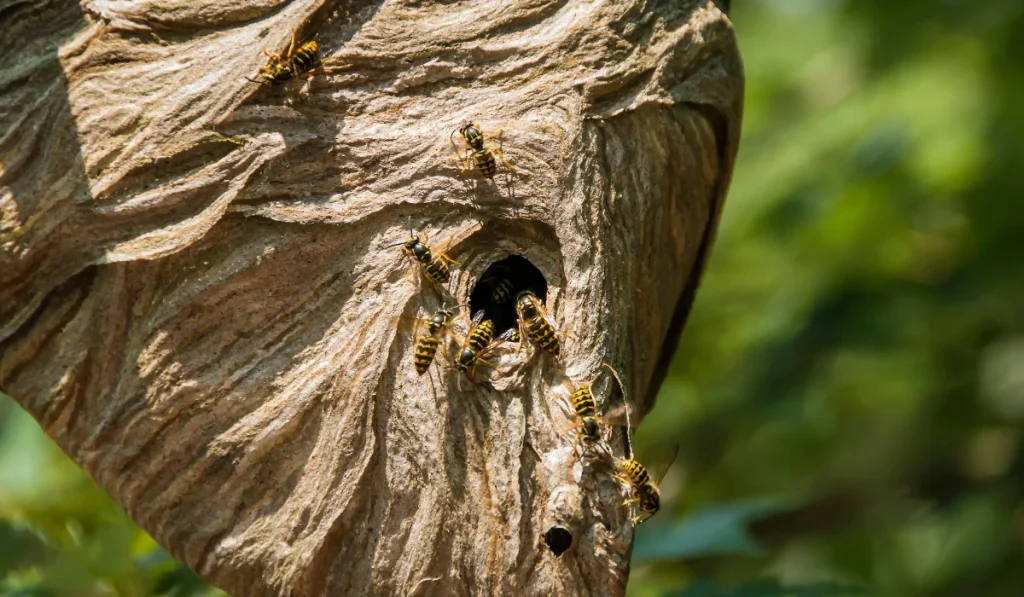
A hidden yellow jacket nest often gives away its location before you can see the entrance. The strongest clue is not one insect moving through the yard. It is a repeated flight path, with several yellow jackets traveling toward the same patch of ground, shrub bed, siding gap, or protected opening.
Learning how to find a yellow jacket nest starts with separating random foraging from nest-bound traffic. Yellow jackets searching for food may circle a trash can, inspect an outdoor meal, or move between flowers. Workers returning to a colony usually fly with more direction and repeatedly disappear into the same area.
Across North Carolina and the Virginia Beach area, yellow jackets may nest underground or inside protected structural spaces. Careful observation can help you identify a likely entrance without approaching or disturbing the colony. Once you confirm steady traffic at one location, stop watching, keep people and pets away, and arrange for professional help when the nest poses a risk.
How to Find a Yellow Jacket Nest by Watching the Flight Path
The best way to locate a yellow jacket nest is to watch several insects from a stationary position. Following one yellow jacket is rarely useful because an individual worker may visit several food sources before returning to the colony. A group of workers repeatedly traveling along the same route provides much stronger evidence.
Choose a spot that gives you a broad view without placing you between the insects and their suspected destination. Watch where they go after leaving a trash container, flowering plant, fallen fruit, or outdoor eating area. Nest-bound workers often move quickly and steadily instead of circling, landing, and changing direction.
Random Foraging Versus Nest-Bound Flight
The difference between foraging and nest traffic becomes easier to recognize when you watch the pattern rather than the individual insect.
| Behavior | Random Foraging | Possible Nest-Bound Flight |
| Direction | Changes often | Repeats along the same route |
| Movement | Circling, landing, and searching | Fast, direct, and purposeful |
| Number of insects | One or two moving independently | Several workers following a similar line |
| Destination | Food, flowers, drinks, or trash | One ground opening or structural gap |
| Traffic pattern | Irregular movement | Repeated incoming and outgoing activity |
A yellow jacket circling a soda can confirms only that food has attracted it. Several workers crossing the same section of lawn and vanishing near one tree root suggest something different. When insects arrive and leave along the same yellow jacket flight path, a colony may be nearby.
Confirming the Route Without Moving Closer
You do not need to follow the insects on foot. Binoculars or a phone camera with zoom can help you observe a distant area without entering the flight path. Remain still, move slowly when necessary, and avoid blocking the route between the workers and the suspected entrance.
Watch long enough to determine whether the pattern repeats. Look for multiple yellow jackets approaching the same location, disappearing, and later leaving from that point. Once the route leads to a specific opening, do not move closer to inspect it. The goal is to identify the general location, not to see inside the nest.
Where a Yellow Jacket Flight Path Usually Ends
A yellow jacket flight path may end at a hole in the ground, an opening around landscaping, or a narrow gap in a building. The entrance can be much smaller than the colony hidden behind it. Grass, leaves, mulch, siding, and exterior trim may conceal the opening until regular worker traffic draws your attention to it.
According to NC State Extension’s guide to non-honeybee stinging insects, yellow jackets in North Carolina may nest in lawns, at the bases of trees and shrubs, in rotted logs and stumps, and inside attics, wall voids, storage buildings, or cinder-block openings. Each site offers shelter with a small route to the outdoors.
Underground Yellow Jacket Nests
An underground yellow jacket nest often occupies an existing cavity. Common sites include old animal burrows, spaces between tree roots, areas beneath landscape timbers, and protected ground near dense shrubs. The opening may resemble an ordinary hole in the soil, especially when grass or ground cover partly hides it.
Watch where the workers descend. They may approach from several angles before converging on the same point. Regular traffic at ground level is more useful than the size or appearance of the hole itself.
Do not clear leaves, pull weeds, or move mulch to improve your view. You could place your hands or feet directly over the entrance. Yard work near the opening can also disturb the colony before you realize how close you are.
Yellow Jacket Nests in Walls and Structures
A yellow jacket nest in a wall may be reached through a gap around siding, soffits, roof edges, vents, utility lines, or exterior trim. Workers can enter through a narrow opening and travel through the cavity before reaching a nest located farther inside.
The visible entrance does not show the nest’s exact position. Yellow jackets entering near a window frame may be nesting deeper in a wall void, attic, or ceiling space. This is one reason structural nests should not be treated like an exposed paper-wasp nest.
Repeated activity around one building gap deserves attention, especially when workers enter and do not immediately emerge elsewhere. Yellow jackets appearing indoors may also indicate access between a nest cavity and the living space.
Signs You Have Found the Yellow Jacket Nest Entrance
The clearest sign of a yellow jacket nest entrance is steady two-way traffic. Several workers enter through the same opening while others leave and quickly fly away. Their routes may vary slightly, but the insects repeatedly converge on one location.
You may see workers slow down or hover briefly before entering. Others may remain near the opening for a short time. Continued traffic over several minutes is stronger evidence than a brief cluster of yellow jackets near food or flowers.
Do not assume a nest is on your property simply because yellow jackets gather around a patio or trash area. Virginia Tech Extension’s yellow jacket guidance states that workers may travel up to one mile while searching for food. The insects at an outdoor meal may have arrived from a nest beyond the immediate yard.
An underground yellow jacket nest can also have more than one entrance. If traffic stops at the opening you noticed, that does not prove the colony is inactive. Workers may be using a second route nearby. Avoid walking around the area in search of another hole.
What Not to Do After You Locate the Entrance
Finding the entrance is the point when observation should end. Do not stand directly in the flight path, lean over the opening, tap the wall, or disturb the soil to confirm what is inside. Yellow jackets defend their colony and can sting repeatedly.
Avoid mowing, edging, trimming shrubs, digging, or moving landscape materials near an active yellow jacket nest. The vibration from lawn equipment or sudden contact near the entrance may trigger defensive behavior. Keep children, visitors, and pets away until the site has been addressed.
Do not pour gasoline, bleach, boiling water, or other household liquids into a ground opening. Burning, flooding, or smoking the nest creates unnecessary risks and may not reach the colony inside the cavity. A concealed nest can extend beyond the part visible from the entrance.
Never seal an active yellow jacket nest entrance in a wall. Blocking the outdoor opening does not remove the insects inside. Trapped workers may search for another exit and enter the home through drywall gaps, vents, ceiling fixtures, or other interior openings.
Food bait should not be placed beside doors, decks, play areas, or pet spaces in an attempt to track workers. Attracting more yellow jackets to a busy part of the property can make the immediate area harder to use safely.
When the Flight Path Points to a Professional Yellow Jacket Problem
Professional yellow jacket removal is the safer choice when the nest entrance is near a doorway, sidewalk, patio, playground, pet area, or regular mowing route. These locations bring normal household activity close to the colony, increasing the chance of an accidental disturbance.
Professional help is also appropriate when workers enter siding, a wall void, an attic, a soffit, a crawlspace, or another structural cavity. The technician must determine where the activity is coming from and account for the space behind the visible opening. Treating only the entrance may leave the main colony unaffected.
Arrange an inspection when you notice multiple entrances, yellow jackets appearing indoors, or defensive activity when people pass through the area. A trained pest technician can identify the insect, inspect the nest site, and apply targeted products and materials based on its location.
Anyone with a known sting allergy should remain well away from a suspected nest. The American College of Allergy, Asthma & Immunology’s guidance on insect sting allergies lists trouble breathing, swelling of the face or throat, dizziness, widespread hives, and loss of consciousness among the signs of a severe reaction. Contact emergency services immediately when these symptoms occur.
Protecting Your Home After Finding a Yellow Jacket Nest
A repeated flight route can tell you more than a broad search of the yard. Several workers following the same direction, entering one opening, and creating steady two-way traffic provide the strongest visible signs of a nearby yellow jacket nest.
Once you identify the likely entrance, step away and leave it undisturbed. Keep people, pets, and lawn equipment out of the area. Do not seal a structural opening or attempt to dig out an underground colony.
Sage Pest Control provides specialized yellow jacket control for homeowners across Charlotte, Raleigh, Greensboro, and the Virginia Beach area. When repeated traffic leads to a ground hole, wall gap, or concealed space near your home, contact the Sage team to schedule an inspection and have the active site addressed by a trained technician.
