
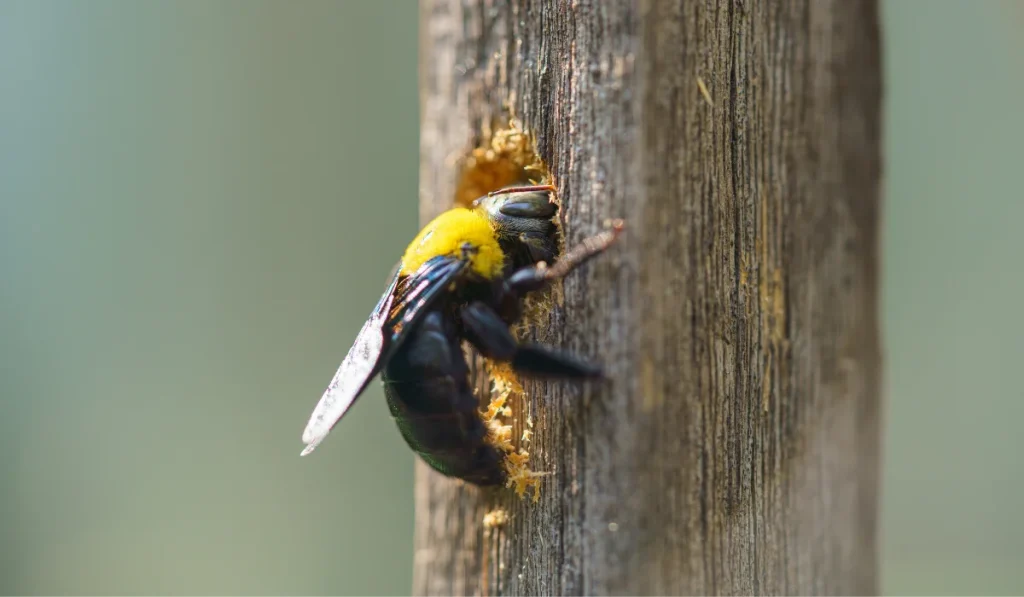
Carpenter bees in North Carolina become especially noticeable when large bees start hovering around decks, porches, railings, eaves, and other exposed wood in spring. Their nearly round entrance holes and fresh sawdust can make homeowners wonder how much damage is hidden below the surface. Carpenter bees usually do not cause serious structural damage from limited activity, but repeated nesting in the same wood over several years can become a property concern. Knowing how to identify these bees, recognize active tunnels, understand their seasonal behavior, and respond appropriately can help you protect your home without treating bees that are simply foraging on flowers.
How to Identify Carpenter Bees in North Carolina
North Carolina is home to two large carpenter bee species: the eastern carpenter bee, Xylocopa virginica, and the southern carpenter bee, Xylocopa micans, according to NC State’s carpenter bee research. The eastern carpenter bee is the most common large carpenter bee across the eastern United States.
Carpenter bees are large-bodied bees that can resemble bumble bees at a glance. One of the easiest differences to see is the abdomen. Carpenter bees have a smooth, shiny or hairless abdomen, while bumble bees have a hairy abdomen. Because several types of bees in North Carolina can appear around homes and gardens, looking at both appearance and behavior gives you a better chance of identifying what you are seeing.
Carpenter Bee vs. Bumble Bee
The biggest practical difference for homeowners is nesting behavior. Carpenter bees excavate galleries in wood, while bumble bees do not bore those characteristic round tunnels into decks or trim.
| Feature | Carpenter Bee | Bumble Bee |
|---|---|---|
| Abdomen | Smooth, shiny, or mostly hairless | Hairy or fuzzy |
| Wood-boring behavior | Females excavate nesting galleries in wood | Does not excavate wood galleries |
| Common clue around a home | Round entrance holes, sawdust, repeated activity near wood | More often noticed foraging or entering a separate nest site |
| Social behavior | Does not form a honey bee-style colony | Lives in colonies |
Male carpenter bees can make identification more confusing because they often hover around nesting areas and approach people who come nearby. Although that behavior can look defensive, males do not have stingers. Females can sting, but NC State Extension’s carpenter bee guidance says they generally do so when handled or highly agitated.
Wasps can also be mistaken for bees from a distance. If the insect has a noticeably narrow waist or is associated with a papery nest rather than a round hole in wood, information about wasps in North Carolina may be more relevant.
When Carpenter Bees Are Active in North Carolina
Carpenter bee season in North Carolina follows a fairly recognizable cycle. Adults overwinter, often inside old nest tunnels, and typically become active during April and May. Males tend to appear first, followed by females that mate and begin preparing nesting sites.
Females use their jaws to excavate wood rather than consume it. After creating a gallery, a female provisions individual brood cells with pollen and nectar and lays eggs within the tunnel. New adults develop and begin emerging later in the summer. As colder weather returns, carpenter bees can use existing holes as overwintering sites.
That reuse helps explain why one section of a porch, deck, or roofline may attract activity for more than one season. An existing carpenter bee nest is not necessarily abandoned for good once spring ends. Old galleries can be used again and extended, so previously affected wood deserves another look when warm weather returns.
For North Carolina homeowners, spring is a useful time to inspect wood that showed activity the previous year. Pay attention to porch railings, deck components, overhangs, eaves, exterior trim, and other exposed wooden surfaces where bees repeatedly hover or disappear into a hole.
Signs of Carpenter Bee Damage Around Your Home
Carpenter bee damage is easier to recognize once you know what to look for. Unlike termites, carpenter bees do not eat wood for nutrition. Females remove wood as they excavate space for their nests.
According to NC State Extension’s guide to stinging insects in North Carolina, carpenter bees typically leave round entrance holes about one-half inch across. Fresh sawdust may collect below the opening, and yellowish-brown staining from bee waste may also appear on the wood beneath an active nesting area.
What Happens Beyond the Entrance Hole
The opening you see is only the beginning of the nest. After entering the wood, the female turns and follows the grain as she excavates the gallery. NC State reports that larval galleries are commonly six to seven inches long, although they can extend farther. When the same entrance is reused over several years, connected tunnels can eventually extend several feet through the wood.
That hidden growth is why recurring carpenter bee holes deserve more attention than an isolated opening. A homeowner may only see a small round entrance while the gallery extends along the board behind it.
Signs worth checking for include:
- Nearly round holes about one-half inch across
- Fresh sawdust beneath the wood
- Yellowish-brown staining near an entrance
- Carpenter bees repeatedly entering and leaving the same opening
- New holes appearing close to older carpenter bee holes
- Woodpecker damage around areas with established bee activity
Woodpeckers may open or enlarge damaged wood while searching for carpenter bee larvae. NC State notes that this secondary damage can be especially significant in thin wood such as siding.
How Serious Is Carpenter Bee Damage?
A carpenter bee hole does not automatically mean your home has serious structural damage. NC State Extension reports that carpenter bees typically do not cause major structural damage unless large numbers of bees create many tunnels over successive years.
The pattern of activity matters more than the sight of a single bee. One new hole in an isolated board is different from several galleries that are repeatedly extended in the same section of a porch, overhang, or other wooden component.
Location matters too. Damage to a piece of outdoor furniture may be mostly a maintenance issue, while repeated nesting in trim, siding, porch components, or other wood attached to the house deserves closer inspection. Woodpecker activity can also make an existing problem more visible by opening up the surface around tunnels.
This is why homeowners should look for recurring activity rather than assuming every carpenter bee in the yard is causing damage. Carpenter bees collect pollen and nectar from flowers and serve as pollinators. Control is most useful when it focuses on active nesting in wood that you need to protect.
How to Prevent Carpenter Bees From Nesting in Wood
There is no single prevention method that guarantees carpenter bees will stay away from wooden structures. Some older guidance recommends finishing wood or plugging holes, but newer NC State research notes that commonly suggested surface treatments and repellents do not have consistent research support as complete prevention methods.
Home maintenance still has a role. The goal is to identify wood that repeatedly attracts nesting and reduce opportunities for the same galleries to be used season after season.
Focus on Recurring Problem Areas
Start with the places where you have already seen carpenter bee activity. During routine exterior maintenance:
- Inspect previously affected boards for new sawdust or bee traffic.
- Repair damaged wood after active nesting has been addressed.
- Replace deteriorated material when normal home maintenance calls for it.
- Consider composite or other materials carpenter bees cannot excavate when replacing wood in a chronic problem area.
You do not need to treat every wooden surface around the property simply because carpenter bees are present nearby. Focusing on documented nesting sites keeps the response proportional to the problem.
Do Not Simply Seal an Active Tunnel
Plugging a carpenter bee hole while bees are still using the gallery can create another problem. NC State Extension notes that carpenter bees trapped inside an untreated tunnel may chew another exit through the wood.
Before repairing a carpenter bee hole, determine whether the opening is still active. Fresh sawdust and bees entering or leaving the tunnel can indicate ongoing use. If galleries are concentrated across several boards, located high along the roofline, or difficult to inspect, professional carpenter bee control may be more practical than trying to evaluate each opening yourself.
When Carpenter Bee Control Makes Sense
Carpenter bee control is most appropriate when you have confirmed nesting activity in wood around the home. Bees feeding on flowering plants away from the structure do not create the same property concern as females excavating galleries in porch rails or exterior trim.
Professional help may make sense when:
- Carpenter bee holes return to the same area each year.
- Several active entrances are concentrated in one section of wood.
- Nesting occurs along elevated eaves, fascia, or other difficult-to-reach surfaces.
- Woodpeckers have begun damaging wood around the tunnels.
- You are unsure whether the insect is a carpenter bee, another bee, or a wasp.
Identification should come first because similar-looking insects have different nesting habits. A targeted carpenter bee treatment should address the nesting areas involved rather than treating every bee seen outdoors.
Protecting Your North Carolina Home From Carpenter Bees
Carpenter bees in North Carolina are easier to manage when you recognize the difference between normal pollinator activity and repeated nesting in your home. Nearly round half-inch holes, fresh sawdust, staining, and bees repeatedly returning to the same wood are much more useful signs than simply seeing a large bee in the yard.
If activity returns year after year, appears across several pieces of wood, or involves areas you cannot safely inspect, Sage Pest Control can help assess the situation. Homeowners in Charlotte, Greensboro, Raleigh, and other Sage service areas can contact Sage Pest Control to discuss carpenter bee activity and an appropriate control approach for the property.
