
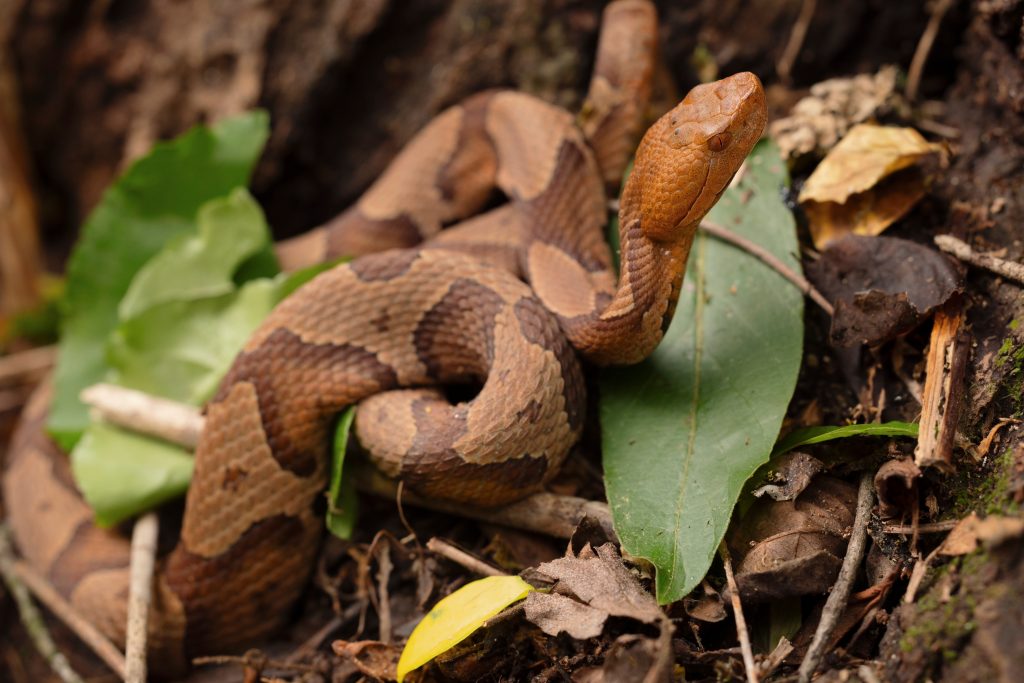
Copperheads in Virginia are the state’s most frequently encountered venomous snake, responsible for an estimated 100 reported bites statewide each year, most of them between May and October. A bite is rarely fatal, but it’s always a medical emergency, and most bites happen by accident rather than from someone trying to handle a snake. This guide covers how to identify a copperhead, the habitat and conditions that draw them close to a home, and what actually matters if one turns up on your property.
Key Takeaways
- Copperheads are Virginia’s most frequently encountered venomous snake, with an estimated 100 bites reported statewide each year, most between May and October.
- Copperhead activity tracks the weather directly: warmer temperatures, rainfall, and rising humidity all increase how often they’re seen, and they favor spots like woodpiles and garages for the stable conditions these places offer.
- A copperhead bite is rarely fatal and about 10 percent are dry bites with no venom injected, but every bite still needs prompt medical evaluation, since there’s no way to tell the two apart without one.
Identifying Copperheads in Virginia
Markings alone won’t always settle an identification, since a couple of harmless species in Virginia have evolved to look the part. Physical traits and a direct comparison to the two most common look-alikes both matter here.
Copperhead Physical Traits and Markings
An adult copperhead typically measures 2 to 3 feet long, with a thick, muscular body covered in ridged scales. Its coloring ranges from copper to light tan, marked with dark hourglass-shaped crossbands that narrow near the spine and widen at the sides, with darker coloring along the edges of each band that helps the snake blend into fallen leaves. The head is triangular and unmarked, distinctly wider than the neck due to venom glands in the jowls, and the eyes are yellow to reddish-brown with vertical, cat-like pupils, a reliable sign of a pit viper. Juveniles look different from adults: they’re lighter in color and carry a bright yellow tail tip that fades as they mature.
Copperhead vs. Water Moccasin and Hognose Snake
Two other snakes in Virginia get confused with copperheads regularly. Water moccasins, found only in a small area of southeastern Virginia, are darker overall, often nearly black, an adaptation that mimics wet fallen leaves rather than the dry leaves copperheads blend into. The eastern hognose snake causes a different kind of confusion: when threatened, it flattens its head into a triangular shape to mimic a venomous species, despite being completely harmless and lacking the vertical pupils and heat-sensing pits that mark an actual pit viper.
Copperhead Habitat in Virginia
Where a copperhead is likely to be found breaks down into three related questions: how far its range actually extends, what specifically draws one close to a house, and how weather shifts change its activity from week to week.
Where Copperheads Are Found Statewide
Copperheads are widely distributed across nearly every part of Virginia except the barrier islands, found in old fields, forests, rocky outcrops, and marshes. Unlike Virginia’s other two venomous species, which have much more limited ranges, a copperhead encounter is a realistic possibility almost anywhere in the state.
What Draws Copperheads Close to a Home
Copperheads seek out spots with stable temperatures and reliable cover, which makes woodpiles a particular favorite; the interior stays consistent regardless of outdoor conditions, and the snake can slip in and out easily. Garages, compost piles, covered outdoor equipment like a grill, and dense brush piles offer similar appeal. Compost in particular draws copperheads indirectly, since it attracts the rodents they hunt, and moist, overgrown grass supports the crickets, grasshoppers, and cicadas young copperheads rely on for food.
Where Copperheads Are Found in Residential Areas
Around a house specifically, copperheads favor structural features that combine cover with stable ground temperature: gaps beneath decks and porches, retaining walls and stacked stone, thick mulch beds pushed up against the foundation, and utility boxes or AC units where the ground stays cool and undisturbed. Landscaping features like rock gardens and dense ground cover plantings offer similar appeal, and a stone or brick walkway with loose-fitting pavers can hide a copperhead resting just beneath the surface. Checking these specific spots before reaching in, sitting down, or letting pets explore closely reduces the odds of an accidental encounter more than general yard tidiness alone.
Weather-Driven Copperhead Activity
Copperhead activity responds directly to weather conditions. Warmer temperatures, increased rainfall, and rising humidity all correspond with more sightings, and a dry spell followed by rain reliably brings copperheads out. They generally prefer temperatures in the 80s, retreating to cooler, sheltered spots when it gets too hot and to denser, more stable cover when temperatures drop. In hot summer weather, copperheads shift toward nocturnal activity, while in milder spring and fall conditions, they’re more active during the day.
Copperhead Reproduction and Denning Behavior
Copperheads have two mating seasons, one in spring from April through May and another in late summer into early fall. Unlike snakes that lay eggs, copperheads give birth to live young, and a female that mates in fall can store sperm through winter dormancy before giving birth the following year. Only an estimated 10 to 25 percent of newborns survive their first winter to reach adulthood. Despite hunting alone, copperheads are semi-social when it comes to shelter: they frequently den communally, sometimes alongside other snake species entirely, and tend to return to the same den site year after year. Newborn copperheads add one more wrinkle to their reputation: they lack full muscle control over their venom glands, so once a bite begins, a baby copperhead may continue injecting venom until it’s physically removed, though its shorter fangs limit how deep that venom actually reaches.
Are Copperhead Bites Dangerous?
A copperhead bite is a genuine medical emergency, but understanding what actually happens to the body puts the risk in better perspective than fear alone does.
What a Copperhead Bite Feels Like
A copperhead bite causes immediate, significant pain and swelling at the site. The venom is hemotoxic, meaning it breaks down red blood cells and damages tissue locally rather than affecting the nervous system, and while a bite is a serious injury, the estimated fatality rate is very low, close to 0.01 percent. About 10 percent of bites are dry bites, delivering no venom at all, but there’s no reliable way to tell a dry bite from an envenomated one without medical evaluation.
First Aid: What to Do
Get to emergency care as quickly as possible, and keep the bitten limb still and at or below heart level along the way. Don’t cut the wound, attempt to suck out venom, apply a tourniquet, or use ice, since none of these outdated methods help and some can make the injury worse. Never attempt to pick up a snake, even one that appears dead, because a copperhead struck by a car or otherwise injured can still deliver a bite reflexively.
Preventing Copperhead Encounters Around Your Property
Keeping grass cut short and on the dry side removes both the cover copperheads use and the insect prey that draws them in. Clearing brush piles, keeping compost tidy, and storing woodpiles away from the house cuts down on the shelter and rodent activity that attracts them close to a structure. When doing yard work, wearing boots instead of sandals, using heavy gloves while weeding or moving wood, and scanning the area with a flashlight in the evening all reduce the chance of an accidental encounter.
When to Call a Professional
A copperhead spotted once and left alone typically moves on without further incident. Recurring sightings in the same area, especially near entryways, decks, or anywhere children or pets spend time, are worth addressing directly, since that pattern often points to an active den or a steady rodent food source nearby rather than a single wandering snake.
Get Help With What Draws Copperheads to Your Property
Sage Pest Control doesn’t handle venomous snake removal directly, but a meaningful part of what draws a copperhead toward a yard, rodent activity supported by compost or clutter, is exactly what Sage’s general pest control service addresses. Sage is GreenPro certified, offers same-day service 90 to 95 percent of the time, and provides free re-services if activity returns between scheduled visits. Visit Sage Pest Control or contact the team to schedule an inspection, and contact a licensed wildlife removal specialist directly for the snake itself.
Frequently Asked Questions
Why do copperhead bites seem to be increasing in Virginia?
Poison control data shows accidental bites, cases where someone wasn’t trying to handle or catch the snake, have become more common relative to bites from people actively picking snakes up. That shift likely reflects more people and copperheads sharing the same outdoor spaces rather than any change in the snake’s behavior itself.
Do copperheads live in groups?
Not day-to-day, since they hunt and move independently, but a den site can host several individuals at once, sometimes even snakes of other species sharing the same shelter. That matters practically: finding one copperhead near a den doesn’t rule out others being nearby, which is part of why a recurring sighting in the same spot deserves more attention than a single one-off encounter elsewhere on the property.
Is a baby copperhead more dangerous than an adult?
Not in venom potency, but in practice a bite from a juvenile can be just as serious as one from an adult, since a young snake’s limited control over its bite means more venom can end up delivered relative to its size. Treat any copperhead bite, regardless of the snake’s size, as the same medical emergency.
