
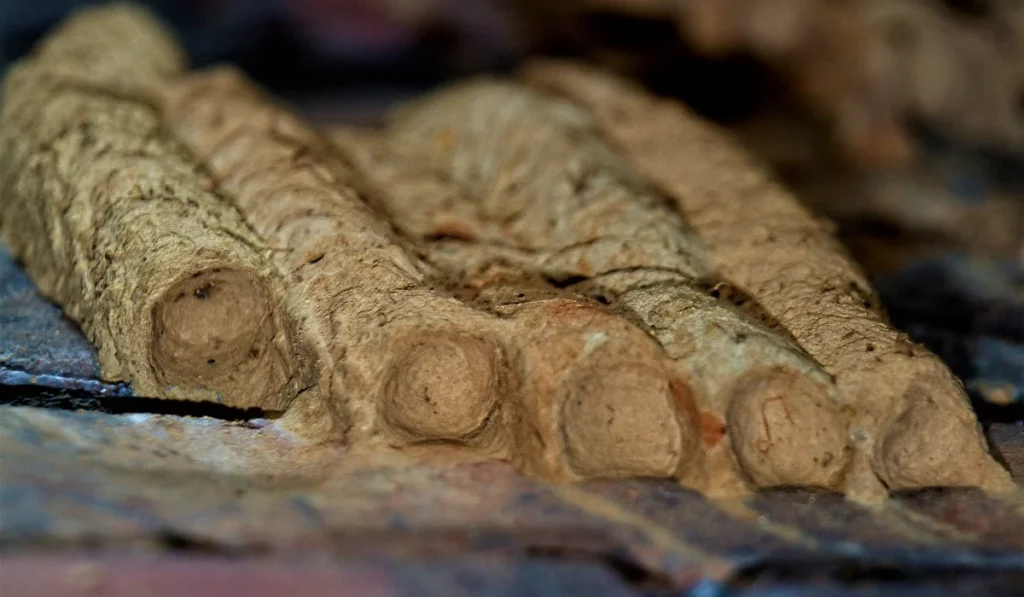
Dirt daubers build mud nests and fill each sealed chamber with paralyzed spiders. The spiders are not food for the adult wasp. They are a stored food supply for a single larva that will hatch, feed, pupate, and eventually chew its way out of the nest.
You may find a dirt dauber nest on a porch ceiling, garage wall, shed, attic beam, or sheltered area beneath an overhang. Some nests resemble rough clumps of dried mud. Others form neat rows of tubes that look like a small pipe organ.
The pipe-shaped nest belongs most closely to the organ pipe mud dauber. Other mud dauber species build different structures, but their basic nesting strategy is similar. A solitary female constructs brood cells, hunts spiders, paralyzes them with her sting, and seals them inside with an egg.
For homeowners in North Carolina and Virginia, these nests can look alarming without posing the same risk as a yellow jacket or hornet colony. Knowing what is inside the nest, which wasp built it, and whether it is active can help you choose the right response.
Why Dirt Daubers Pack Paralyzed Spiders Into Mud Nests
Female dirt daubers collect spiders to feed their developing young. An adult mud dauber can leave the nest to find its own food, but a larva develops inside a sealed chamber. The female must provide everything the larva will need before she closes the cell.
She hunts spiders near webs, plants, buildings, and other protected areas. After locating suitable prey, she uses her sting to immobilize it. The spider cannot escape or fight back, allowing the female to carry it to the nest and place it inside the brood cell.
Paralysis also helps preserve the food supply while the egg develops. The female does not bring dead, decomposing prey into the nest or return later to feed the larva. Instead, she stocks the chamber in advance with spiders that remain intact long enough for the young wasp to use them.
According to the University of Florida IFAS guide to mud daubers, a black-and-yellow mud dauber may place as many as 25 live, paralyzed spiders in one cell. The exact number varies, and that maximum should not be applied to every mud dauber species or every nest.
One Cell Supports One Developing Wasp
Once a brood cell contains enough prey, the female lays one egg on one of the spiders and seals the opening with mud. She does not lay one egg on each spider. The entire collection serves one developing larva.
After hatching, the larva begins eating the stored prey. It remains protected by the hardened mud wall as it grows and later enters the pupal stage. When development is complete, the adult wasp chews an exit hole through the cell.
This life cycle explains why an active mud dauber nest may contain spiders that appear fresh. They were deliberately immobilized and stored as provisions, not collected after they died.
What Different Mud Dauber Nests Look Like
“Dirt dauber” and “mud dauber” are common names for several solitary wasps that build with mud. Their nests share the same basic purpose, but the shape of the structure can help narrow down which species built it.
The organ pipe mud dauber makes the tubes most closely associated with mud pipe nests. The black-and-yellow mud dauber creates blockier clusters of cells. Blue mud daubers often use mud structures built by other species rather than constructing a complete nest of their own.
| Mud Dauber Type | Typical Appearance | Nest Style |
| Organ pipe mud dauber | Dark, slender body with a narrow waist | Builds long, parallel tubes that resemble organ pipes |
| Black-and-yellow mud dauber | Black body with yellow markings | Builds clustered or rectangular mud cells covered by an uneven outer layer |
| Blue mud dauber | Metallic blue or blue-black body | Often renovates or reuses nests built by other mud daubers |
The Mississippi State University profile of organ pipe mud daubers describes the species’ distinctive tubular construction. Each tube may contain several separate brood chambers rather than one open interior shared by multiple wasps.
This distinction matters when assessing a nest around your home. A row of narrow tubes points toward an organ pipe mud dauber, while a rough mud mass may belong to a black-and-yellow species. Nest shape alone is not always conclusive, especially when an older nest has been repaired or reused.
How a Mud Dauber Builds and Stocks Its Nest
A female begins by locating damp soil that can be shaped into a firm structure. She gathers a small portion of mud, carries it to a protected surface, and presses it into place. Building one cell requires repeated trips between the soil source and the nesting site.
Sheltered surfaces help protect the drying mud from rain and direct disturbance. This is why nests often appear under eaves, inside open garages, beneath porch roofs, on shed walls, and around attic or crawl space openings.
Once a chamber is ready, the female shifts from construction to hunting. She captures spiders, paralyzes them, and transports them to the nest one at a time. Each spider is placed inside the cell until the female has collected enough prey for the larva.
Research published in Behavioral Ecology on black-and-yellow mud dauber prey selection found that sampled cells contained between five and 22 spiders. The researchers also found differences among individual females. Some collected a narrow selection of prey, while others brought spiders from several families.
Those findings show that dirt daubers do not follow one fixed menu. Prey availability, hunting location, wasp species, and the behavior of the individual female can affect what ends up inside the nest.
After laying the egg, the female closes the chamber and starts another. She does not remain inside to guard or feed the larva. Her work is completed once the cell contains prey and has been sealed.
What an Exit Hole Reveals About the Nest
A round hole in a dried mud cell often means an adult wasp has completed development and emerged. Freshly constructed cells usually remain sealed, while older nests may contain one or more visible openings.
An exit hole does not prove that the entire structure is vacant. A large mud dauber nest can contain several cells, and each one may be at a different stage. One adult may have emerged while larvae or pupae remain in nearby chambers.
Old nests can also attract new occupants. Blue mud daubers may renovate existing cells, and other insects can use abandoned openings for shelter. For that reason, homeowners should not assume that a mud nest is inactive based only on its age or appearance.
Watch the area from a safe distance before disturbing it. A wasp repeatedly arriving with mud or carrying prey confirms active nesting. A lack of visible traffic may suggest the nest is older, but observation over time provides a better indication than a single glance.
Are Dirt Daubers Dangerous?
Dirt daubers can sting, but they are less defensive than social wasps. Yellow jackets, paper wasps, and hornets live in colonies where workers protect a shared nest. A mud dauber female works alone and does not have a colony of workers responding to threats.
Stings are uncommon because the female usually avoids confrontation rather than defending the nest. A sting is more likely when someone grabs the wasp, traps it against clothing, or handles an active nest at close range.
Even so, avoid handling an unidentified wasp or nest. Several stinging insects use sheltered areas around homes, and activity near a mud structure does not always confirm that the insect you see is a mud dauber. A more defensive species may be nesting nearby or inside a hidden opening.
Mud daubers also remove spiders from the surrounding area as they provision their nests. That makes them beneficial predators, though their presence should not be treated as a complete form of spider control. One nest may contain several spiders without meaning the property has an unusual infestation.
Should You Remove a Mud Dauber Nest?
A dirt dauber nest in an unused corner of a shed or beneath a distant overhang may not require immediate action. When the nest is out of reach, does not interfere with the structure, and is clearly associated with a low-risk solitary wasp, leaving it alone may be reasonable.
Location changes the decision. A nest above an entry door, beside outdoor seating, near a play area, or on equipment creates more opportunities for accidental contact. Mud that blocks a vent, narrow opening, or moving component can also cause a practical problem even when the wasp itself is not aggressive.
Active nests deserve more caution than old, open cells. Knocking down a nest while a female is building or returning with prey brings you closer to a wasp that can sting. Removal is also harder when the nest is high beneath an eave or attached to a delicate painted surface.
To reduce repeat nesting, monitor protected areas where mud nests have appeared before. Repair damaged screens, seal appropriate gaps, and limit access to sheltered interior spaces such as garages, attics, and sheds. Once a nest has been confirmed inactive and removed, cleaning the remaining mud makes new construction easier to spot.
Making the Right Wasp Control Choice for Your Home
Mud pipe nests are nurseries, not social colonies preparing to swarm. Each sealed chamber contains one developing wasp and the spiders its mother collected for food. The nest reflects a complete cycle of construction, hunting, egg laying, feeding, and emergence.
In many settings, dirt daubers can remain undisturbed without creating a serious problem. Professional help makes more sense when the species is uncertain, the nest is active, the location is difficult to reach, or wasp activity is concentrated near a frequently used part of the property.
For help identifying a nest and deciding how it should be handled, turn to Sage Pest Control. You can also contact the Sage team to describe what you are seeing and arrange service for wasp activity around your home.
