
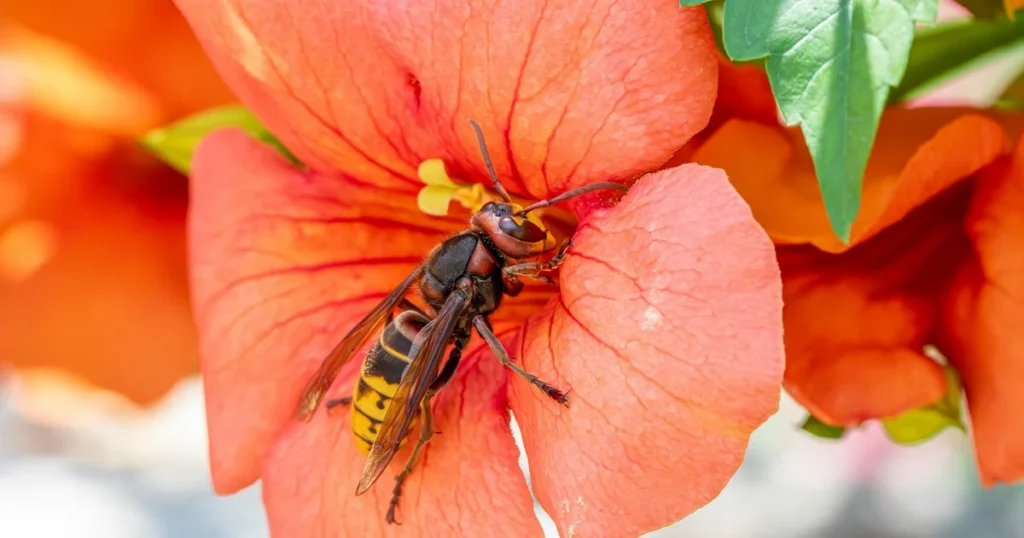
Two hornet species live in North Carolina, the European hornet and bald-faced hornet. Both sting repeatedly when nests are disturbed.
Key Takeaways
- North Carolina has two true hornets: the European hornet and the bald-faced hornet, which is closely related to yellow jackets.
- Bald-faced hornets build large aerial paper nests and defend them aggressively with alarm pheromones that coordinate mass stinging.
- European hornets are the only true hornet species established in the eastern United States and are active at night.
- The northern giant hornet (sometimes called the murder hornet) is not present in North Carolina.
- Active hornet nests near living spaces require professional treatment; DIY sprays directed at large nests often provoke mass attacks.
Which Hornet Species Live in North Carolina
Two species account for almost every hornet encounter in North Carolina homes and yards: the European hornet and the bald-faced hornet. Knowing which one you are looking at changes how you respond to it. Misidentifying a bald-faced hornet as a wasp, or confusing a yellow jacket with a hornet, leads to underestimating how aggressively a nest will be defended.
European Hornet Found in North Carolina Yards and Trees
The European hornet (Vespa crabro) is the only true hornet species established in the eastern United States, as documented in a 2025 study published in Entomologica Americana. Adults reach about 1.5 inches in length, with a reddish-brown head, yellow-and-brown banded abdomen, and a body noticeably larger than any wasp you will find in the state. One trait that distinguishes this species: it flies at night and is attracted to porch lights, which startles homeowners who assume hornets are strictly daytime insects.
European hornets nest inside hollow trees, wall voids, attics, and barn walls. They build paper nests from chewed wood fiber, typically enclosed rather than exposed. Colonies can reach 200 to 400 workers by late summer. Workers forage for insects, tree sap, and fruit, and they will chew bark from shrubs and small trees to reach the sap underneath, causing visible damage to landscape plantings near the nest.
Bald-Faced Hornet Found in North Carolina Trees and Eaves
The bald-faced hornet (Dolichovespula maculata) is technically a large yellow jacket, but most homeowners and pest professionals refer to it as a hornet because of its size and the enormous aerial nests it builds. Colonies grow to 400 to 700 workers by late summer, according to a species profile published in the Annals of Allergy, Asthma and Immunology. Adults are black with bold white facial markings, which makes identification straightforward once you see one up close.
Nests are built from gray paper pulp and hang from tree branches, eaves, utility boxes, and fence posts. A mature nest can reach three feet in length. The outer shell is layered and insulating, protecting multiple interior combs. Only fertilized queens overwinter. Every worker, drone, and the original queen dies when temperatures drop in late fall, leaving empty nests behind. Those empty nests do not get reused the following spring.
What About Murder Hornets in North Carolina
The northern giant hornet, widely called the murder hornet, is not present in North Carolina. Confirmed sightings of the Asian giant hornet have been limited to the Pacific Northwest, and eradication efforts there have significantly reduced that population. NC State Extension Entomology does not list the Asian giant hornet among established species in the state. If you see a very large hornet-like insect in your yard, it is almost certainly a European hornet or a cicada killer wasp, both of which are common in the Carolinas.
How Hornets in North Carolina Build Nests and Defend Them
Understanding how hornets build and defend nests helps you recognize why a disturbed colony is genuinely dangerous. Both North Carolina hornet species are social insects. Queens emerge from overwintering in spring, select a nest site, and begin building alone before the first workers hatch and take over construction and foraging duties.
Nest Building Behavior Across North Carolina
European hornets begin nest building inside existing cavities. A fertilized queen chews wood fiber into pulp and layers it into a small paper comb, then raises the first generation of workers. As worker numbers grow, the nest expands rapidly through summer. By August, a European hornet nest inside a wall void or hollow tree can hold several hundred workers and active brood.
Bald-faced hornets build exposed aerial nests from scratch. The queen starts with a small paper stalk attached to a branch or overhang, then adds layer after layer of paper combs. Workers add the outer shell as the colony grows. The result is a football-to-basketball-sized structure by midsummer, expanding to three feet or more by early fall. Nests in high-traffic areas near doors, play sets, or driveway trees are the ones most likely to cause stings.
Hornet Sting Defense and Alarm Pheromones in NC
Bald-faced hornets release an alarm pheromone when the nest is threatened, recruiting nearby workers to sting in coordinated waves. Research on bald-faced hornets identified the components of this pheromone and confirmed its role in mass nest defense. One sting near a nest is the beginning, not the end. Workers continue until the threat moves away.
Both hornet species can sting multiple times. Unlike honey bees, which have barbed stingers that lodge in skin, hornets have smooth stingers they can use repeatedly. Venom contains proteins that cause immediate pain, localized swelling, and redness. Most reactions resolve on their own. A severe allergic reaction, including anaphylaxis, requires emergency treatment. Anyone who develops hives, throat tightness, or difficulty breathing after a hornet sting should call 911 immediately.
Wasps and Hornets in North Carolina: Other Stinging Insects Nearby
Several other stinging insects in North Carolina are frequently mistaken for hornets, and each one behaves differently around people. Telling them apart helps you decide whether the nest near your porch needs professional treatment or can be left alone.
Yellow Jackets in North Carolina Yards and Walls
Yellow jackets are the stinging insects most often confused with hornets because of their similar yellow-and-black coloring. They are smaller than European hornets and build nests in the ground, in wall voids, and inside structures. Yellow jackets become aggressive in late summer when colony populations peak and food sources thin out. Accidentally stepping on a ground nest or bumping a wall void can provoke the same coordinated sting response as disturbing a hornet nest. Yellow jacket stings are painful, and the venom can cause allergic reactions in sensitive individuals.
Paper Wasps and Mud Daubers in North Carolina
Paper wasps build open, umbrella-shaped nests under eaves, railings, and deck boards. They are slender with long dangling legs and are far less aggressive than hornets or yellow jackets. A paper wasp nest will rarely prompt a mass sting response unless someone handles it directly. Mud daubers are solitary wasps that build small mud tubes on walls and ceilings. They provision their nests with paralyzed spiders as prey for their larvae. Mud daubers almost never sting humans and present minimal risk near homes.
Carpenter Bees and Bumble Bees in North Carolina
Carpenter bees drill round entry holes in unpainted or weathered wood, including siding, decks, and fascia boards. Male carpenter bees hover and dive aggressively but cannot sting. Females can sting but rarely do unless handled. The real concern with carpenter bees is structural damage from repeated boring over several seasons. Bumble bees are large, fuzzy, and social, nesting in the ground or in abandoned rodent burrows. They are important pollinators and collect pollen for their colonies. Bumble bees will sting to defend a nest but are not aggressive when foraging.
Cicada Killers in North Carolina Lawns
Cicada killers are large solitary wasps that hunt and paralyze cicadas to stock their underground burrows. They are one of the biggest wasps in the state, which leads many homeowners to report them as hornets. Males are territorial and fly aggressively around nesting areas, but they cannot sting. Females can sting but almost never do. Cicada killers do not defend nests communally, so there is no risk of a mass sting event. Their burrowing does create visible mounds in lawns and can damage well-drained soil areas near patios and garden beds.
When to Call Pest Control for Hornets in North Carolina
Active hornet nests within 10 feet of doors, windows, play equipment, or high-traffic areas should be treated by a professional. The combination of large colony size, coordinated sting response, and the smooth stinger that allows multiple attacks makes a disturbed bald-faced hornet or European hornet colony a medical risk, particularly for households with children, elderly adults, or anyone with a known venom allergy.
Why DIY Hornet Treatment in North Carolina Carries Real Risk
Spray applications directed at large aerial nests often fail to penetrate the outer paper shell fast enough to stop an alarm response. Workers near the nest entrance detect the spray and begin releasing alarm pheromone before the treatment reaches the interior combs. The result is a swarm of agitated workers looking for the source of the threat.
The EPA’s integrated pest management framework recommends evaluation before treatment. That means confirming nest location, colony size, and proximity to occupied spaces before deciding on a control method. Most homeowners skip evaluation when they reach for a can of spray.
Stand upwind if you need to observe a suspected nest from a distance. Avoid dark clothing near active nests, since hornets associate dark moving shapes with natural predators. Do not stand directly below a bald-faced hornet nest and look up. Workers at nest entrances detect vibration and body heat from below and may treat a person standing underneath as a threat.
Hornet Treatment and Nest Removal in North Carolina
Sage Pest Control’s standard service covers paper wasp nest removal and non-honey bee species. Bald-faced hornets and yellow jackets require a specialized treatment program because of colony size and sting risk. Technicians assess nest location and activity level before applying targeted treatments to active colony sites. Treatment timing matters: early morning and late evening are when foraging workers return to the nest, increasing coverage.
After a successful treatment, the nest itself poses no further risk. The paper structure can be removed once all activity stops. Empty bald-faced hornet nests left in place through winter will not be reused in spring, but new queens will site new nests nearby if the surrounding habitat remains attractive. Removing wood debris, sealing soffit gaps, and clearing dense shrubs from the home’s perimeter reduces the number of suitable nest sites available the following season.
Seasonal Timing for Hornet Control in NC
Late spring through early summer is the best time to address hornet activity in North Carolina, when colonies are small and workers are fewer. A nest treated as early as February or March and mostly finish by early May may hold fewer than 50 workers. That same nest treated in September could hold 600. Both species reach maximum colony size in late summer and early fall before worker populations collapse as temperatures drop in early winter. Queens mate in fall, disperse, and overwinter under bark, in leaf litter, and in wood piles. They emerge in spring to start the cycle again.
Bottom Line on Hornets in North Carolina Homes
North Carolina homeowners are most likely to encounter the bald-faced hornet and the European hornet. Both are capable of repeated stinging and defend nests aggressively when threatened. The murder hornet is not established in the state. Yellow jackets, paper wasps, mud daubers, carpenter bees, bumble bees, and cicada killers round out the stinging insect landscape and each requires a different response.
Nests close to living spaces are the ones that need attention. Early-season treatment is safer and more effective than waiting until colonies peak in late summer. If you spot an active nest near your home in Charlotte, Raleigh, Greensboro, or Virginia Beach, text Sage Pest Control. We respond in under a minute and can get a technician to you the same day.
Frequently Asked Questions
Are murder hornets in North Carolina?
No. The northern giant hornet, sometimes called the murder hornet or Asian giant hornet, has not been established in North Carolina. Confirmed sightings have been limited to the Pacific Northwest. Large insects reported as murder hornets in the Carolinas are almost always European hornets or cicada killer wasps, both of which are native to the region and far less dangerous than the name implies.
How do I tell a hornet nest from a wasp nest in my yard?
Bald-faced hornet nests are large, enclosed, gray paper structures hanging from tree branches, eaves, or overhangs. They look like a papier-mache football or basketball. Paper wasp nests are smaller, open, and umbrella-shaped, with visible cells and no outer shell. European hornets nest inside cavities like hollow trees, wall voids, and attics, so you often find the entry hole before you find the nest. If the nest is exposed and enclosed, treat it as a hornet nest.
What should I do immediately after a hornet sting?
Move away from the nest area first to avoid additional stings. Once clear, wash the sting site with soap and water and apply a cold compress to reduce swelling. Over-the-counter antihistamines can reduce localized itching and inflammation. Watch for signs of a severe allergic reaction, including hives spreading beyond the sting site, throat tightness, difficulty breathing, or dizziness. These symptoms require emergency medical attention. If you have a known venom allergy, use your epinephrine auto-injector and call 911.
Do bald-faced hornets come back to the same nest each year?
No. Only fertilized queens survive winter, and they do not return to old nests. Each spring, a queen builds a new nest from scratch in a new location. Old nests left in place are empty and pose no sting risk after the first hard frost. However, the same property may attract new queens the following year if habitat conditions remain favorable, so sealing entry points and reducing available nest sites can lower the chance of a new colony forming nearby.
When should I call a pest control professional for a hornet nest?
Call a professional when the nest is near an entrance, window, play area, or any space people use regularly. Any nest larger than a softball, any nest inside a wall void or attic, and any situation where someone in the household has a known venom allergy warrants professional treatment rather than DIY spray. Sage Pest Control offers same-day service across Charlotte, Raleigh, Greensboro, and Virginia Beach. Text or call and a technician will assess the nest and recommend the right treatment approach.
