
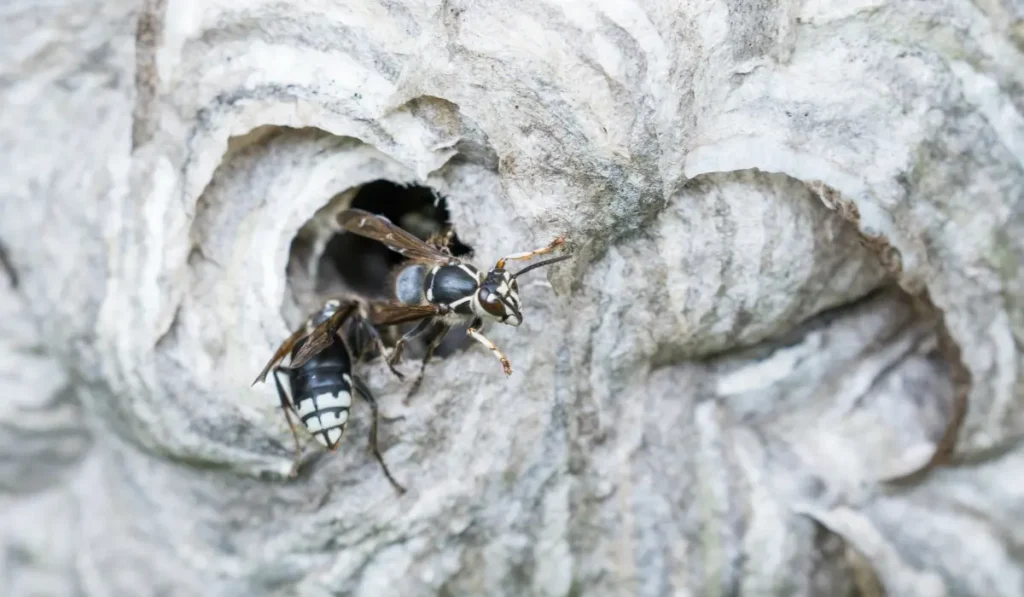
The two types of hornets in Virginia homeowners should recognize are European hornets and bald-faced hornets. European hornets are large, reddish-brown insects that usually nest in sheltered cavities, while bald-faced hornets are black-and-white wasps that build enclosed paper nests in trees and around buildings. Both can sting repeatedly and defend their colonies when disturbed, especially in late summer. Knowing how to identify these insects and recognize nesting activity can help you decide when a nest can be left alone and when professional removal is necessary.
What Types of Hornets Are Found in Virginia?
European hornets and bald-faced hornets differ in color, size, and nesting habits. European hornets are true hornets belonging to the genus Vespa. Bald-faced hornets are technically aerial yellowjackets, despite their common name.
Both are social wasps that live in colonies with a queen and workers. The workers gather food, care for developing young, expand the nest, and defend it against perceived threats.
European Hornets
European hornets (Vespa crabro) are among the largest social wasps found in Virginia. They have reddish-brown heads and thoraxes, yellow abdomens with dark brown markings, and reddish-orange wings. Adults are commonly around one inch long, making them noticeably larger than typical yellowjackets.
According to Virginia Cooperative Extension’s European hornet guide, these insects establish nests in protected spaces such as hollow trees, sheds, barns, porches, and attics. They also chew bark from trees and shrubs to obtain sap, sometimes damaging smaller branches.
European hornets also fly at night. They’re attracted to bright lights and may repeatedly fly toward porch fixtures or illuminated windows. Seeing one near a light doesn’t necessarily mean there’s a nest on your house, but repeated flights into a nearby opening may indicate nesting activity.
Bald-Faced Hornets
Bald-faced hornets (Dolichovespula maculata) have black bodies with prominent white markings on their faces and other body segments. Their coloring makes them easier to distinguish from the yellow-and-black wasps commonly seen around Virginia homes.
These insects build enclosed paper nests that often resemble gray footballs. The nests usually hang from tree branches, although they can also be attached to roof overhangs and other exterior structures.
Bald-faced hornets hunt insects such as flies and caterpillars to feed their young. They may also visit flowers for nectar. While individual hornets away from the nest aren’t necessarily a threat, workers can respond defensively when the colony is disturbed.
Hornets vs. Wasps and Yellowjackets: What’s the Difference?
Hornets are members of the wasp family, but not every wasp is a hornet. The distinction matters because insects that appear similar from a distance may build different nests and respond differently when disturbed.
European hornets are true hornets, while bald-faced hornets belong to the yellowjacket group. Paper wasps are another common type found around homes, particularly beneath porch ceilings, deck railings, and roof overhangs.
How to Identify Common Stinging Insects
Color patterns and nest construction offer the most useful identification clues.
| Insect | Appearance | Typical Nest |
| European hornet | Large, reddish-brown body with yellow and brown abdominal markings | Concealed nest in a tree cavity, attic, or wall void |
| Bald-faced hornet | Black body with prominent white markings | Enclosed gray paper nest attached to branches or structures |
| Paper wasp | Slender body, narrow waist, and long legs | Open paper comb with visible hexagonal cells |
| Yellowjacket | Compact body, usually with black-and-yellow markings | Often underground or inside protected structural cavities |
Paper wasps build exposed, umbrella-shaped nests, making the individual cells easy to see. Bald-faced hornets enclose their combs in a paper covering, while European hornets frequently build inside cavities where the nest remains hidden.
Several common wasps in Virginia share sheltered spaces around homes, so an insect entering a soffit or wall opening isn’t automatically a hornet. Color, body shape, and visible nesting activity can help narrow the identification without approaching the colony.
Where Do Hornets Build Nests in Virginia?
Hornet nests can be found in trees, wall voids, attics, eaves, and other protected areas around Virginia properties. European hornets generally favor concealed cavities, while bald-faced hornets are more likely to construct visible aerial nests.
The location matters because a colony hidden inside a wall may require a different approach from one suspended in a tree. Homeowners should identify signs of activity from a safe distance rather than attempting to inspect the nest directly.
European Hornet Nesting Locations
European hornets commonly use hollow trees, hollow posts, sheds, and other enclosed spaces. Around homes, they may establish colonies in attics, wall cavities, or sheltered openings beneath a roofline.
Their nests consist of a papery material made from chewed wood and plant fibers. Inside protected cavities, the nest may have little or no outer covering, making it different from the enclosed aerial nests associated with bald-faced hornets.
If hornets repeatedly enter a gap in your siding or soffit, there may be a nest inside. The opening itself may be small even when the colony occupies a larger concealed space.
Bald-Faced Hornet Nesting Locations
Bald-faced hornets usually suspend their nests from branches, although they can also attach them to buildings and other elevated structures.
The gray paper covering protects the combs inside. As the colony grows, workers add more material, and the nest becomes larger throughout the season.
A nest among the branches of a mature tree may go unnoticed until leaves thin out or the structure becomes more visible. A nest beneath an eave, however, may be easier to spot because workers regularly travel to and from the entrance.
Signs of a Hidden Hornet Nest
Repeated flights through the same opening are one of the clearest signs of a concealed colony. You might notice several hornets entering a roofline gap or moving between a hollow tree and nearby vegetation.
Activity concentrated around one location is more meaningful than seeing a single hornet crossing the yard. Foraging hornets can travel away from their nests while searching for prey or other food sources.
Don’t seal an opening while hornets are actively using it. Blocking their normal entrance doesn’t remove the colony and may complicate treatment, particularly when the nest is inside a wall.
When Is Hornet Season in Virginia?
Hornet season in Virginia generally runs from spring through fall. Colonies begin with a founding queen, expand as new workers emerge, and usually reach their largest populations toward the end of summer.
The University of Maryland Extension’s guide to social wasps explains that colony populations typically peak in late summer or early autumn. This is when homeowners may notice more insects flying around established nests and a greater defensive response when colonies are disturbed.
Spring and Early Summer: New Colonies Form
In spring, fertilized queens emerge from sheltered overwintering locations and begin constructing nests. A queen initially gathers food and raises the first workers herself.
Once those workers mature, they take over much of the feeding, building, and nest maintenance. The queen can then devote more of her activity to producing additional offspring.
At this stage, nests are relatively small. A colony may remain unnoticed until enough workers are traveling regularly between the nest and nearby food sources.
Late Summer and Early Fall: Colonies Become More Defensive
By late summer, established colonies contain more workers. A disturbance near the nest can bring several defensive insects into the same area, increasing the chance of multiple stings.
Bald-faced hornets are especially protective of their occupied nests. Trimming a branch that supports a nest or moving equipment against a nearby structure can trigger a response from workers.
European hornets also defend their colonies, including those concealed inside walls and tree cavities. Their nighttime flight activity means encounters aren’t limited to daylight hours.
Late Fall and Winter: Colonies Die Out
When cold weather arrives, established colonies decline and die. Newly fertilized queens survive winter in protected locations and establish new nests the following spring.
Neither European hornets nor bald-faced hornets reuse their previous year’s nests. An empty gray paper nest remaining in a tree during winter is generally a remnant of the previous season.
A favorable nesting location can still attract a new colony in another year. Hollow trees, open structural cavities, and sheltered roofline gaps may continue providing suitable conditions.
Are Hornets in Virginia Dangerous?
Hornets pose the greatest sting risk when they are defending an active nest. An individual hunting insects or flying through the yard is less concerning than workers gathering around a colony entrance.
Both European hornets and bald-faced hornets can sting more than once. If several workers respond to a disturbance, a homeowner may receive multiple stings before leaving the area.
Mowing near a concealed entrance, trimming an occupied branch, or approaching a nest with maintenance equipment can provoke a defensive response. The safest action is to move away promptly and avoid further disturbance.
Hornet Sting Symptoms and Allergic Reactions
A hornet sting usually causes immediate pain, redness, and swelling. Some people develop a larger area of swelling around the sting site, even without a severe allergic reaction.
For people with venom allergies, a sting can cause anaphylaxis. Symptoms can include difficulty breathing, swelling of the face or throat, widespread hives, dizziness, or fainting.
Call 911 if a severe allergic reaction is suspected. Someone prescribed an epinephrine auto-injector should use it promptly according to their medical instructions.
For a mild reaction, washing the area with soap and water and applying a cold compress can help relieve discomfort. Mayo Clinic’s insect sting first-aid guidance also explains when worsening symptoms require medical attention.
Why Multiple Stings Are a Concern
Hornets generally retain their stingers after stinging, allowing them to sting repeatedly. Honey bees, by comparison, commonly leave their stingers embedded in human skin.
The risk increases when more than one worker responds to a nest disturbance. Similar behavior explains why yellowjacket stings can occur multiple times during an encounter with a defensive colony.
If hornets begin flying toward you, leave the area promptly. Don’t stop beside the nest to identify the insects or attempt to knock them away.
What Should You Do if You Find a Hornet Nest?
The safest response to an active hornet nest is to leave it undisturbed and assess how close it is to normal household activity. A nest beside a doorway or children’s play area presents a different concern from one high in a tree away from walkways.
You don’t need to approach the nest to decide whether professional help is appropriate. Its location, visible activity, and proximity to people provide useful information for an initial assessment.
Keep People and Pets Away
If you discover a nest near your home, stop activities that could disturb it. Keep children and pets away, and use another entrance or outdoor area when possible.
Avoid mowing directly around the nesting site, trimming nearby branches, or moving objects supporting the structure. Vibrations and physical contact can cause workers to defend the colony.
If the nest is in a place you can’t avoid, contact a pest control professional rather than attempting to monitor it from close range.
Why DIY Hornet Nest Removal Is Risky
Spraying an occupied nest, striking it with an object, or attempting to knock it down can provoke defensive workers. Climbing a ladder to reach an elevated nest adds the risk of falling if insects begin stinging.
Concealed nests create another problem because you may not know where the colony is located within a wall or attic. Treating only the visible entrance may fail to address the nesting area.
Waiting until dark doesn’t eliminate the danger. European hornets can fly at night, and both species can defend occupied nests when disturbed.
When Professional Hornet Control Makes Sense
A professional assessment is appropriate when a nest is close to doors, patios, play areas, or other frequently used spaces. Nests inside walls and attics also warrant professional attention because access and treatment can be difficult.
A trained technician can identify the species, assess the colony’s location, and determine an appropriate treatment method. Protective equipment helps reduce exposure to defensive insects during work around active nests.
Some nests can be left alone, particularly when they are well away from people and aren’t interfering with normal activity. Removing every hornet nest isn’t necessary simply because one is present on the property.
How to Reduce Hornet Activity Around Your Virginia Home
You can’t keep every hornet out of your yard, but a few property maintenance practices can reduce avoidable encounters. Focus on food residue around outdoor living areas, accessible nesting cavities, and lighting that attracts European hornets after dark.
These measures are intended to reduce attractive conditions and help you recognize new activity. They won’t eliminate an established colony.
Keep Outdoor Food and Trash Covered
Close outdoor trash containers and clean up sugary drinks, fruit residue, and food spills around patios and decks. Adult social wasps consume sugary liquids, so exposed food and drink residue can attract foraging insects.
Pay particular attention to outdoor dining areas during warm weather. Regular cleanup can reduce opportunities for insects to gather where your family eats and spends time.
Check Potential Nesting Sites
Inspect exterior structures visually from the ground, especially soffits, roofline gaps, damaged siding, and sheltered openings around sheds.
If an opening is unoccupied, repairing it can help limit access to suitable nesting cavities. However, don’t seal a gap that hornets are actively entering or exiting.
Watch for repeated flight activity around specific openings during spring and summer. Recognizing a developing colony can help you arrange an assessment before nesting activity interferes with outdoor routines.
Reduce Unnecessary Outdoor Lighting
European hornets are attracted to bright lights and may fly toward porch fixtures or illuminated windows at night.
Turning off unnecessary exterior lights when outdoor spaces aren’t in use can reduce encounters near those fixtures. Closing curtains or blinds may also limit light shining through windows.
Lighting changes won’t remove a nest or prevent hornets from foraging nearby, but they can make illuminated entrances less attractive after dark.
Protecting Your Virginia Home From Hornets
European hornets and bald-faced hornets are both found in Virginia, but their nesting habits can lead to different problems around homes. European hornets often occupy concealed cavities, while bald-faced hornets build enclosed paper nests on branches and structures. Their colonies grow through summer, making late-season nest disturbances more concerning.
If an active nest is close to your home, leave it undisturbed and arrange a professional assessment. Nests in wall voids, near entrances, or beside regularly used outdoor spaces are especially difficult to address without proper protective equipment.
Sage Pest Control serves homeowners in Virginia Beach and surrounding Hampton Roads communities, with specialized treatment options for stinging insect concerns. If you’ve found a hornet nest near a living space, contact Sage Pest Control to request an assessment and determine the appropriate next steps.
