
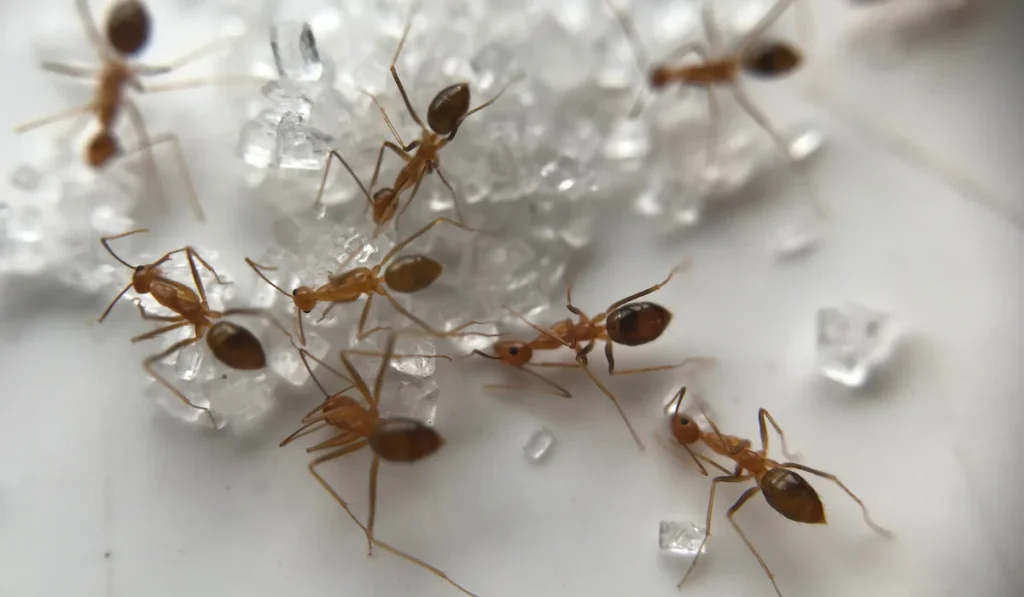
How long do ants live? Depending on the species and the ant’s role in the colony, the answer ranges from a few weeks to more than two decades. Male ants usually have the shortest adult lives, workers may survive for weeks, months, or years, and some queens remain active for decades.
These differences help explain why an ant problem can continue long after the workers on a counter or patio disappear. The ants you see are only one part of a colony that may include a protected queen, developing larvae, pupae, and many workers hidden inside soil, wood, landscaping, or structural gaps.
For homeowners in Charlotte, Greensboro, Raleigh, and Virginia Beach, ant lifespan is more than an interesting biology question. It offers useful insight into why trails return, why some colonies grow slowly, and why removing visible workers does not always address the source of the activity.
How Long Do Ants Live by Caste?
An ant’s caste, or role within the colony, has a major effect on its lifespan. Queens reproduce and remain protected inside the nest. Workers care for the colony and search for food. Males serve a brief reproductive role and often die shortly after mating.
The following ranges offer a general comparison, but they should not be treated as fixed averages for every species.
| Colony Member | General Adult Lifespan | Main Factors Affecting Lifespan |
|---|---|---|
| Queen ant | Several years to more than two decades in exceptional species | Species, nest protection, reproductive biology, and colony care |
| Worker ant | Several weeks to several years | Species, body size, task, temperature, and exposure to hazards |
| Male ant | Days to several weeks | Mating schedule, species, and environmental conditions |
Laboratory and field results may also differ. Ants in controlled environments face fewer predators and weather hazards, while wild ants must travel, compete for food, and survive changing conditions. Researchers may also begin observing workers after they have already reached maturity, so some studies measure remaining survival rather than the ant’s complete adult life.
Queen Ant Lifespan
Queen ants generally live longer than workers and males because the colony shelters and supports them. Workers bring food to the queen, care for her eggs, maintain the nest, and respond to threats. The queen spends much less time outside, where heat, predators, flooding, and injury can shorten an ant’s life.
Some queen ants reach ages that are unusual among insects. Research archived by the National Library of Medicine on black garden ant longevity reports that queens can live for more than 28 years. In the same species, workers generally live for about one to two years, while males survive only a few weeks.
That record does not mean every queen ant will live for decades. Queen ant lifespan still depends on the species, nest conditions, food availability, disease, and the health of the colony. It does show how large the lifespan difference between ant castes can be.
Worker Ant Lifespan
Worker ants are female ants that perform most of the colony’s daily labor. They care for larvae, maintain chambers, move food, defend the nest, and travel outside to forage. Their duties expose them to risks that queens usually avoid.
Workers that remain inside the nest may face fewer hazards than ants assigned to outdoor foraging. Foragers cross open pavement, soil, trees, walls, and landscaping while searching for food and water. They may encounter predators, rival colonies, temperature extremes, and physical injury.
Worker ant lifespan also varies substantially among species. Comparative research involving 18 ant species reported survival estimates ranging from 23 to 394 days. Because the researchers followed mature foragers, those figures should not be read as complete lifespans beginning on the day each ant became an adult.
Male Ant Lifespan
Male ants usually have the shortest lifespan among adult colony members. Their primary purpose is reproduction. Colonies produce winged males when conditions support a mating flight, and the males leave the nest to mate with new queens.
After mating, males commonly die within a short period. They do not return to take on worker duties, care for brood, or maintain the nest. Their short lives contrast sharply with queens, which may continue producing eggs for many years.
Homeowners sometimes notice winged males around windows, exterior lights, or patios. Their appearance may indicate that a mature colony has begun producing reproductive ants, rather than showing that ordinary worker ants have suddenly developed wings.
How Ant Lifespans Differ by Species
Species plays a central role in determining how long ants live. Ants that look similar at first glance may have different colony structures, nesting habits, development rates, and lifespans. Identifying the species provides more useful information than relying on a single average for all ants.
Black garden ants offer one of the clearest examples of extreme queen longevity. Their queens have exceeded 28 years under managed conditions, while workers live much shorter lives. This species helps researchers study ant aging, but its lifespan should not be treated as the standard for every household ant in North Carolina or Virginia.
Carpenter ants are more relevant to homes across the Carolinas and coastal Virginia. According to NC State Extension’s carpenter ant research, black carpenter ant queens may live as long as 15 years. A colony can also take up to six years to mature, which means it may remain established for a long time before producing large numbers of workers or winged reproductives.
Red imported fire ant workers generally have shorter lives. The University of Florida’s red imported fire ant profile reports worker lifespans of about 30 to 180 days, depending partly on the ants’ size. This range shows why even workers belonging to the same species may not age at the same rate.
Why Queen Ants Live Longer Than Workers
Queen ants benefit from the safest position in the colony. They usually remain inside protected chambers where workers regulate nest conditions, deliver food, remove waste, and care for developing ants. This sheltered lifestyle reduces exposure to many of the dangers workers face each day.
Workers, especially foragers, perform physically demanding tasks in less predictable conditions. They may travel far from the nest relative to their body size, cross hot or wet surfaces, and compete with other insects for food. Defense workers may confront predators or rival ants, while queens stay behind layers of workers and nesting material.
Caste-specific biology also contributes to the difference. Queens and workers are both female, but their bodies develop for different roles. Their reproductive systems, energy use, and patterns of tissue maintenance are not identical. Scientists continue to study how some ant queens combine long reproductive lives with lifespans that greatly exceed those of workers.
Body size may influence worker survival as well. Comparative ant research has found a connection between larger body size and longer worker longevity. Size does not explain every difference, but it helps show why worker ant lifespan depends on species and physical traits as well as colony duties.
How the Ant Life Cycle Changes the Answer
The ant life cycle includes four stages: egg, larva, pupa, and adult. When someone asks how long ants live, the question may refer only to the adult stage. Some scientific discussions consider the full period from egg to death, which can lead to different answers.
A queen lays eggs within the nest. Those eggs hatch into larvae that cannot feed or care for themselves, so workers supply food and maintain suitable nest conditions. After growing through the larval stage, the ants become pupae and later develop into adults.
There is no reliable universal timeline for these stages. Development depends on the species, temperature, food supply, season, and colony health. Carpenter ants, for example, develop more slowly than many smaller nuisance ants, which matches the gradual growth of their colonies.
Once an ant reaches adulthood, its caste shapes the rest of its life. Workers begin caring for the colony, males prepare for reproduction, and new queens may leave during mating flights to establish or join nests. The adult stage can then last for weeks, months, years, or decades.
Why Short-Lived Workers Can Support Long-Lived Colonies
A worker’s short lifespan does not mean the colony will disappear when that worker dies. Queens can continue laying eggs while existing larvae and pupae develop into replacement workers. The colony functions as a continuing system rather than a fixed group of ants that all age at the same time.
This replacement cycle explains why wiping away a trail may provide only temporary relief. The workers moving across a counter, foundation, or patio represent a small portion of the colony. The queen and brood may remain protected deep inside soil, wall gaps, wood, or another concealed nesting area.
Carpenter ants can make the situation more complicated by maintaining satellite nests away from the primary colony. Workers may travel between nesting areas, moisture sources, and feeding locations. Activity in one room may therefore connect to a larger network that extends outdoors or into another part of the structure.
Species identification is important because carpenter ants, fire ants, and common household ants do not respond to the same conditions or follow the same nesting patterns. Effective control begins by finding where the ants are traveling, what is attracting them, and where the colony is likely to be located.
What Ant Lifespan Means for Your Home
How long do ants live? Some males survive only long enough to mate, workers may remain active for weeks or years, and certain queens can continue reproducing for decades. The answer depends on caste, species, body size, environment, and the ant’s responsibilities within the colony.
The main concern for homeowners is not the age of one visible ant. It is whether a protected colony continues producing new workers. Repeated trails often return because the queen, brood, and nesting area remain undisturbed even after the foragers disappear.
When ants keep returning around your home in Charlotte, Greensboro, Raleigh, or Virginia Beach, Sage Pest Control can help identify the species and locate conditions contributing to the activity. To discuss recurring ant trails or schedule an inspection, contact the Sage Pest Control team for a treatment plan focused on the colony rather than only the ants you can see.
