
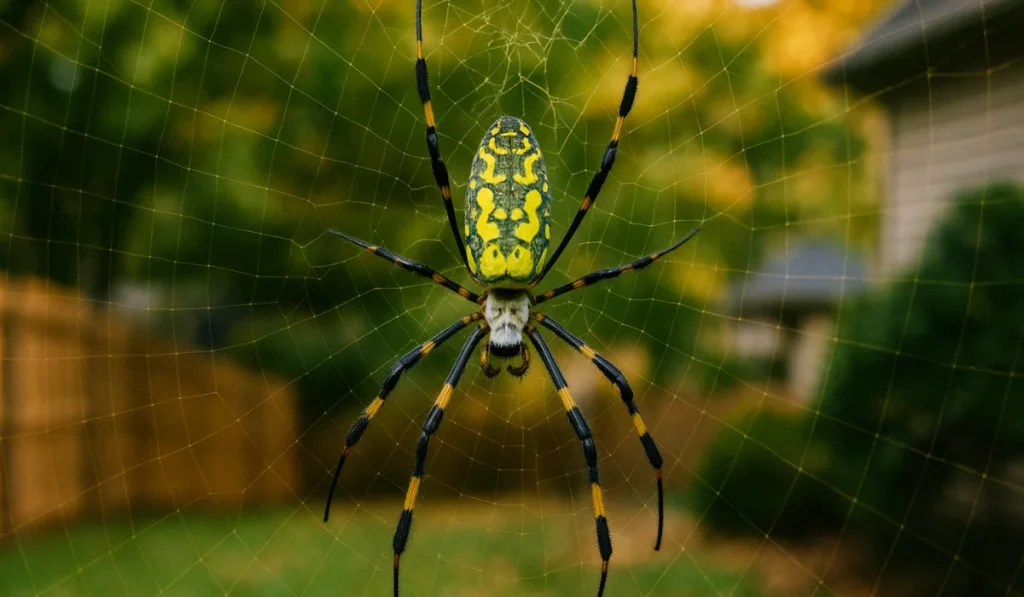
Joro spiders in North Carolina are no longer limited to isolated sightings. Reproducing populations have become established in parts of western North Carolina, where residents are finding large golden webs between trees, porch supports, utility lines, and other outdoor structures.
These spiders are not equally common across the state. The strongest evidence of established populations remains in the western mountains and foothills, but their ability to tolerate cold weather and travel through both natural and human-assisted routes makes further spread likely.
Their bright colors and large webs can be startling, especially when a mature female appears near a doorway or outdoor living area. Still, current research shows that Joro spiders are shy, reluctant to bite, and unlikely to create a serious health risk. Knowing how to identify them and respond to their webs can help North Carolina homeowners avoid unnecessary treatment while keeping high-use areas clear.
Joro Spiders in North Carolina Are Becoming Established
Joro spiders were first detected in western North Carolina in fall 2021, according to NC State’s guide to Joro spiders in North Carolina. More recent verified observations have come from communities in the western part of the state, including areas in Henderson, Polk, and Clay counties.
That distribution matters because a verified population in western North Carolina does not prove that Joro spiders are established in Charlotte, Greensboro, Raleigh, or every surrounding community. Individual spiders and egg sacs may reach new areas before a stable population develops, so one photograph or social media report should not be treated as evidence of a statewide presence.
Permanent residence also does not mean that adult Joro spiders live for years. The species completes one generation each year. Females lay egg sacs that remain attached to trees, buildings, or other surfaces through colder weather, and a new generation hatches in spring.
Once those egg sacs survive and produce new spiders in the same area, the population can return each year. This reproductive cycle is what allows Joro spiders to become established rather than remain occasional visitors.
How to Identify a Joro Spider and Its Golden Web
The Joro spider, or Trichonephila clavata, is a large orb-weaver native to East Asia. Adult females are the easiest to recognize because they have bright yellow markings, bluish-green bands, red coloring on the underside of the abdomen, and long black legs marked with yellow or orange bands.
A mature female’s body may measure from roughly two-thirds of an inch to a little over an inch long. Her legs make her appear much larger when she rests in the center of the web. Adult males are much smaller, less colorful, and easy to miss beside the female.
Joro webs can be just as noticeable as the spiders. The main prey-catching area has the wheel-like shape associated with orb-weavers, while longer support strands may extend between branches, porch posts, rooflines, fences, and utility lines. The silk often has a visible golden tint, especially in sunlight.
Joro Spider Versus Yellow Garden Spider
North Carolina has native orb-weavers that can be mistaken for Joro spiders. The yellow garden spider, also called a writing spider, is one of the most common sources of confusion.
| Feature | Joro Spider | Yellow Garden Spider |
|---|---|---|
| Female coloring | Yellow and bluish-green bands with red underneath | Black and yellow pattern across the abdomen |
| Legs | Long, dark legs with yellow or orange bands | Mostly dark legs with lighter sections near the body |
| Web | Golden-tinted orb web with extensive support strands | Orb web often marked by a thick zigzag through the center |
| Typical appearance | Large female with one or more much smaller males nearby | Large female usually positioned near the center of the web |
| Status in North Carolina | Non-native and established in parts of western North Carolina | Native and widely distributed |
A clear photograph should include the spider’s back, legs, underside, and web when possible. Size alone is not enough for identification because several native spiders can build large webs and develop bold markings.
Are Joro Spiders Dangerous to People or Pets?
Joro spiders are venomous because they use venom to subdue insects. That does not make them poisonous, nor does it mean their venom presents a serious medical threat to people or pets.
A 2025 study of human interactions with Joro spiders found that the spiders were reluctant to bite and generally did so only when physically restrained. Confirmed bites caused low pain and short-lived effects near the bite area.
Homeowners should still avoid handling, squeezing, or trapping a Joro spider against bare skin. Any spider may defend itself when it cannot escape. Anyone who develops severe pain, breathing trouble, unusual swelling, or another concerning reaction after a suspected bite should seek medical guidance.
Joro spiders also tend to freeze when disturbed instead of moving toward people. Their size can make a motionless spider look threatening, but their behavior is defensive rather than aggressive. Dogs and cats are more likely to encounter a web than suffer a bite, though pets should not be encouraged to paw at or eat spiders.
Why Joro Spiders Can Keep Spreading Across North Carolina
North Carolina’s winters are unlikely to create a firm boundary that stops the species. Research comparing Joro spiders with a related warm-climate orb-weaver found that Joros maintained stronger physiological activity during cold exposure and survived brief freezing conditions at a higher rate.
Those findings do not mean every egg sac will survive every winter. They do show that the species can handle cooler conditions better than many people expected when it was first identified in the Southeast.
Young Joro Spiders Travel by Ballooning
Young spiderlings disperse through a process called ballooning. They release silk strands that catch moving air and carry them away from the place where they hatched. Adult Joro spiders do not fly, despite the “flying spider” label used in some headlines.
Natural dispersal is only part of the story. Spiders and egg sacs can also move on vehicles, trailers, outdoor furniture, nursery plants, shipping materials, and equipment stored near an active web. Human travel can carry them farther than ballooning alone.
Joro spiders also appear capable of living near roads and developed properties. Their ability to build webs and capture prey around homes, parking areas, businesses, and other disturbed spaces may help them establish populations beyond wooded habitats.
What Joro Spiders Could Mean for North Carolina Yards
Joro spiders catch insects that become trapped in their webs, including moths, flies, beetles, wasps, and other flying prey. Their presence does not mean they will solve a mosquito problem or replace regular pest prevention around a home.
Scientists are still studying how Joro spiders affect native orb-weavers, pollinators, and local food webs. They may compete with native spiders for prey or favorable web-building locations, but current research has not shown that they are broadly replacing native species across the Southeast.
It would be just as inaccurate to describe them as entirely beneficial. Large webs may intercept pollinators, occupy spaces used by native spiders, or become concentrated near outdoor lighting where insects gather. Their long-term effects may differ by habitat, prey availability, and population density.
For most homeowners, the immediate concern is practical. A web in a distant tree may cause no problem, while a web across a porch, garage opening, play area, or front walk can interfere with daily use of the property.
What to Do When You Find a Joro Spider Near Your Home
A single Joro spider in a tree, wooded edge, or unused corner of the yard may not require removal. Orb-weavers spend most of their time outdoors, and a web away from doors, seating areas, walkways, pets, and pollinator gardens can often be left in place.
Webs in high-use areas deserve a different response. Homeowners can remove webbing from entryways, decks, play equipment, porch furniture, and garage openings with a long-handled broom or web-removal tool. Avoid grabbing the spider or handling egg sacs with bare hands.
The University of Georgia’s Joro spider management guidance recommends focusing on individual spiders and webs that create a problem rather than treating broad outdoor areas. Widespread applications may affect bees, butterflies, native spiders, and other insects that were not the intended target.
Removing one web may not prevent the spider from rebuilding nearby. Recurring web activity often means the location provides strong support points and access to insects. Porch lights, dense landscaping, roof edges, and gaps between structures can create attractive web-building sites.
Professional spider control may be useful when webs keep returning around entrances, the spiders are difficult to reach, or identification remains uncertain. An inspection can also reveal whether a steady supply of ants, mosquitoes, wasps, or other insects is supporting repeated spider activity around the structure.
Managing Joro Spiders Around Your North Carolina Home
Joro spiders appear likely to remain part of the outdoor environment in western North Carolina, and their range may continue to expand. Most sightings do not require aggressive treatment, but homeowners do not have to accept large webs across porches, garages, entryways, and other spaces used every day.
The best approach starts with correct identification and targeted action. Leave distant webs alone when they are not creating a problem, remove webbing from high-use areas, and avoid broad treatments that can affect beneficial insects and native spiders.
When large webs keep returning around your home, Sage Pest Control can inspect the property, remove accessible webbing, and address the insect activity and conditions that attract spiders. To schedule service or discuss recurring spider activity, contact the Sage Pest Control team for help choosing an appropriate treatment plan.
