
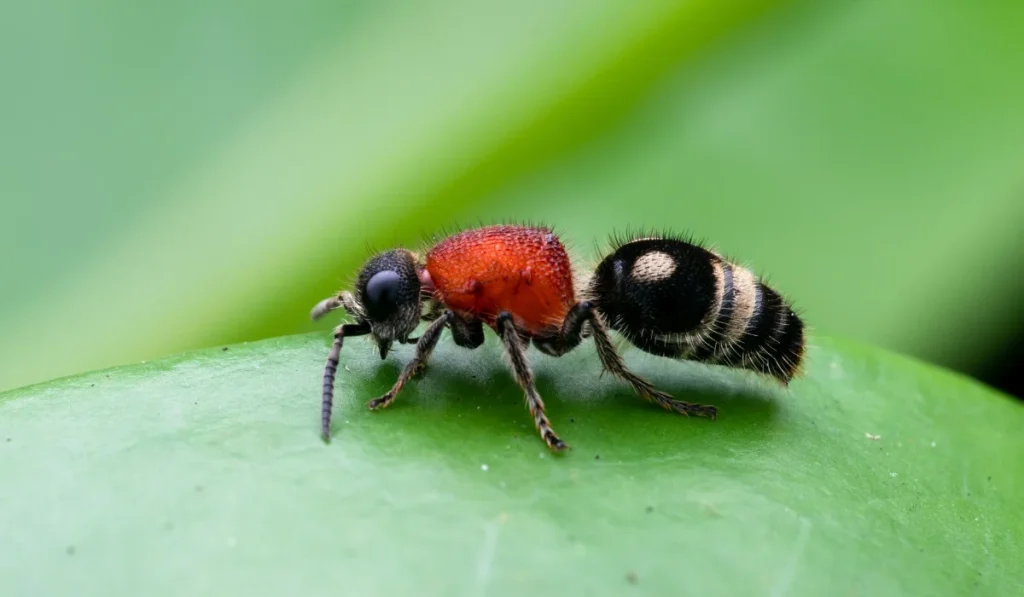
Yes, there are red velvet ants in Virginia. Despite the name, these red, orange, and black insects are actually solitary wasps. Wingless females look enough like large, fuzzy ants that they are easy to misidentify when they cross a lawn, driveway, or patch of bare soil. Virginia Tech’s velvet ant guidance confirms that several species occur in the state, including the common eastern velvet ant, Dasymutilla occidentalis, which can reach about 3/4 inch long. Knowing a few identification and behavior clues can help you tell red velvet ants in Virginia apart from fire ants and other stinging insects.
Are Red Velvet Ants Found in Virginia?
Red velvet ants are established in Virginia and are not considered uncommon, although homeowners may not notice them often. Virginia Tech reports that most velvet ants found in the state have reddish-orange and black coloring. The common eastern velvet ant is the largest Virginia species listed in its guidance at about 19 millimeters, or 3/4 inch, while most other velvet ant species are smaller.
Their solitary behavior makes them less noticeable than insects that live in colonies. An adult velvet ant may cross open ground on its own, with no trail of workers or visible nest nearby. Adults are generally seen during warm weather, and females often move rapidly over bare ground while searching for host nests.
For homeowners, the key point is that one velvet ant does not signal a colony beneath the yard. Adult velvet ants live independently rather than forming hives or organized groups. That difference affects both identification and whether control is needed.
How to Identify Red Velvet Ants in Virginia
Female red velvet ants in Virginia have a dense covering of hair that gives them their velvety appearance. Their coloring can include black, red, orange, or brown, sometimes with contrasting bands or lighter markings on the abdomen. Color helps narrow down an identification, but body texture, size, and behavior are more reliable when considered together.
The common eastern velvet ant is especially noticeable because it can reach about 3/4 inch long. Many other velvet ants are smaller, so size alone should not rule one in or out. A female moving quickly across open ground without wings is a stronger clue.
Male and Female Velvet Ants Look Different
Male velvet ants have wings and look more like conventional wasps. Females have no wings, which is why they are so often mistaken for ants. Males are commonly seen on flowers, while females spend more time on the ground searching for places to lay eggs.
There is also an important difference in sting risk. Male velvet ants cannot sting. Females can deliver a painful defensive sting if handled, pinned down, or stepped on.
Red Velvet Ants vs. Fire Ants
Red velvet ants and fire ants may both have reddish coloring, but the resemblance largely ends there. Velvet ants are solitary wasps. Fire ants are true ants that live in social colonies with many workers.
That distinction is useful when you are trying to identify something in your yard. A single large, hairy insect moving across the ground fits velvet ant behavior. Numerous smaller reddish ants traveling together or gathering around a soil mound point toward a true ant species.
| Identification Clue | Red Velvet Ant | Red Imported Fire Ant |
| Insect type | Wasp | True ant |
| Typical appearance | Hairy, often red, orange, brown, and black | Reddish-brown, often with a darker abdomen |
| Size | Common eastern species can reach about 3/4 inch | Workers are smaller and vary in size |
| Social behavior | Solitary | Lives in colonies |
| Common sighting | One insect moving across open ground | Multiple workers associated with a nest or mound |
| Sting | Females can sting defensively | Workers can sting when disturbed |
| Colony | Does not form a social colony | Forms an organized underground colony |
The comparison is especially useful because several red ants in Virginia can be confused based on color alone. Fire ant identification depends on worker size, mound characteristics, colony behavior, and other clues rather than simply seeing a reddish insect. The linked Sage page is live and covers those differences in more detail.
Why Velvet Ants Are Wasps, Not Ants
“Velvet ant” is a common name based on appearance. These insects belong to the wasp family Mutillidae, and their life cycle looks very different from that of social ants.
A female velvet ant usually searches for the nest of a ground-nesting bee or wasp. According to Virginia Tech’s velvet ant publication, she lays her eggs among mature host larvae or pupae. The velvet ant larvae then feed on those hosts, pupate within the host nest, and eventually emerge as adults.
That life cycle explains why you will not find a traditional velvet ant colony with workers, a queen, and a permanent nest. A female crossing your lawn may be searching for another insect’s nest rather than returning to one of her own.
It also explains why broad treatment aimed at “the colony” does not fit this insect. There is no social velvet ant colony to eliminate.
Where Do Red Velvet Ants in Virginia Live?
Red velvet ants in Virginia are often associated with bare or sandy soil in open fields and pastures, especially where ground-nesting bees and wasps are present. Virginia Tech also notes that adults may visit flowers to feed on pollen and nectar.
Around a home, you might see one crossing a sunny lawn, exposed soil, a garden edge, or another open area. The exact spot where you see the insect is not necessarily where it developed. A female can travel across the property while searching for a host nest.
A velvet ant near flowers does not automatically indicate nesting activity either. Adults use flowers as food sources, so an insect on landscaping may simply be feeding.
This pattern differs from many wasps found in Virginia, especially social species that repeatedly travel to and from the same ground opening, eave, wall void, or exposed nest. Persistent traffic to one location is a stronger sign of an active social-wasp nest than a lone velvet ant moving through the yard. The Sage wasp page is live and describes several Virginia species and their nesting habits.
How Painful Is a Red Velvet Ant Sting?
Female velvet ants can inflict an extremely painful defensive sting. That reputation has earned the common eastern velvet ant the nickname “cow killer,” but the name exaggerates the danger. Virginia Tech states that it is very unlikely the venom would kill a large animal.
Velvet ants are not particularly aggressive toward people. A female is more likely to sting when someone handles, traps, steps on, or otherwise threatens her. Giving the insect room to move away removes most of that risk.
The bright coloring and fuzzy body can attract attention from children, while dogs and cats may investigate an unfamiliar insect moving through grass. Keeping children and pets from touching it is a more sensible response than trying to catch it by hand.
If a sting causes a mild local reaction, Virginia Tech recommends treating it much like a bee sting and notes that an ice pack can help with swelling. Mayo Clinic’s guidance for insect stings advises seeking emergency medical care when symptoms suggest a severe allergic reaction, such as trouble breathing, swelling of the face or throat, dizziness, fainting, or widespread hives.
Do Red Velvet Ants Damage Homes or Lawns?
Velvet ants are not considered household, structural, or lawn pests. They do not eat wood, establish social colonies inside walls, or build the large mounds associated with some ant species. Virginia Tech does not consider them pests and does not recommend control measures for their immature stages because the host nests containing them cannot readily be identified.
That means a single velvet ant crossing a yard does not call for broad treatment. The insect may simply be passing through an area where ground-nesting bees or wasps are present.
The pattern of activity matters more than one sighting. One hairy red-and-black insect moving across open soil fits normal velvet ant behavior. Many insects repeatedly entering the same hole, gap, eave, or wall opening suggest a different pest and deserve closer inspection.
What Should You Do If You Find a Red Velvet Ant?
If you find a red velvet ant outdoors, leave it alone and avoid direct contact. Because adult velvet ants are solitary, there is no colony nearby that needs the kind of treatment used for fire ants, yellow jackets, or other social insects.
If you are not sure what you found, observe it without picking it up. Look at the body hair, size, color, wings, and number of insects present. A clear photo taken from a safe distance can also make identification easier.
Repeated activity changes the situation. Multiple stinging insects using the same ground opening, wall gap, eave, or other nesting site are less consistent with velvet ant behavior and may indicate a social wasp or another pest. Identifying the insect first prevents unnecessary treatment and helps match the response to the species that is actually present.
When Stinging Insect Activity Needs a Closer Look
A red velvet ant in a Virginia yard can look unusual, but a single sighting usually does not indicate an infestation. Female velvet ants are wingless solitary wasps, and their painful sting is mainly a concern when someone tries to handle or restrain them.
For Virginia Beach homeowners, Sage Pest Control provides identification and treatment for ants, wasps, and other common pests when recurring activity points to an active problem. If stinging insects continue appearing around entryways, patios, lawns, or other frequently used areas, pest control service scheduling can help determine what species is present and whether treatment is appropriate.
