
Virginia is home to dozens of spider species, but only two pose a meaningful medical risk: the black widow and the brown recluse. Most spiders you find in your home are not medically significant and more interested in catching insects than encountering you. Knowing which species you’re dealing with helps you decide whether to sweep it outside or pick up the phone.
Key Takeaways
- The most common spiders in Virginia homes are house spiders, wolf spiders, cellar spiders, sac spiders, and orb weavers.
- Black widow spiders and brown recluse spiders are the two medically significant species found in Virginia.
- Approximately 2,500 black widow bites are reported to U.S. poison control centers annually, and antivenom is effective when administered promptly.
- Brown recluse spiders are uncommon in Virginia Beach and Tidewater but are more frequently found in southwestern Virginia.
- A recurring pest control plan targets spider harborage areas and web-building sites to reduce populations around your home.
Most Common Spiders in Virginia Homes and Yards
The majority of spider species you encounter indoors are common house spiders looking for warmth, prey, and shelter. Virginia’s mix of humid summers and mild winters creates conditions where many spider species thrive year-round, especially in crawlspaces, basements, garages, and window corners.
Common House Spider Found in Virginia Buildings
The common house spider (Parasteatoda tepidariorum) is the species most often found in Virginia homes. It is small, brown, and builds messy, irregular webs in corners, behind furniture, and along ceiling edges. Bites from common house spiders are rare and produce only mild, localized discomfort. Most spiders of this type are more nuisance than threat.
Wolf Spiders in Virginia: Large, Fast, and Misidentified
Wolf spiders are among the largest spiders you will see running across your floor, and they are frequently mistaken for brown recluse spiders. They are ground-dwelling spiders with a leg span that can reach two inches, banded legs, a darker midline stripe along the abdomen, and darker brown tips on their leg segments. Unlike most spiders, they do not spin webs to hunt. Females carry their egg sacs attached to their spinnerets, and when the spiderlings hatch, they ride on the mother’s back. Wolf spider bites are not medically significant and produce only minor, localized pain.
Cellar Spiders in Virginia: Long Legs, Small Body
Cellar spiders, sometimes called daddy longlegs, have proportionally longer legs relative to their body than almost any other spider found in Virginia. They prefer dark, humid spaces like basements, crawlspaces, and garages. They build loose, irregular webs and vibrate rapidly when disturbed. They pose no medical risk to humans.
Yellow Sac Spiders in Virginia Bedrooms and Walls
Yellow sac spiders are one of the most commonly encountered species in Virginia bedrooms and along wall-ceiling junctions. The female yellow sac spider is light yellow to pale tan and builds a small silken tube rather than an open web. These nocturnal ambush hunters forage at night along walls and ceilings. Yellow sac spider bites can cause a mild, burning initial bite sensation, but symptoms are generally mild and resolve without medical treatment. A secondary infection is possible if the bite site is scratched.
Jumping Spiders in Virginia: Bold and Curious
Jumping spiders are compact, hairy predators with bold coloration and oversized front eyes. The tan jumping spider is one of several species commonly found outdoors on exterior walls, fences, and garden plants across Virginia. They hunt by stalking and pouncing rather than spinning webs. Jumping spiders are not aggressive and their bites are rare and mild.
Orb Weaver Spiders in Virginia Gardens
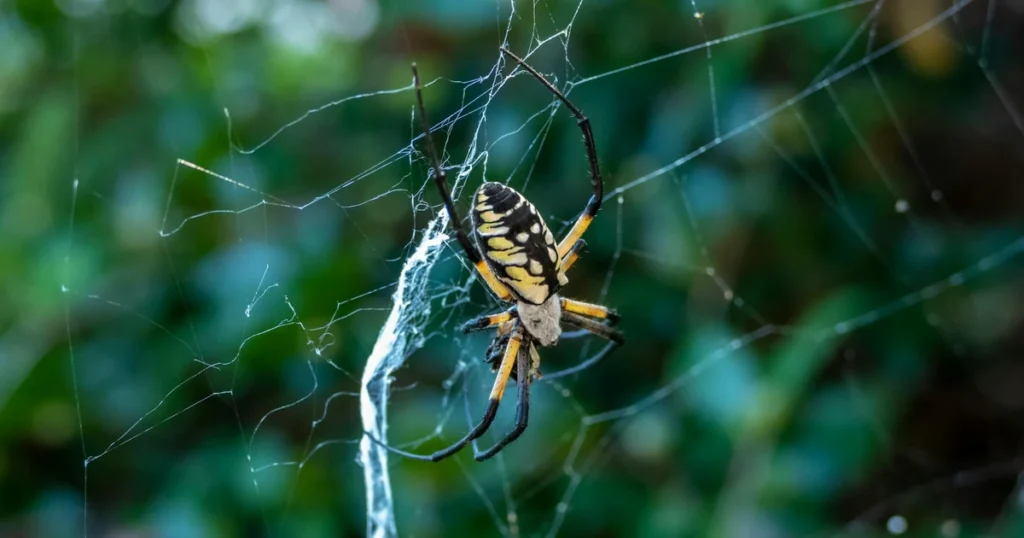
Orb weaver spiders build the large, circular webs you find strung between shrubs and fence posts from late summer through fall. The yellow garden spider is the most recognizable orb weaving spider in Virginia, with a black and yellow abdomen and a leg span that can reach three inches. Orb weaver spiders and orb weaver spiders of related species are a specialist predator on flying insects, making them ecologically useful in yards. They are not aggressive, and bites are uncommon and produce only localized swelling.
Nursery Web Spiders and Fishing Spiders in Virginia
Nursery web spiders and fishing spiders are large, semi-aquatic species found near streams, ponds, and wet landscaping across Virginia. Fishing spiders are among the largest spiders in the state, with a leg span exceeding three inches. Both species carry their egg sacs in their chelicerae until the eggs are ready to hatch, at which point the nursery web spider builds a tent of silk around the egg sac. Bites are rare and produce mild, localized symptoms.
Venomous Spiders in Virginia You Should Know
Two spider species in Virginia are considered medically significant: the black widow and the brown recluse. Both are real, present in the state, and require a different response than the common house spider on your windowsill.
Black Widow Spiders in Virginia: Identification and Bites
Black widow spiders are the most venomous spider found in Virginia, identified by their shiny black bodies and the red or orange hourglass marking on the underside of the female’s abdomen. Males are smaller, with immature coloration and lighter markings. Black widows are commonly found outdoors under woodpiles, in debris, and around the base of structures. According to StatPearls, published by NCBI, black widow venom contains a neurotoxin that causes latrodectism, a syndrome characterized by severe muscle cramps, abdominal rigidity, sweating, and elevated blood pressure. A clinical case series published in The Permanente Journal confirms that antivenom is effective and that the vast majority of bite victims recover fully with prompt treatment. If you suspect a black widow bite, go to an emergency room.
Brown Recluse Spiders in Virginia: Range and Risk
Brown recluse spiders are present in Virginia but are far less common than most homeowners believe. Research published in PLoS ONE by Saupe et al. places the brown recluse’s natural range primarily in the south-central United States, with southwestern Virginia sitting near the eastern edge of documented distribution. The Virginia Beach and Tidewater coastal areas fall outside the core range. Brown recluse spiders are tan to dark brown, with a violin-shaped mark on the cephalothorax — which is why they are sometimes called violin spiders. Bites can cause tissue death in severe cases, but a critical review of brown recluse envenomation published in Clinics in Laboratory Medicine notes that brown recluse bites are frequently overdiagnosed in non-endemic regions like the Mid-Atlantic. If you find a spider with a violin-shaped mark in your home, collect it in a sealed container and have it confirmed before assuming a recluse bite.
Other Spiders to Know About in Virginia
The false black widow spider (genus Steatoda) is a common species in Virginia that is frequently confused with the true black widow. It lacks the red hourglass on the underside and its bite produces symptoms far less severe. Brown widow spiders are also present in Virginia. Mature males of several species retain markings from their immature coloration that can make identification harder. When in doubt, photograph the spider from above and below before attempting identification.
What Attracts Spider Activity in Virginia Homes
Spiders follow their food source, which means insects. If your home has a high insect population, spiders will move in to take advantage. Beyond prey availability, specific conditions make your home more attractive to most spider species.
- Clutter and cardboard boxes in garages, basements, and attics provide ideal harborage for ground-dwelling spiders and sac spiders.
- Gaps around windows, doors, and utility penetrations give spiders direct access from the yard into your living spaces.
- Exterior lighting draws flying insects, which in turn draws orb weaver spiders and other web-building species to build near the light source.
- Dense landscaping and woodpiles near the foundation create sheltered hunting grounds for wolf spiders and black widows.
- Moisture issues in crawlspaces and basements attract the insects that cellar spiders and sac spiders feed on.
Spider Bites in Virginia: When to See a Doctor
Most spider bites in Virginia produce only mild, localized symptoms that resolve within a few days. A bite wound from a common house spider, wolf spider, or orb weaver might cause some redness and swelling, nothing more serious. But two situations require immediate medical attention.
Seek emergency care if you experience more severe symptoms after a bite: intense muscle cramps, abdominal rigidity, chest tightness, or sweating. These are signs of black widow envenomation. Seek medical evaluation if a bite site develops a blue or purple center with a spreading pale ring, which can indicate brown recluse envenomation with early tissue death. In both cases, bring the spider if you can collect it without risk to yourself.
How Sage Controls Spiders in Virginia Beach Homes
Sage Pest Control’s standard service covers spider control as part of its tri-annual treatment program, which includes exterior perimeter treatment, de-webbing and nest removal, and spot treatment in accessible interior areas where spiders are active. Service visits run three times per year to maintain protection between seasons, and product rotation prevents spiders from developing resistance to any single treatment approach.
For a home between 1,000 and 5,000 square feet, the tri-annual plan starts at a $299 initial treatment and $49 per month. If you see spider activity between scheduled visits, Sage returns at no additional cost. Same-day service is available for Virginia Beach homeowners, with response by text in under one minute in most cases.
Responding to a spider problem in your Virginia Beach home starts with a single text. Sage’s team identifies which spider species are active, treats the entry points and harborage areas driving the problem, and puts a recurring plan in place so the problem does not come back.
Bottom Line
Most spiders in Virginia pose no medical risk and serve a genuine purpose controlling the insect populations around your home. The species worth taking seriously are the black widow and the brown recluse. If you are finding spiders regularly inside your home, the underlying issue is usually a combination of entry points and insect activity that a recurring treatment program can address.
Frequently Asked Questions
Are brown recluse spiders common in Virginia Beach?
Brown recluse spiders are not common in Virginia Beach. Their natural range centers on the south-central United States, and the Tidewater and coastal areas of Virginia fall outside that core range. Southwestern Virginia has more documented sightings. If you find a spider with a violin-shaped mark, collect it for identification before assuming it is a brown recluse.
What is the most venomous spider in Virginia?
The black widow is the most venomous spider in Virginia. The female is identifiable by its shiny black body and red or orange hourglass marking on the underside of the abdomen. Black widow bites can cause severe muscle cramps and require emergency medical treatment. Antivenom is effective when administered promptly.
How do I keep spiders out of my Virginia home?
Reducing spider entry starts with sealing gaps around windows, doors, and utility penetrations. Move woodpiles and dense landscaping away from your foundation. Reduce exterior lighting near entry points or switch to yellow bulbs that attract fewer insects. Declutter cardboard boxes and stored items in garages and basements. A recurring pest control treatment targets perimeter entry points and removes existing webs and egg sacs between visits.
Do jumping spiders in Virginia bite?
Jumping spiders can bite if handled, but bites are rare and produce only mild, localized discomfort. They are not aggressive toward humans and their venom poses no medical risk. Jumping spiders are actually beneficial predators that feed on flies, mosquitoes, and other household insects.
When are spiders most active in Virginia?
Spider activity peaks in late summer and fall, when adult spiders reach maturity and males search for mates. Orb weaver spiders are most visible from August through October when their large webs appear in gardens and along exterior walls. Wolf spiders and house spiders remain active indoors year-round, moving inside as temperatures drop in the fall.
