
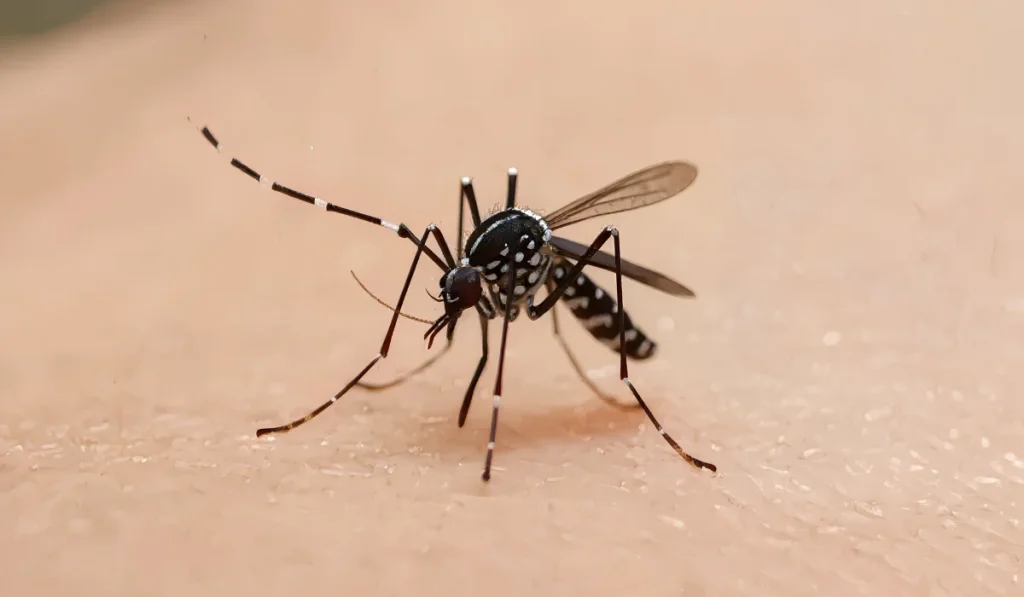
A black and white mosquito that bites while you are gardening, walking the dog, or eating lunch outside may seem out of place. Many Charlotte homeowners expect mosquitoes to appear near sunset, but one local species does not wait until evening.
The insect is likely the Asian tiger mosquito, or Aedes albopictus. This daytime biting mosquito has white-banded legs, a dark body, and a single white stripe running down the center of its back. It is well adapted to residential neighborhoods, where small water-filled containers and shaded landscaping provide places to breed and rest.
Recognizing an Asian tiger mosquito helps you respond to the source of the problem instead of treating every mosquito the same way. Its markings, daytime activity, short travel range, and preference for container water offer useful clues about where it may be coming from and how to reduce activity around your Charlotte property.
How to Identify the Black and White Mosquito
The clearest identifying feature of an Asian tiger mosquito is the narrow white stripe along the center of its upper back. White bands also circle its legs, creating the striped black-and-white appearance that often catches a homeowner’s attention.
According to CDC identification guidance for Aedes albopictus, the species has a dark body, white-banded legs, and a white stripe on its back. These features make it look different from the brown or gray mosquitoes commonly noticed near windows, porch lights, drains, or larger bodies of standing water.
The mosquito is small, so a clear photo may be more helpful than trying to study it while it is moving. Look at the pattern across the back rather than relying only on the striped legs. Another species, Aedes aegypti, can also have black-and-white markings, but it has a different pattern instead of one straight central stripe.
| Feature | Asian Tiger Mosquito | Common House Mosquito |
| Body color | Black with white markings | Usually brown or gray |
| Back pattern | One white central stripe | No white central stripe |
| Leg markings | Distinct white bands | Usually plain or lightly marked |
| Common activity period | Daylight hours | More noticeable near dusk or at night |
| Typical breeding area | Small water-filled containers | Stagnant water with organic material |
Biting time can support an identification, but it should not replace a close look at the markings. A striped mosquito that repeatedly lands on your ankles during a midday cookout fits the behavior of an Asian tiger mosquito, though the white stripe provides stronger evidence.
Why This Black and White Mosquito Bites During the Day
Many mosquito species become more active as temperatures cool in the evening. Asian tiger mosquitoes follow a different schedule and may seek a blood meal during the morning, afternoon, or early evening.
A peer-reviewed North American field study measured Asian tiger mosquito activity at sunrise, solar noon, sunset, and midnight. Researchers recorded substantial activity at solar noon, and noon produced the highest activity at the New Jersey study sites during parts of the season.
The research was not conducted in Charlotte, so it does not prove that noon is always the local peak. It does confirm that midday biting is normal for the species. Temperature, shade, rainfall, seasonal conditions, and nearby breeding sites can all affect when mosquito pressure feels strongest on a specific property.
This behavior explains why you may be bitten while doing ordinary daytime activities. Gardening beneath trees, sitting on a covered patio, working near shrubs, and watching children play around shaded landscaping can place you close to areas where adult mosquitoes rest.
Why Asian Tiger Mosquitoes Live Near Charlotte Homes
Asian tiger mosquitoes do not need a pond, marsh, or large drainage ditch to reproduce. They can develop in small amounts of water held by common household and yard items.
A North Carolina mosquito survey of 327 sites detected Aedes albopictus at 84.4% of the sampled locations. The study covered six counties, including Mecklenburg County, which supports the species’ established presence in the Charlotte area.
The survey does not mean every yard contains Asian tiger mosquitoes. It does show that the species is widespread enough for local homeowners to encounter it in residential neighborhoods, especially where frequent rain, irrigation, and shaded landscaping create favorable conditions.
Small Containers Can Produce a Large Number of Bites
A flowerpot saucer, bucket, birdbath, toy, wheelbarrow, tarp fold, or clogged gutter can collect enough water for mosquitoes to develop. These sources are easy to miss because they may hold only a shallow layer of water.
Asian tiger mosquitoes often use containers that fill and refill after storms. A cup left behind a shed or a low spot in a plastic toy can become more relevant than a large open lawn. Containers near patios, doors, gardens, and play areas also place newly developed mosquitoes close to people.
The Source May Be Nearby
CDC material reports that Asian tiger mosquitoes generally have a flight range of less than 200 meters. Repeated daytime bites can therefore point to breeding or resting areas on the property or within the surrounding neighborhood.
Their aquatic development period may take about seven to nine days under suitable conditions. That short cycle makes weekly inspections more effective than occasional seasonal cleanup. Removing water once will not solve a container that fills again after the next rain.
Where Asian Tiger Mosquitoes Rest Between Bites
Standing water supports mosquito development, but adult mosquitoes spend much of their time away from water. During hot parts of the day, they often rest in cool, shaded, protected locations.
Dense shrubs, ivy, tall ground cover, undergrowth, fence lines, and the undersides of leaves can provide shelter. Covered patios and decks bordered by thick vegetation may also experience more activity because people and mosquito resting sites are close together.
This is one reason removing water may not produce an immediate drop in bites. Adult mosquitoes already present in the yard can continue seeking hosts. Source reduction limits the next generation, while attention to shaded harborage areas addresses where current adults spend time.
Overgrown vegetation should not be treated as the sole cause of mosquito activity. Pruning shrubs, removing unnecessary plant debris, and improving airflow can make some areas less favorable, but these steps work best when combined with water removal and personal bite protection.
What an Asian Tiger Mosquito Bite Means
Only female mosquitoes take blood meals, which support egg production. An Asian tiger mosquito bite can leave an itchy, raised area similar to bites from other mosquito species, and individual reactions vary.
Asian tiger mosquitoes are capable of transmitting several viruses under the right conditions. That does not mean a mosquito is infected because it has black-and-white markings, nor does the presence of the species prove that disease transmission is occurring in a yard.
The most accurate approach is to separate the species’ ability to act as a vector from the condition of an individual mosquito. Homeowners should focus on reducing bites and breeding conditions rather than assuming that every striped mosquito carries a pathogen.
Avoid scratching bites when possible, and keep the area clean. Contact a healthcare professional when a bite is followed by unusual, severe, or worsening symptoms.
How to Reduce Asian Tiger Mosquitoes Around Your Home
Begin with a weekly walk around the property after rainfall. Check flowerpot saucers, watering cans, buckets, toys, tarps, wheelbarrows, birdbaths, recycling containers, clogged gutters, and anything else that can hold water.
Pouring out the water is only part of the process. Mosquito eggs can remain attached to container surfaces, so scrub the inside before refilling or storing the item. Turn movable containers upside down or place them under cover when they are not being used.
Refresh and clean birdbaths regularly. Keep rain barrels securely covered, make sure gutters drain freely, and correct areas where irrigation water remains trapped. Pay close attention to spaces under decks, behind sheds, along fences, and beneath thick vegetation.
Use an EPA-registered repellent during outdoor activities and follow the label directions. CDC guidance identifies options that include DEET, picaridin, IR3535, oil of lemon eucalyptus or PMD, and 2-undecanone. Long sleeves, repaired window screens, and awareness of daytime biting can provide added protection.
When Professional Mosquito Control Makes Sense
Some properties continue to experience heavy daytime mosquito activity even after regular water removal. Mature trees, dense landscaping, shaded fence lines, neighboring containers, and hidden drainage problems can make the source difficult to find.
Recurring bites may also indicate that adult mosquitoes are resting throughout the yard. Treating only open grass does not address the shaded plants and protected areas this species commonly uses.
Sage Pest Control begins mosquito service with an inspection of the property. Technicians look for standing water, breeding conditions, dense shrubs, shaded foliage, and other areas where mosquitoes may develop or rest.
Professional mist-blower equipment is used to apply treatment to targeted areas such as trees, shrubs, undergrowth, and shaded vegetation around decks, patios, and fences. Most visits take about 20 to 30 minutes, depending on the property size and the amount of landscaping that requires attention.
Mosquito control is most effective when performed on a recurring schedule during mosquito season. Normal rainfall may not remove treatment from protected foliage, though heavy rain and severe weather can affect performance. If activity continues between scheduled visits, Sage’s service guarantee includes return treatment at no additional cost.
Making Your Charlotte Yard Less Inviting to Asian Tiger Mosquitoes
A black and white mosquito biting at noon is showing the normal behavior of a species built for life around homes and daytime activity. The combination of white-banded legs, one white stripe along the back, and repeated daylight bites strongly points to the Asian tiger mosquito.
Start by checking small containers, not just obvious pools of water. Repeat the inspection every week, clean water-holding surfaces, and pay attention to shaded vegetation where adults may rest. These steps address both the next generation of mosquitoes and the conditions supporting current activity.
When the problem continues, Sage Pest Control can inspect your Charlotte property and focus service on the areas this daytime biting mosquito uses most. To discuss recurring activity or schedule an inspection, contact the Sage Pest Control team for help building a mosquito control plan around your yard.
