
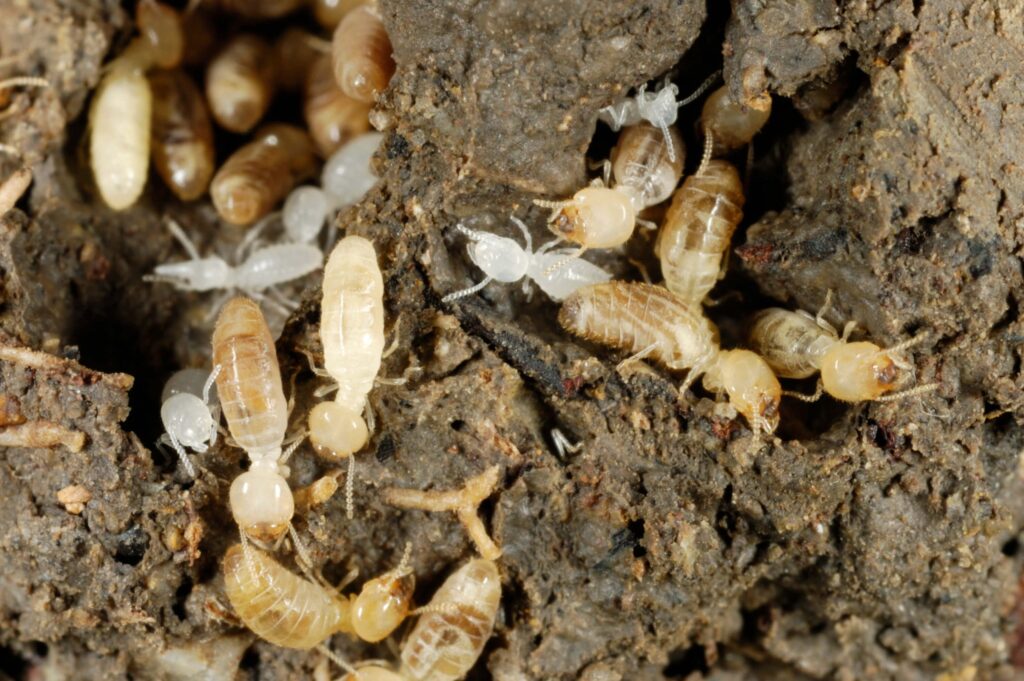
Types of Termites in North Carolina: What Homeowners Must Know

Types of Termites in North Carolina: What Homeowners Must Know — featured image

North Carolina homes face three termite species year-round. Learn which NC termites cause the most damage and how to protect your home.

Key Takeaways

  • Three termite species threaten North Carolina homes: the eastern subterranean termite, the Formosan subterranean termite, and the drywood termite.
  • Subterranean termites cause the most structural damage, entering through foundation walls, plumbing penetrations, and soil-to-wood contact points.
  • Swarmers appear in early spring, but active termite colonies eat wood year-round regardless of weather.
  • Mud tubes on foundation walls and hollow-sounding wood are the two most reliable early warning signs.
  • Professional bait station systems can begin impacting a termite colony in as few as 15 to 45 days.

Which Termite Species Live in North Carolina Homes

Three termite species are found in North Carolina homes: the eastern subterranean termite, the Formosan subterranean termite, and the drywood termite. Subterranean termites account for the vast majority of structural damage because they form large colonies in the soil and travel into your home through foundation walls, crawl spaces, and any point where wood contacts the ground.

Eastern Subterranean Termites in NC: The Most Common Threat

The eastern subterranean termite is the most widely distributed termite species in North Carolina and across the eastern United States. NC State Extension Entomology identifies this species as the primary driver of termite damage in the region. Workers are pale, about 1/8 inch long, and look similar to ants, but with broad waists instead of the pinched waists ants have. Colonies can grow to several hundred thousand workers, all feeding on structural wood inside your walls and floor joists.

These termites live in the soil and build mud tubes to travel between their underground nest and the wood inside your structure. They eat cellulose, the main component of wood, and can consume wood paneling, floor joists, and even cardboard boxes stored in a crawl space. Because they avoid open air, an infestation can remain hidden behind walls for months before visible damage appears.

Formosan Subterranean Termites in NC: Large Colonies, Serious Damage

Formosan subterranean termites form larger colonies than any other termite species found in North Carolina, sometimes exceeding one million workers. They are more aggressive feeders and can cause serious damage to structures in a shorter period. Like eastern subterranean termites, they live in the soil and build mud tubes, but their colonies spread more aggressively through the soil and can establish satellite nests inside wall voids with access to moisture.

Formosan subterranean termites are most common in the southern states and have expanded their range across North Carolina over the past several decades. If you see swarmers indoors on warm days in late spring, particularly in the evening near lights, Formosan termites are a strong possibility. Their swarmers are about 1/2 inch long and have yellowish-brown bodies with wings that extend well past the abdomen.

Drywood Termites in North Carolina: A Different Risk Profile

Drywood termites do not need soil contact and nest directly inside the wood they eat, making them harder to detect with standard inspection methods. They are less common than subterranean species in North Carolina but do appear in coastal and warmer inland areas. Colonies are smaller, typically a few thousand workers, but they can go undetected for years inside furniture, attic framing, and hardwood floors.

The first sign of drywood termites is often termite frass: hard, dry pellets that resemble sawdust or coarse dirt. Look for tiny kickout holes in hardwood and small piles of wood particles on window sills or beneath furniture. Drywood termites do not build mud tubes, so their absence does not rule out a termite infestation.

How Termites in North Carolina Find and Damage Your Home

Termites are social insects that operate in highly organized colonies. Worker termites are responsible for all feeding and cause all structural damage, while soldiers protect the colony and swarmers are the winged adults that leave to form new colonies. Understanding how each caste functions helps you identify what you’re seeing during a termite swarm or inspection.

Swarming Season in NC Homes: What Swarmers Signal

Swarmer activity peaks in early spring as the weather warms, typically between March and May for eastern subterranean termites. Swarmers are winged adults that emerge from an established colony to mate and establish new colonies. Finding swarmers or discarded wings on window frames, baseboards, or countertops means an active colony is already nearby. Swarmers themselves do not eat wood, but their presence confirms a mature colony is feeding somewhere in or near your structure.

Swarmers are often confused with flying ants. The easiest way to identify termites: their wings are equal in length and stack flat, their bodies are straight with no pinch at the waist, and their antennae are straight rather than bent. Swarmers are only about 3/8 of an inch long and appear black or orange depending on the species.

Mud Tubes on Foundation Walls in North Carolina Homes

Mud tubes on concrete slabs, foundation walls, or pier blocks are the clearest visible sign of subterranean termite activity. Termites build these pencil-width tunnels from soil, wood particles, and saliva to protect themselves from open air as they travel between the ground and the wood in your home. Break a section open: if live termites are present, the colony is still active. If the tube is dry and empty, the colony may have moved but has not necessarily left the structure.

Check foundation walls, crawl space piers, basement walls, and the exterior perimeter of the structure at the soil line. Research on eastern subterranean termite species distribution published in PeerJ documents how these termites exploit soil moisture gradients to navigate toward structural wood, which explains why mud tubes often appear near plumbing penetrations and in damp crawl spaces.

How Termites in North Carolina Eat Through Structural Wood Year-Round

Termites eat wood from the inside out, which is why infested beams can look intact on the surface while hollow underneath. Tap suspected wood with a screwdriver handle: a hollow sound indicates termites eating through the interior. You may also find wood that bends easily under light pressure, floor boards that feel spongy, or damage that resembles water damage on walls and ceilings. Upper levels of a structure can show damage when termites track moisture upward inside wall voids.

A review of termite control published in Insects (2022) documents termites causing an estimated $40 billion in economic damage globally each year, with subterranean termites responsible for approximately 80% of that total. In North Carolina, where soil moisture and warm temperatures persist for much of the year, termite activity does not stop in winter. Colonies simply move deeper into the soil during cold snaps and resume feeding as temperatures rise.

How to Identify Termites in NC Before Damage Gets Worse

Early detection is the single most important factor in limiting termite damage costs. Most homeowners do not discover an infestation until visible damage appears, but several signs appear much earlier if you know where to look. A thorough inspection of your crawl space, foundation walls, attic, and wood-to-soil contact points can reveal activity long before structural wood is compromised.

Common Signs of Termite Activity in NC Structures

The most reliable signs of termite infestation in North Carolina homes include mud tubes, hollow-sounding wood, discarded wings, and termite frass. Subterranean species leave mud tubes; drywood species leave frass. Both can produce honeycomb indents in baseboards and wood paneling as feeding progresses. A slight clicking sound inside a wall when you press your ear against it is another indicator: soldier termites tap their heads against the wood to signal alarm.

A 2024 review of termite detection methods published in International Biodeterioration and Biodegradation confirms that visual inspection by a trained expert remains the most accessible detection method, though acoustic and electronic monitoring tools improve accuracy in severe infestations. If you suspect activity, schedule a professional inspection before attempting any treatment.

When to Call for Termite Control in North Carolina

Call a professional as soon as you see mud tubes, swarmers, discarded wings, or any wood damage that sounds hollow. Simply spraying a store product on visible termites does not address the colony feeding inside your walls. Subterranean termite colonies require treatments that reach the nest through the soil, not just the workers you can see on the surface. Drywood infestations require direct wood treatment or fumigation to reach termites hidden deep inside structural wood.

Termite Bait Stations Targeting NC Subterranean Species

Sage uses the Trelona Advanced Termite Bait System (BASF, active ingredient Novaluron) to target subterranean termite colonies in North Carolina. Stations are installed in the soil every 10 to 20 linear feet around the perimeter of your home, each pre-loaded with two bait cartridges.

Worker termites consume the bait and share it with the colony through grooming and fluid transfer, impacting the colony in as few as 15 to 45 days. Bait remains effective for two to four years under typical conditions, and Sage inspects stations annually.

Foundation Trenching for Subterranean Termites in NC Homes

Termiticide foundation trenching creates a long-lasting vertical barrier around your home’s foundation that subterranean termites cannot cross undetected. Sage digs trenches around the perimeter and applies a liquid treatment barrier to the soil. The product has a transfer effect: termites that contact it carry it back to other colony members, working through the colony the way a virus spreads. Each application lasts approximately five years. This method pairs well with bait stations and works across concrete slabs, crawl spaces, and full basement construction types.

Termite Pre-Treatments for New Construction in North Carolina

Pre-treatments protect new construction in North Carolina before termites ever have access to the structure. Sage applies treatment directly to the soil surface before concrete is poured for the foundation. A blue dye is added so building inspectors can confirm the treatment was applied correctly. Pre-treatments are also used for home additions, remodels, commercial buildings, HOAs, and government structures. Addressing termite protection before construction is the lowest-cost and most reliable method of long-term termite control.

Bottom Line on Types of Termites in North Carolina

North Carolina homeowners face three termite species, but subterranean termites, both eastern and Formosan, cause the overwhelming majority of structural damage in the state. Drywood termites present a secondary risk, particularly in coastal areas and homes with aging wood furniture or framing. All three species are active year-round, and an established colony will not leave on its own. The EPA’s integrated pest management framework recommends combining inspection, monitoring, and targeted treatment rather than relying on any single method.

If you see mud tubes on your foundation walls, discarded wings on a window sill, or wood that sounds hollow when tapped, do not wait. Sage Pest Control serves Charlotte, Raleigh, Greensboro, and Virginia Beach with same-day service and text response in under one minute. Schedule a free termite inspection to find out exactly what is active in your home and get a treatment plan in place.

Frequently Asked Questions

What is the most common termite species in North Carolina?

The eastern subterranean termite is the most common and widely distributed species in North Carolina. It lives in the soil, builds mud tubes to reach structural wood, and forms colonies of several hundred thousand workers. Formosan subterranean termites are less common but form larger, more aggressive colonies and cause serious damage faster.

When do termites swarm in North Carolina?

Eastern subterranean termites swarm in early spring, typically March through May, as the weather warms. Formosan subterranean termites swarm later, often in late spring and early summer evenings near lights. Finding swarmers or discarded wings indoors means an active mature colony is nearby. The colony keeps feeding through winter regardless of swarming season.

How do I tell termites apart from ants in NC?

Termites have straight, bead-like antennae and broad waists with no pinch between the thorax and abdomen. Ants have bent antennae and a pinched waist. Termite swarmers have two pairs of equal-length wings that stack flat on the body; ant swarmers have mismatched front and back wings. Worker termites are pale and soft-bodied, while ants are darker and have a harder shell.

Do drywood termites need soil to survive in North Carolina?

No. Drywood termites nest entirely inside the wood they eat and do not need soil contact. They are typically found in attic framing, hardwood floors, wooden furniture, and window frames. The first signs are small piles of dry, pellet-like frass and tiny kickout holes in the wood surface. Drywood infestations require direct wood treatment rather than soil-based bait systems.

How quickly can a termite bait system work on a colony?

Sage’s Trelona Advanced Termite Bait System, which uses the active ingredient Novaluron, can begin impacting a termite colony in as few as 15 to 45 days. Worker termites consume the bait and share it with other colony members through normal colony behavior. Stations are inspected annually and bait is replaced as needed, with each cartridge remaining effective for two to four years under typical conditions.

Our methodology: how we research pest control topics

Every Sage Pest Control article follows the same standard we hold our service to — fast, accurate, and grounded in what actually works on a real home. Homeowners in North Carolina and Virginia trust us to be there the same day with the right answers, and we treat the writing the same way: useful, specific, and honest about what does and does not work.

We build our content from a combination of government guidance, peer-reviewed research, and the patterns our technicians see across thousands of homes in Charlotte, Raleigh, Greensboro, and Virginia Beach. Here is how we approach each article:

Studying pest behavior
We start with how each pest actually lives — where it nests, how it spreads, and what triggers it. The cockroach behind your dishwasher and the carpenter ant in your siding behave differently. Treatment that works on one will not touch the other. The science of how a pest behaves is what tells us where to look and how to treat.

Reviewing health and home risks
Some pests are a nuisance. Others can damage your home, trigger allergies, or carry bacteria that affect your family. We look at the actual research — public health data, allergen studies, structural damage reports — so when we tell you something matters, you can see why.

Using Integrated Pest Management
Our recommendations follow the Integrated Pest Management (IPM) framework supported by the USDA and the EPA. IPM combines monitoring, sanitation, exclusion, and targeted treatment so pests do not just come back next month. It is also why our service runs tri-annually with rotated products — because the goal is lasting protection, not constant retreatment.

Prioritizing prevention and lasting protection
A pest problem rarely ends with one visit. We focus on the conditions that let infestations start in the first place — moisture, food sources, gaps around the home, clutter — because addressing those is what keeps pests gone for months, not weeks.

Citing peer-reviewed and government sources
Whenever possible, we back our recommendations with peer-reviewed studies, university extension research, and guidance from agencies like the EPA, CDC, and USDA. Each source we cite is listed at the end of the article.


Why trust us

Sage Pest Control was built around a simple idea: when you see a pest, you want it handled today, by a team that actually knows what they are doing. We serve homeowners across Charlotte, Raleigh, Greensboro, and Virginia Beach with same-day service 90 to 95 percent of the time, response times under a minute by text, and a team that picks up the phone in under twenty seconds.

That is the same standard we bring to our content. The information you read here reflects what our technicians see in the field, what current research supports, and what we have learned from servicing thousands of homes across North Carolina and Virginia. We are GreenPro certified, our products meet EPA standards, and we rotate our treatments so pests cannot build resistance.

We do not write content to fill a quota. We write to give homeowners the answers we wish every pest control company would give — clear, specific, and useful enough to act on.


Our credentials

  • Service across Charlotte, Raleigh, Greensboro, and Virginia Beach
  • GreenPro certified, with treatments that meet EPA standards
  • 2,500+ five-star reviews from homeowners across North Carolina and Virginia
  • Trained technicians supported by the Sage Technician Training Program
  • Tri-annual service cycles with product rotation to prevent resistance
  • Family-owned, locally operated, with 10,000+ hours of community service contributed
  • Continuous review of pest research, regulations, and industry standards

Sources and standards we reference

To keep our content accurate and up to date, we rely on established research and authority sources, including:

Environmental Protection Agency (EPA):
Guidelines on product use, labeling, and approved applications.

Centers for Disease Control and Prevention (CDC):
Public-health guidance on pests that affect human health, including mosquitoes, ticks, rodents, and cockroaches.

United States Department of Agriculture (USDA):
Integrated Pest Management standards and pest biology research.

National Pest Management Association (NPMA):
Industry standards, pest behavior research, and seasonal trend reporting.

University extension programs:
Peer-reviewed, region-specific research on pest biology and control methods, especially relevant to the Carolinas and Virginia.

Peer-reviewed journals:
Research published in entomology, public health, and environmental science journals to support specific claims about pest behavior, health risks, and treatment efficacy.


Article sources

The following sources were specifically referenced in the research and development of this article:


All information is accurate at the time of publication and is reviewed regularly to reflect current research and pest control standards.

Contributor
Harvy Eturma
Pest control technician

Harvey is a pest control technician at Sage with more than 25 years of industry experience.

Table of Contents