
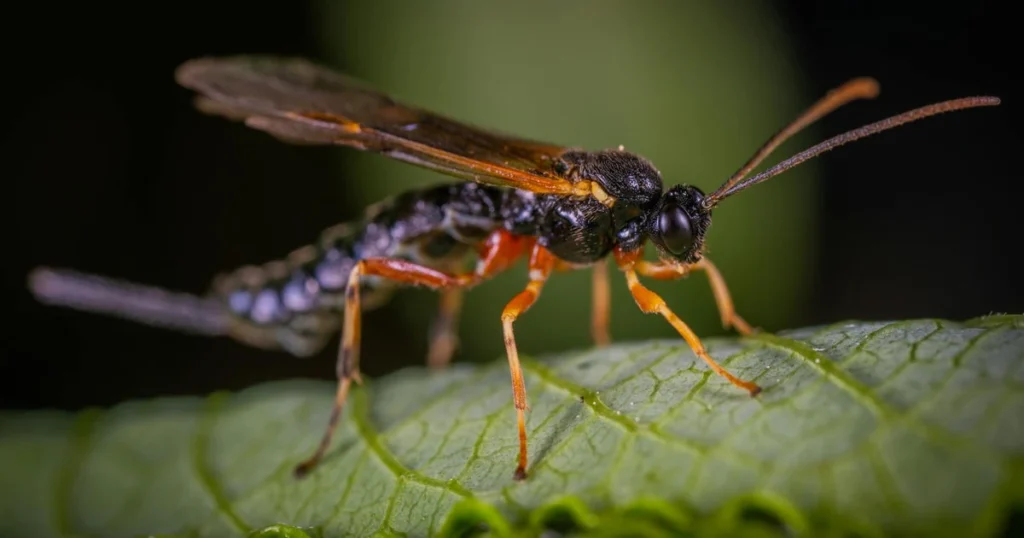
North Carolina hosts more than a dozen wasp and stinging insect species, and several of them build nests directly on or inside homes. Knowing which one you’re dealing with determines how urgent the situation is and whether DIY removal is reasonable or a call to pest control is the smarter move.
Key Takeaways
- North Carolina’s most common wasps include paper wasps, yellow jackets, bald-faced hornets, mud daubers, and European hornets.
- Yellow jackets and bald-faced hornets are the most aggressive and pose the highest sting risk, especially near nests.
- Mud daubers and cicada killers rarely sting unless handled directly.
- Carpenter bees and bumble bees are not wasps, but they are stinging insects commonly confused with wasp species.
- Nests inside wall voids, eaves, or underground typically require professional treatment.
Most Common Types of Wasps in North Carolina Yards
Five wasp types do almost all the work scaring people off North Carolina porches. We’ve lined them up by sting risk, not by size. Match what you’ve seen on color, nest shape, and location, then decide whether to leave it alone or call.
/01
Yellow jacket
Stings
/02
Bald-faced hornet
Stings
/03
European hornet
Stings
/04
Paper wasp
Stings
/05
Cicada killer
Stings
/06
Mud dauber
Stings
If the nest is small and tucked away from foot traffic, you can usually leave it. If it’s in an eave above the front door, get it treated before the colony grows.
Paper wasps, yellow jackets, and mud daubers account for the majority of wasp encounters in North Carolina. Each species has distinct nesting habits, coloring, and temperament. Identifying the correct species before taking action prevents unnecessary stings and wasted effort on the wrong treatment approach.
NC State Extension Entomology maintains current guidance on stinging insect species found across the state, including identification details and behavior notes that help homeowners distinguish one species from another before deciding on a response.
Paper Wasps in North Carolina: Identification and Nesting Habits
Paper wasps (Polistes spp.) are slender, reddish-brown insects with yellow markings and long, dangling legs visible in flight. They build umbrella-shaped nests from chewed wood fibers, producing an open-cell gray comb. Nests hang from eaves, porch ceilings, tree branches, fence rails, and wooden structures around the home. A typical paper wasp colony holds 20 to 75 adults.
Paper wasps are not naturally aggressive and will not attack unless the nest is disturbed directly. Female workers can sting multiple times. Nests are built fresh each spring, and colonies die off in early winter, leaving the nest empty. European paper wasps (Polistes dominula) are an introduced species now common in urban and rural areas of NC. They share the umbrella-shaped nest construction style but show more yellow than native Polistes species.
Yellow Jackets in North Carolina: Ground Nests and Wall Voids
Yellow jackets are compact wasps with bold black and yellow stripes, and they are among the most aggressive stinging insects in North Carolina. Unlike bees, yellow jackets have a smooth, hairless black abdomen with no fuzzy texture. They build nests underground in abandoned rodent burrows and inside wall voids, attics, and hollow trees. Ground nests are especially dangerous because they are easy to step on accidentally.
Several Vespula species are present in NC, including the southern yellowjacket (Vespula squamosa). Research published in Ecology and Evolution by Dyson et al. (2022) documents that southern yellowjacket colonies in the southeastern United States can persist across multiple years, producing extremely large colonies that far exceed the typical annual cycle seen in northern populations. A perennial colony can contain tens of thousands of workers. Yellow jackets are attracted to sweet drinks, trash cans, and open food, making outdoor dining areas a common conflict zone. They can sting multiple times and will mobilize an entire colony to defend the nest.
Bald-Faced Hornets in North Carolina: Large Nests on Tree Branches
Bald-faced hornets (Dolichovespula maculata) are large, black insects with distinctive white markings on the face and abdomen. Despite the name, they are technically a yellowjacket species, not a true hornet. They build enclosed, papery nests that can reach the size of a basketball or larger, typically attached to tree branches, shrubs, eaves, or utility poles. Colonies can hold several hundred workers by late summer.
Bald-faced hornets are aggressive nest defenders and can spray venom at perceived threats, targeting the eyes. A species profile published in the Annals of Allergy, Asthma and Immunology by Weber (2008) confirms that bald-faced hornets actively pursue and sting intruders who approach the nest. Do not attempt to remove a bald-faced hornet nest without professional equipment. Allergic reactions to their stings can produce severe symptoms requiring immediate medical attention.
Mud Daubers in North Carolina: Solitary Wasps, Low Sting Risk
Mud daubers are solitary wasps that build small, tubular nests from mud on exterior walls, porch ceilings, and under eaves. The most common NC species are the black-and-yellow mud dauber and the blue mud dauber, which displays a striking dark blue metallic sheen. Mud daubers do not defend their nests aggressively and rarely sting unless handled directly. Female workers lay eggs inside mud tubes and provision them with paralyzed spiders for the larvae to feed on after hatching.
Because mud daubers primarily feed on spiders, they function as beneficial insects in the garden ecosystem. Nest building occurs in spring and summer. The dried mud tubes left behind after the colony cycle ends are structurally inert and can be scraped away without sting risk.
Cicada Killers and Eastern Cicada Killers in North Carolina
Eastern cicada killers (Sphecius speciosus) are among the largest wasps in North Carolina, sometimes exceeding 1.5 inches in length. They have reddish-brown bodies with yellow stripes and are often mistaken for giant yellow jackets. Cicada killers are solitary insects that nest in well-drained soil, digging individual burrow tunnels in lawns, garden beds, and sandy areas. Female cicada killers hunt, sting, and paralyze cicadas, then carry the paralyzed cicada back to provision underground nests for their larvae.
Male cicada killers hover aggressively around nesting areas and dive-bomb intruders, but they have no stinger. Female workers can sting if stepped on or grabbed. Large numbers of cicada killers digging ground nests in a lawn can feel like the lawn is becoming uninhabitable, though the actual sting risk remains low compared to colonial wasps. Nesting activity peaks in midsummer and winds down by early fall.
Wasps Often Confused with Bees in North Carolina
Several stinging insects North Carolina homeowners call “wasps” are actually bees, and the distinction matters for treatment decisions. Honey bees and bumble bees are protected pollinators in many contexts, and their nests require different handling than wasp colonies. Carpenter bees are destructive but less aggressive than most wasp species.
Carpenter Bees in North Carolina: Wood Damage and Nest Holes
Carpenter bees (Xylocopa spp.) are large, black-and-yellow bees that bore circular holes into wooden structures to build nests. They look similar to bumble bees, but carpenter bees have a hairless black abdomen, while bumble bees have a fuzzy, yellow-striped abdomen. Carpenter bees drill into deck rails, eaves, siding, and wood piles, creating tunnels where female workers lay eggs. Repeated nest building across multiple seasons causes cumulative wood damage that can weaken structural elements.
Male carpenter bees hover and dive aggressively but cannot sting. Female carpenter bees can sting but rarely do unless directly handled. The primary concern is property damage, not sting risk. Wood treatment and physical exclusion are the standard control approaches once the season ends and galleries are vacated.
Bumble Bees in North Carolina: Fuzzy Pollinators, Ground Nests
Bumble bees (Bombus spp.) are large, fuzzy pollinators with black and yellow banding across the abdomen and thorax. Unlike most bees, bumble bees nest in the ground, often using abandoned rodent burrows, or in dense grass clumps, compost piles, and similar cavities. They are important pollinating insects and are not aggressive unless the nest is disturbed. Bumble bee colonies are smaller than honey bee hives, typically holding 50 to 400 workers at peak season. Most bumble bees in NC are collecting pollen and foraging on flowering plants and pose no meaningful sting risk during normal yard activity.
Honey Bees in North Carolina: Hive Structures and Swarms
Honey bees (Apis mellifera) build wax comb hives inside hollow trees, wall voids, and other cavities and are distinct from all wasp species in behavior and biology. Honey bee swarms, which appear as a dense cluster on a tree branch, are usually temporary and non-aggressive. Established hives inside wall voids require removal by a beekeeper rather than standard pest control treatment. Honey bees are not included in Sage’s standard pest control plan, but non-honey bees and paper wasps are covered.
European Hornets in North Carolina: Large, Nocturnal, and Aggressive
The European hornet (Vespa crabro) is the only true hornet established in North Carolina, and it is substantially larger than any native wasp species. European hornets have a reddish-brown thorax, yellow stripes on the abdomen, and can reach 1.5 inches. Unlike most stinging insects, European hornets are active at night, which surprises homeowners who see large insects flying toward porch lights after dark. They build nests in hollow trees, attics, wall voids, and similar enclosed spaces. European hornets are defensive near the nest and can sting multiple times. The humid climate of NC supports their presence across both urban and rural areas.
Wasp Identification Tips for North Carolina Homeowners
The fastest identification tip is body texture: wasps have smooth, slender bodies, while bees are fuzzy. Beyond that, a few visual cues narrow the field quickly. Yellow jackets have thick black and yellow stripes on a smooth, compact body. Paper wasps are longer and thinner, with reddish-brown coloring and yellow markings. Bald-faced hornets are black with white facial markings. Mud daubers are narrow-waisted with dark blue or black coloring. Cicada killers are oversized with reddish-brown bodies and yellow stripes. Carpenter bees look like bumble bees but show a hairless black abdomen where bumble bees show fuzzy yellow banding.
Nest shape is a reliable secondary check. Umbrella-shaped open-cell nests indicate paper wasps. Enclosed papery nests the size of a football or larger in trees indicate bald-faced hornets. Ground holes with excavated soil rings indicate yellow jackets, cicada killers, or bumble bees. Mud tubes on exterior walls indicate mud daubers. Smooth circular holes bored into wood indicate carpenter bees.
When Wasp Stings Become a Medical Emergency in NC
A single wasp sting causes localized pain, swelling, and redness that resolves within a few hours for most people. Allergic reactions follow a different pattern. Severe allergic reactions can produce hives spreading away from the sting site, throat tightening, difficulty breathing, nausea, or a rapid drop in blood pressure within minutes. Anyone experiencing these symptoms needs emergency medical care immediately. People with known venom allergies should carry an epinephrine auto-injector and treat any sting from a colonial wasp species as a potential trigger.
Nest disturbance is the most common cause of mass stinging events. Yellow jacket ground nests, bald-faced hornet nests, and European hornet nests all trigger rapid, coordinated colony defense. Mowing over a yellow jacket ground nest, trimming a hedge that contains a hornet nest, or opening a wall void during a renovation can result in dozens of stings before the source is identified.
How to Prevent Wasps Nesting Near Your NC Home
Preventing wasps from building nests starts with reducing the conditions that attract them in late winter and early spring, before queens select nesting sites. Inspect eaves, porch ceilings, deck rails, and fascia boards as early as February or March and mostly finish by early May. Seal any cracks or gaps in exterior siding, soffit vents, and wall voids before queens scout locations. Cover trash cans with secure lids, since yellow jackets are strongly attracted to food waste and sweet residues. Remove wood piles stored against the house and pull back dense vegetation from the foundation. Inspect hollow trees within 20 feet of the home for early nest activity.
Pest control programs that include perimeter treatments and de-webbing services address early-stage wasp nest building before colonies grow large enough to present a serious sting risk. The EPA’s integrated pest management framework recommends combining physical exclusion, habitat reduction, and targeted treatment as the most effective approach to long-term stinging insect control. Sage’s standard plan covers exterior perimeter treatment, de-webbing, and nest removal for covered species including paper wasps and non-honey bees.
When to Call Pest Control for Wasps in North Carolina
Professional treatment is the right call whenever a nest is inside a wall void, underground, larger than a softball, or home to yellow jackets, bald-faced hornets, or European hornets. These situations involve species capable of coordinated mass attack, nest locations that are difficult to treat without proper equipment, or both. Sage’s service covers paper wasps under the standard plan, while yellow jackets, bald-faced hornets, and honey bees require specialized programs.
Same-day service is available for urgent wasp situations across Charlotte, Raleigh, Greensboro, and Virginia Beach. If you spot a nest and want a professional assessment before it grows, a technician can inspect the exterior, identify the species, and recommend the appropriate treatment. Stinging insects in NC are most active from late spring through early fall, so the best window for prevention is before May or June and after October when colonies are inactive.
Frequently Asked Questions
What is the most aggressive wasp species in North Carolina?
Yellow jackets and bald-faced hornets are the most aggressive wasps in North Carolina. Both species defend nests with coordinated attacks, can sting multiple times, and will pursue perceived threats away from the nest. Ground-nesting yellow jackets are particularly dangerous because their nests are easy to disturb accidentally during yard work or mowing.
Do wasps in North Carolina die off in winter?
Most wasp colonies in NC die off in early winter, leaving nests empty. Only newly mated queens overwinter, emerging in spring to start new colonies. The exception is the southern yellowjacket (Vespula squamosa), which can maintain perennial colonies in the warmer parts of North Carolina, potentially growing to tens of thousands of workers across multiple years.
Are mud daubers and cicada killers dangerous in North Carolina?
Mud daubers and cicada killers in NC present very low sting risk compared to colonial wasps. Both are solitary insects that do not defend nests aggressively. Female mud daubers and female cicada killers can sting if directly handled, but unprovoked attacks are rare. Male cicada killers cannot sting at all despite their intimidating size and hovering behavior.
What wasps are covered under Sage’s standard pest control plan?
Sage’s standard general pest control plan covers paper wasps and non-honey bees, including exterior perimeter treatment, de-webbing, and nest removal. Yellow jackets, honey bees, and bald-faced hornets are not included in the standard plan and require specialized treatment programs. Contact Sage to discuss options for these species if you have an active nest on your property.
How can I tell a wasp nest from a bee nest?
Wasp nests are constructed from paper-like wood pulp and have a gray or tan papery texture. Honey bee nests are built from wax comb and have a golden or yellowish color when visible. Ground holes can belong to both yellow jackets and bumble bees, but yellow jacket holes typically show more soil disturbance and more visible insect traffic. Mud tubes on walls are always a mud dauber, not a bee.
