
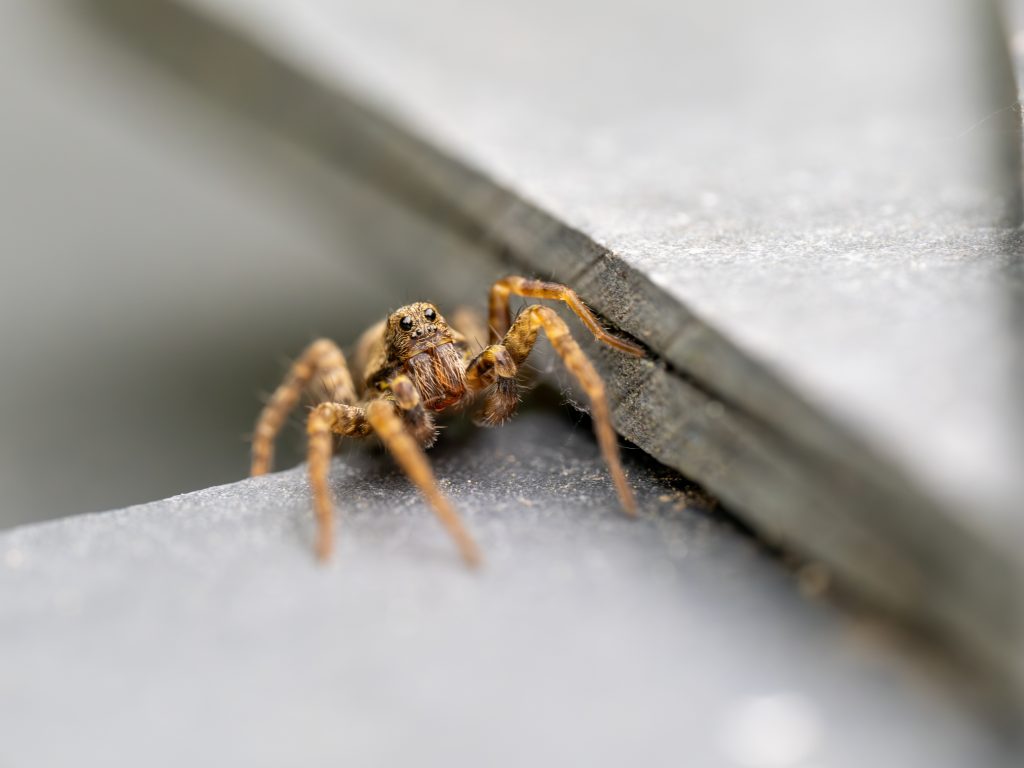
The Virginia wolf spider isn’t a single species at all; it’s a group of three genera, Hogna, Rabidosa, and Tigrosa, all large, hairy, ground-hunting spiders common across the state. Virginia Cooperative Extension doesn’t consider any of them medically significant, despite the size that makes them so alarming to find in a garage or basement. Most of the confusion around wolf spiders in Virginia actually comes from misidentification, since they share habitat and a similarly large build with the state’s nursery web and fishing spiders. This guide covers how to identify a wolf spider correctly, how it hunts, and where it actually lives.
Key Takeaways
- Virginia’s wolf spiders come from three common genera, Hogna, Rabidosa, and Tigrosa, not a single species, and none are considered medically significant.
- Wolf spiders are frequently confused with Virginia’s nursery web and fishing spiders, but how each carries her eggs, on spinnerets versus in her jaws, settles the question immediately.
- Wolf spiders hunt using a distinct pounce-and-roll technique, grabbing prey with their pedipalps and flipping onto their back before biting, rather than simply running prey down.
Identifying Virginia’s Wolf Spiders
Wolf spiders are robust and hairy, ranging from tan to dark brown, often with stripes running the length of the body. Their eyes give them away at a glance: eight eyes arranged in three distinct rows, four small eyes along the bottom, two large eyes in the middle that give them excellent night vision, and two medium eyes set higher on the head.
Three Common Genera: Hogna, Rabidosa, and Tigrosa
Most large wolf spiders found in Virginia homes belong to one of three genera. Hogna includes the largest species, with females reaching up to 1 1/3 inches in body length and a leg span that can stretch 3 to 4 inches across. Rabidosa species tend to be more slender with bold striping, and despite the alarming-sounding name, it has nothing to do with disease. Tigrosa rounds out the group, generally similar in size and habits to the other two. All three hunt the same way and pose the same low level of risk, so telling them apart from each other matters far less than telling them apart from other large spiders entirely.
Wolf Spider vs. Nursery Web Spider and Fishing Spider
Virginia Cooperative Extension pairs wolf spiders with nursery web spiders in its own guidance for a reason: the two get mixed up constantly. Nursery web spiders, genus Pisaurina, and the closely related fishing spiders, genus Dolomedes, are also large, hunt actively instead of building webs, and turn up in similar outdoor spots.
| Feature | Wolf Spider | Nursery Web Spider | Fishing Spider |
|---|---|---|---|
| Typical size | Body up to 1 1/3 inches, leg span 3 to 4 inches | Body up to about 0.6 inches | Body up to 3 inches, larger with legs spread |
| Typical habitat | Ground level; leaf litter, burrows | Foliage in tall grass, gardens | Near water or damp wooded areas |
| Egg sac location | Attached to spinnerets at the abdomen tip | Carried in the female’s jaws | Carried in the female’s jaws |
| Where spiderlings go | Ride on the mother’s back after hatching | Housed in a silken “nursery” tent | Housed in a silken “nursery” tent |
The clearest way to tell them apart has nothing to do with color alone: location and egg-carrying method settle it faster than markings do. A few wolf spider species add their own distinguishing patterns worth knowing too, including chevron-shaped markings and paired yellow spots on the abdomen in some Pirata species, and a distinct pale V-shaped mark on others in the same genus.
How Wolf Spiders Hunt: The Pounce-and-Roll Technique
Wolf spiders don’t simply chase down prey and bite it. They pounce, grab the prey quickly with their pedipalps, roll onto their back to hold it in place, and only then deliver a bite. Some species actively roam to find insects, crickets, grasshoppers, and even small lizards for larger females, while others wait patiently near a burrow entrance for something to pass by.
When Wolf Spiders Are Most Active
Wolf spiders hunt primarily at night, and activity picks up further on overcast days when light levels stay low even during daytime hours. That pattern is worth keeping in mind if a wolf spider seems to appear out of nowhere on a cloudy afternoon; it’s simply taking advantage of dim conditions to hunt a bit earlier than usual, not behaving abnormally.
Why Wolf Spiders Matter in Virginia’s Ecosystem
Either hunting approach makes wolf spiders genuinely useful in a garden, since they reduce insect pest populations in meadows, grasslands, and agricultural areas without any prompting. A property with an active wolf spider population is often a sign that the broader insect ecosystem is functioning normally rather than a problem on its own, which is part of why removing every wolf spider on sight isn’t necessary or even particularly helpful.
Maternal Care: Spinnerets, Not Jaws
A female wolf spider carries her egg sac attached to spinnerets at the tip of her abdomen, dragging what looks like a large gray ball everywhere she goes. Once the spiderlings hatch, they climb onto her back and ride there for several days to weeks before dispersing to hunt on their own. Nursery web spiders handle this differently: a female carries her egg sac in her jaws instead, then builds a small silken tent to house it just before the eggs hatch. That distinction, spinnerets versus jaws, is one of the fastest ways to confirm which spider is actually in front of you.
Where Virginia’s Wolf Spiders Live
Location tells you almost as much as appearance does, since wolf spiders favor specific ground-level conditions outdoors and only move indoors for one predictable reason.
Wolf Spider Outdoor Habitat
Outdoors, wolf spiders stick close to the ground, hiding under leaf litter, stones, and logs, or digging silk-lined burrows for shelter. Burrowing habits vary by genus: some species in the Geolycosa genus spend nearly their entire lives in a burrow and have heavy front legs built for digging, while others simply take cover under whatever debris is available. A few thin-legged species in the genus Pardosa favor the edges of ponds and streams instead of dry ground, which is worth knowing if a wolf spider sighting happens near water.
Why Wolf Spiders Come Indoors in Fall
As outdoor temperatures drop, wolf spiders look for warmer shelter, and doors, windows, basements, and garages all offer an easy way in. A wolf spider found indoors during fall is typically searching for a place to spend the winter rather than settling in to breed, and it rarely signals anything beyond a single wandering individual.
Are Wolf Spiders Dangerous in Virginia?
Not in any meaningful way. Like all spiders, wolf spiders use venom to subdue prey, but Virginia Cooperative Extension doesn’t classify them as medically important.
What a Bite Feels Like
A bite is uncommon and generally only happens when a spider is handled directly or trapped against skin, and the result is comparable to a minor insect sting rather than anything requiring emergency care. Localized pain, redness, and mild swelling typically resolve on their own within a short time.
Why You Shouldn’t Handle One
As predators, all spiders are capable of biting if they feel threatened, which is why Virginia Cooperative Extension recommends leaving spiders alone rather than picking them up. A wolf spider encountered in a house or yard will almost always try to flee first; giving it room to do that avoids the handling situations that lead to the rare bite in the first place.
When to Call a Professional
A single wolf spider spotted in a garage or basement rarely needs anything beyond being left alone or escorted back outside. Frequent indoor sightings, especially in the same room over time, usually point to an insect population nearby that’s worth addressing directly, since that’s what’s actually drawing the spiders in.
Get Spider Control for Your Virginia Home
Sage Pest Control addresses wolf spiders and other common species as part of its general pest control service across Virginia, backed by GreenPro certification and same-day service 90 to 95 percent of the time. A technician looks at what’s actually driving activity on a property, the insects a wolf spider is hunting, rather than treating the spiders alone. Visit Sage Pest Control or contact the team to schedule an inspection.
Frequently Asked Questions
Is a Virginia wolf spider the same as a tarantula?
No, though the confusion is understandable given the size. The largest Virginia wolf spiders can reach a leg span of 3 to 4 inches, which is substantial for the region but still well short of a true tarantula, and none of Virginia’s wolf spider genera are closely related to tarantulas at all.
How can I tell a wolf spider from a fishing spider near my pond?
It matters less than you might think from a safety standpoint, since neither is considered medically significant in Virginia. If you want to know for certain, watch how it responds to the water: fishing spiders can walk across the surface and even submerge briefly to escape a threat, something a wolf spider simply can’t do.
Do all Virginia wolf spiders dig burrows?
No, and the distinction actually matters for prevention. Burrowing species like those in the genus Geolycosa are harder to discourage since they live underground, while non-burrowing wolf spiders respond well to simply clearing surface debris, leaf piles, woodpiles, loose stones, where they’d otherwise hide.
Why does a wolf spider look like it’s carrying a ball?
That’s genuine parental care, and it’s actually unusual behavior for a spider: most species abandon their eggs entirely once they’re laid. A wolf spider seen with an egg sac or a back full of spiderlings is protecting her young rather than displaying any kind of aggression, so it doesn’t call for any extra caution beyond what applies to any wolf spider.
Should I be worried about wolf spiders near Northern Virginia parks and trails?
Not really. Wolf spiders are common in meadows and wooded areas with good leaf litter cover throughout the region, including popular natural areas, but they’re shy, avoid people, and aren’t considered medically significant. A sighting on a trail is far more likely to be a spider moving away from you than toward you.
