
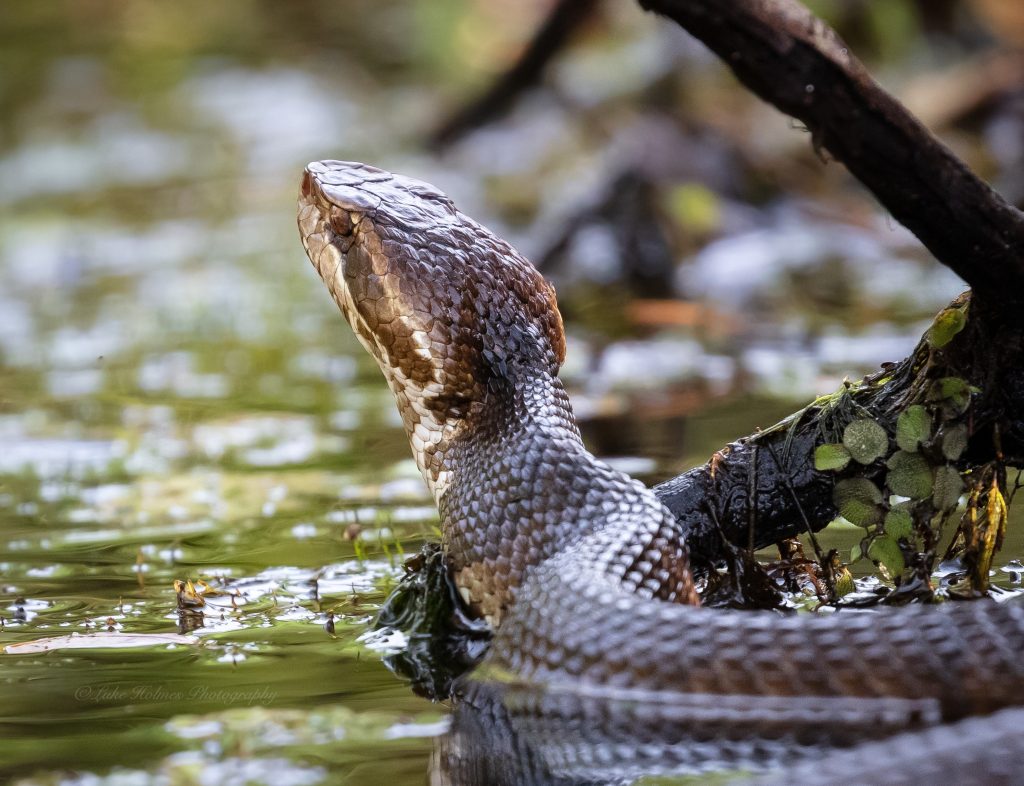
Water moccasins in North Carolina, also called cottonmouths, are limited to a specific band of the state: the Coastal Plain and the Sandhills. They don’t range into the Piedmont or the mountains, which is why sightings reported from cities like Raleigh, Charlotte, or Asheville almost never turn out to be the real thing. This guide covers how to identify a water moccasin correctly, exactly where its range does and doesn’t extend, and how it actually behaves.
Key Takeaways
- Water moccasins in North Carolina are limited to the Coastal Plain and Sandhills; they don’t range into the Piedmont or the mountains, so a sighting reported from Raleigh, Charlotte, or Asheville is almost never the real thing.
- A cottonmouth’s venom ranks fourth in toxicity among North Carolina’s six venomous snake species, behind the coral snake and both of the state’s rattlesnake species.
- Cottonmouths swim with their whole body floating on the surface, unlike watersnakes that swim mostly submerged, and despite a persistent myth, they’re fully capable of biting underwater.
Identifying Water Moccasins in North Carolina
Size, coloring, and head shape all point toward a correct identification, but the two most reliable clues come down to specific physical features rather than general appearance. Learning what to look for on the snake itself, and how that compares to its most common look-alikes, settles most identification questions quickly.
Cottonmouth Size, Color, and Head Shape
An adult cottonmouth typically measures 3 to 4 feet long, occasionally reaching as much as 6 feet in rare cases. Its body is heavy and dark, patterned with crossbands that show light olive or brown centers and are widest along the sides and narrowest across the top, the reverse of the pattern found on most similar-looking watersnakes. The head is distinctly wider than the neck, with a dark bar running from the eye to the jaw on each side, nine large scales across the crown, and vertically elliptical pupils typical of a pit viper.
Water Moccasin vs. North Carolina Watersnakes
At least ten physical characteristics separate a cottonmouth from the state’s watersnake species, but a few stand out as the fastest to check. Watersnakes lack fangs and venom glands entirely, and their crossbands run in the opposite pattern from a cottonmouth’s, narrowest at the sides and widest across the top. Watersnakes also lack the facial pit and the dark bar running from eye to jaw that mark a true pit viper.
Where Water Moccasins Live in North Carolina
Range and habitat answer two different questions here: where a cottonmouth’s territory actually extends within North Carolina, and what specific conditions it looks for once inside that territory. Both matter for correctly judging whether a sighting is even plausible in the first place.
Coastal Plain to the Sandhills: NC’s Real Range
A cottonmouth’s range in North Carolina runs from the Coastal Plain through the Sandhills, and in a few spots within that range, it’s the most abundant snake species around. That range does extend into the eastern edge of Wake County and all of Johnston County, which is why occasional sightings do turn up near the Triangle, but it stops well short of Durham, Orange, and Chatham counties. Outside this band entirely, the Piedmont and the mountains simply don’t have a resident cottonmouth population, regardless of how convincing a sighting might seem.
Cottonmouth Natural Habitat Within That Range
Cottonmouths are the most aquatic of North America’s venomous snakes and turn up in nearly any habitat connected to water: swamps, marshes, slow rivers, and the shorelines of lakes and ponds. Like other cold-blooded reptiles, they bask on branches, logs, and stones right at the water’s edge, which is often the easiest place to spot one during the day.
Water Moccasin Behavior: Diet, Defense, and Dormancy
A cottonmouth’s diet, defensive habits, and winter routine all shift depending on age and season, which is part of what makes this species harder to generalize about than most people expect.
How Cottonmouth Diet Changes as They Grow
Cottonmouths eat an unusually broad range of prey, including fish, other snakes, small mammals, birds, lizards, amphibians, turtles, crayfish, and insects, and their hunting strategy shifts as they mature. Juveniles tend to ambush prey, mostly amphibians, from fixed spots around the open edges of a wetland, while adults range more widely and actively forage across a broader variety of habitat.
What Happens When a Cottonmouth Feels Threatened
Cottonmouths don’t automatically stand their ground when approached; research on their defensive behavior found that more than half of the individuals tested chose to retreat rather than confront a person. Those that do stay tend to coil, vibrate their tail, and gape their mouth open to display the pale white lining the species is named for, a warning display rather than an attack. A cottonmouth that feels sufficiently threatened will still bite, but provoking or handling one is almost always what triggers it.
Cottonmouth Winter Dormancy and Where They Overwinter
Cottonmouths are most active at night and become inactive once cold weather sets in, brumating underground through the winter. Common overwintering spots include rocky, wooded hillsides, crayfish burrows, rotting stumps, and abandoned mammal burrows, all of which offer protection from freezing temperatures until warmer conditions return in spring.
Are Water Moccasin Bites Dangerous in North Carolina?
A cottonmouth bite is a genuine medical emergency, though no human deaths from one have been documented in North Carolina specifically, even though fatalities have occurred elsewhere in the species’ range. Among the state’s six venomous snakes, the cottonmouth’s venom ranks fourth in toxicity, behind the coral snake, the eastern diamondback rattlesnake, and the timber rattlesnake. That ranking doesn’t make a bite any less serious, but it does mean a cottonmouth isn’t the most dangerous venomous snake a person could encounter in North Carolina.
Preventing Accidental Encounters With Water Moccasins
Most bites happen because someone wasn’t watching where their hands or feet were going, so a few habits go a long way toward avoiding one entirely. Wearing sturdy boots rather than sandals while gardening, hiking, or working near water removes much of the risk on its own. Avoid reaching into brush, hollow logs, or gaps you can’t see into, and never step over a log or rock without first checking what’s on the other side.
When a Water Moccasin Sighting Needs a Professional
A cottonmouth spotted at a distance and left alone will typically move off on its own without further incident. Recurring sightings near a dock, shoreline, or any area where people or pets spend regular time are worth addressing directly, since that pattern usually means there’s an established basking or denning spot nearby rather than a single snake passing through.
Get Help With Pest Conditions Around Your North Carolina Property
Sage Pest Control doesn’t handle venomous snake removal directly, but reducing the insects and small prey that draw wildlife close to a property is part of Sage’s general pest control service across North Carolina. Sage is GreenPro certified, offers same-day service 90 to 95 percent of the time, and provides free re-services if activity returns between scheduled visits. Visit Sage Pest Control or contact the team to schedule an inspection, and contact a licensed wildlife removal specialist directly for the snake itself.
Frequently Asked Questions
Can a water moccasin really bite me underwater?
Yes, though in practice it’s a rare cause of actual bites. Cottonmouths generally avoid people in the water the same way they do on land, and swimming-related bites are far less common than bites from someone stepping on or reaching near a snake resting on shore.
Why do people report seeing water moccasins in cities like Raleigh or Charlotte?
Wildlife biologists who track North Carolina’s snake populations get reports every year from cities across the Piedmont and the mountains, and none of them hold up once checked against the species’ actual range. That pattern reflects how convincing some watersnakes look at a glance, not any expansion of where cottonmouths actually live.
How dangerous is a cottonmouth bite compared to North Carolina’s other venomous snakes?
Ranking doesn’t predict how severe any individual bite turns out to be, since venom yield varies from one bite to the next regardless of species. A lower ranking on the toxicity scale is still no reason to treat a bite as less urgent; every cottonmouth bite calls for the same immediate medical response.
