
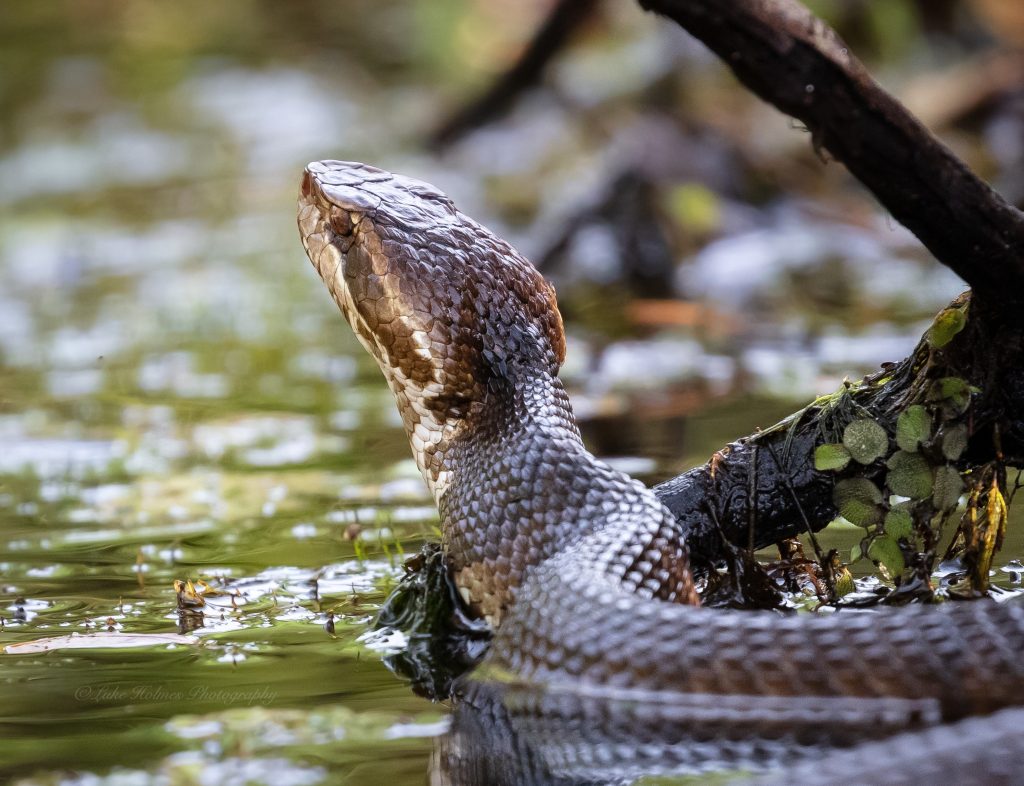
Water moccasins in Virginia have by far the smallest range of the state’s three venomous snakes, confined almost entirely to the southeastern corner around Virginia Beach, Chesapeake, and a handful of nearby counties. Most snakes reported as “water moccasins” elsewhere in the state, including popular fishing spots around Richmond and Central Virginia, turn out to be harmless watersnakes instead. This guide covers what the name actually refers to, where the real thing lives, how to tell it apart from its common look-alike, and what its reputation gets wrong.
Key Takeaways
- Water moccasins, also called cottonmouths, have the smallest range of Virginia’s three venomous snakes, limited almost entirely to the southeastern corner of the state.
- The northern watersnake causes the vast majority of “water moccasin” misidentifications in Virginia, and swimming posture settles the question fast: a cottonmouth floats with its whole body on the surface, while a watersnake swims mostly submerged.
- Cottonmouths are reluctant to bite and prefer to flee; widely repeated stories about them attacking boats or chasing swimmers are folklore, not documented behavior.
What “Water Moccasin” Actually Means
“Water moccasin” and “cottonmouth” refer to the exact same snake, Agkistrodon piscivorus, and neither name is more official than the other. The “cottonmouth” name comes directly from the white interior of the snake’s mouth, visible during its defensive display. Regional nicknames like “black moccasin” and “swamp lion” show up occasionally too, but they’re all the same species under a different name.
Where Water Moccasins in Virginia Actually Live
Range is one of the most useful facts in this entire guide, since it rules out a cottonmouth before any closer identification is even necessary in most of the state. But range alone doesn’t explain what a water moccasin’s actual habitat looks like, or when it’s most likely to be encountered within that range.
A Narrow Cottonmouth Range in the Southeast
Water moccasins in Virginia are concentrated in the southern parts of Virginia Beach and Chesapeake, with isolated populations in Brunswick, Chesterfield, Dinwiddie, Greensville, Prince George, Southampton, Surry, Sussex, and York counties, plus the cities of Suffolk and Newport News. A separate isolated population lives near the confluence of the James and Appomattox rivers around Hopewell. Outside of these areas, a genuine cottonmouth sighting in Virginia is rare.
The Habitat They Actually Prefer
Within that range, water moccasins favor lowland wetland habitat: swamps, freshwater and brackish marshes, drainage ditches, slow streams and rivers, and the edges of permanent or semi-permanent ponds. Away from open water, they shelter under vegetation, fallen boards, and other debris, and they’ll bask on logs or horizontal limbs that overhang the water itself. Adults rarely wander far from water, though juveniles disperse over considerably longer distances while they’re still establishing territory.
Seasonal Activity and Where They Overwinter
Water moccasins in Virginia are active both day and night, especially during warm months, with recorded activity spanning late February through mid-November, though the bulk of sightings cluster between April and September. As temperatures drop in late fall, they move away from open marshes toward more sheltered ground to overwinter, entering a dormant state until conditions warm again in spring. That seasonal shift is part of why an area that seems snake-free in winter can have real activity again within a few months.
Outside That Range, It’s Almost Always a Watersnake
Virginia’s three watersnake species, the northern watersnake, brown watersnake, and plain-bellied watersnake, are found statewide in nearly every county and municipality, occupying lakes, reservoirs, streams, rivers, ditches, and even backyard ponds. Because they share size, habitat, and a passing resemblance to the cottonmouth, they account for the overwhelming majority of “water moccasin” reports from areas like Richmond, Central Virginia, and Northern Virginia, where true cottonmouths essentially don’t occur.
How to Identify a Water Moccasin
Two things settle most identification questions faster than color or pattern alone: a direct comparison to the look-alike species, and how each one actually moves through the water. Before either of those, though, it helps to know what the snake itself actually looks like up close.
Physical Traits: Size, Color, and Head Shape
Adult water moccasins in Virginia typically runs 2 to 4 feet long, occasionally reaching close to 6 feet in rare cases, with a heavy, muscular body covered in rough, keeled scales. Coloring ranges from dark olive-green to nearly black, marked with dark hourglass-shaped crossbands that are widest along the sides and narrowest across the back; older adults often darken enough that the pattern becomes difficult to see at all. The head is broad, angular, and distinctly wider than the neck, a shape created by venom glands housed in the jowls, and the pupils are vertical slits rather than the round pupils found in harmless species. Juveniles look noticeably different from adults: they’re lighter, more clearly patterned, and carry a bright yellow tail tip that fades as they mature.
Water Moccasin vs. Northern Watersnake
The northern watersnake is the species most often mistaken for a cottonmouth, and it’s worth knowing what makes it different rather than what makes a cottonmouth distinct, since that’s already covered above. A northern watersnake is brown to gray with reddish, yellow, or white blotches and crossbands, a thick but more uniformly proportioned body, and a rounded head, though it will flatten its head defensively into a more diamond-like shape when threatened, which is exactly what causes so much confusion. Its pupils are round, not the vertical slits found on a true pit viper.
The Swimming Test: Floating vs. Submerged
Swimming posture is the fastest field test available. A cottonmouth floats with its entire body riding on top of the water, buoyant and fully visible. A watersnake swims with its body mostly submerged, showing only its head above the surface. A snake gliding along with its whole length visible on the water is far more likely a cottonmouth; one showing just a head cutting through the water is almost certainly a watersnake.
Water Moccasin Behavior: Mouth-Gaping and Other Myths
The cottonmouth’s reputation is built on a mix of one real, well-documented defensive display and a handful of stories that don’t hold up against actual field observation.
The Cottonmouth’s Mouth-Gaping Display
When a cottonmouth feels threatened, it performs a distinctive defensive sequence: flattening its body, vibrating its tail, raising its head to roughly a 45-degree angle, and opening its mouth wide to expose the white interior the snake is named for. This display is a warning, not an attack, and it’s the clearest confirmation of a real cottonmouth if it’s safe to observe from a distance.
Debunking the Aggressive Cottonmouth Myth
Cottonmouths have a reputation for aggression that doesn’t match documented behavior. Stories about them attacking boats, chasing water skiers, or “nesting” together in groups are folklore, popularized by fiction rather than field observation. In reality, cottonmouths are reluctant to strike and consistently choose to flee from a confrontation. A snake that drops out of an overhanging tree into a boat is also unlikely to be a cottonmouth in the first place, since the species is a poor climber and rarely found more than a few feet off the ground; brown and plain-bellied watersnakes, which do climb well above the water, are the more likely culprits behind that particular scare.
What Water Moccasins Eat and How They Hunt
Cottonmouths are opportunistic feeders with a genuinely varied diet: fish, amphibians, small mammals, turtles, birds, and even other snakes, including other cottonmouths. Fish make up a favorite part of the diet, and the species is fully capable of biting and swallowing prey underwater, contrary to a persistent myth that cottonmouths can’t bite while submerged. Juveniles use a small trick to help catch prey: wagging a brightly colored tail tip to lure curious frogs or small animals within striking range.
Are Water Moccasin Bites Dangerous?
A cottonmouth bite is a genuine medical emergency that causes significant pain and swelling, but venomous snakebite fatalities in Virginia overall are extremely rare, roughly two people per decade across all three of the state’s venomous species combined. Most bites happen when someone tries to catch, handle, or kill a snake rather than from an unprovoked encounter, and a cottonmouth given room to retreat will almost always take it.
What to Do If You See One
Keep a safe distance and let the snake move away on its own; cottonmouths given an escape route rarely stay put. Avoid reaching into brush, hollow logs, or debris near the water’s edge where one might be resting, and never attempt to catch, handle, or kill a snake to get a closer look.
When to Call a Professional
Sage Pest Control doesn’t handle venomous snake removal, but general habitat cleanup, clearing brush piles, woodpiles, and debris near a shoreline or pond edge, reduces the cover that draws snakes close to a property in the first place. For a confirmed water moccasin on a property, contact a licensed wildlife removal specialist directly rather than attempting removal alone.
Get Help With Pest Conditions Around Your Virginia Property
Sage Pest Control addresses the insects and small animals that create attractive habitat near a home, which indirectly makes a property less appealing to snakes searching for prey or cover. Sage is GreenPro certified and offers same-day service 90 to 95 percent of the time, with free re-services if activity returns between scheduled visits. Visit Sage Pest Control or contact the team to schedule an inspection, and contact a licensed wildlife removal specialist directly for the snake itself.
Frequently Asked Questions
Can water moccasins bite underwater?
Yes. Despite a persistent myth to the contrary, cottonmouths are fully capable of biting and even swallowing prey while submerged. The idea that they can only bite on land isn’t supported by how the species actually hunts.
Of Virginia’s three venomous snakes, is the water moccasin the most dangerous?
Its venom is generally considered the most potent of the three, but that doesn’t translate to the most risk in practice. Timber rattlesnakes and copperheads bite people far more often simply because cottonmouths are so rare and geographically limited in the state, so in terms of actual encounters, water moccasins in Virginia poses the least overall risk of state’s three venomous species.
Is it legal to kill a water moccasin in Virginia?
Killing a snake in Virginia is only legal if it poses an immediate threat to a person or livestock; killing one otherwise isn’t permitted under state law. Given how rarely cottonmouths bite unprovoked, leaving the snake alone and letting it retreat is both the safer and the legal option in almost every situation.
