
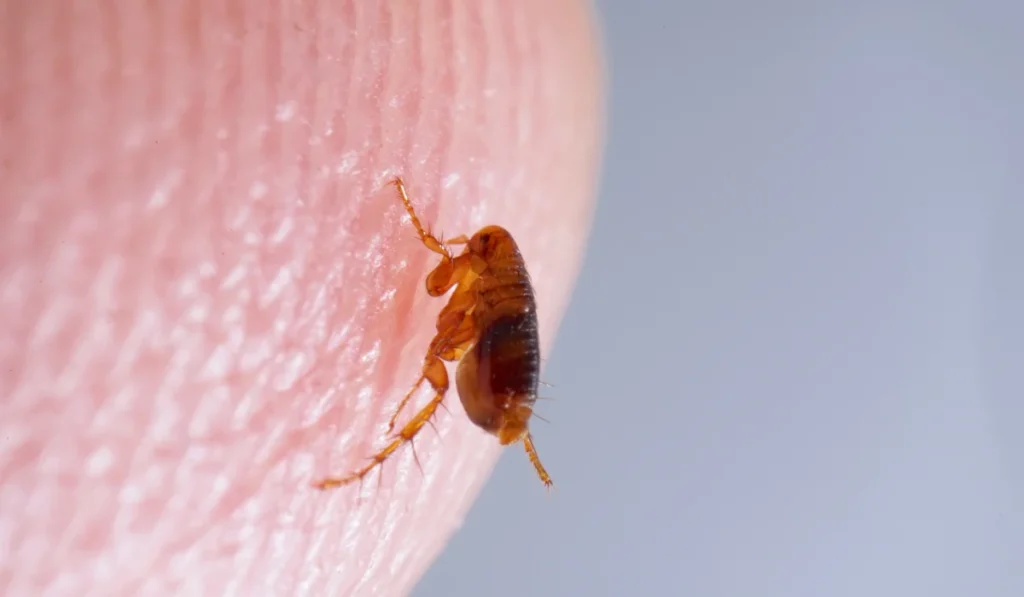
A flea can look like a dark speck that disappears as soon as you try to inspect it. Adult fleas are visible to the human eye, but their small size, narrow bodies, and quick movements make them difficult to identify. They are usually reddish-brown to nearly black and measure less than one-eighth of an inch long.
What do fleas look like up close? They are wingless insects with six legs, a body flattened from side to side, and enlarged hind legs built for jumping. Their firm outer bodies also explain why fleas are so hard to squish between your fingers.
Finding one adult matters, but it does not show the full extent of a flea infestation. Eggs, larvae, and pupae can remain hidden in pet bedding, carpet, furniture, and protected areas outside. Learning how each stage looks can help you confirm what you are seeing and decide what to do next.
What Do Fleas Look Like to the Human Eye?
Adult fleas often look like tiny, dark seeds moving through pet fur or across a light-colored surface. Their bodies range from reddish-brown to dark brown or black, depending on the flea and whether it has recently fed.
Fleas do not have wings. When one suddenly disappears, it has jumped rather than flown. The large hind legs that power this movement are one of the insect’s clearest physical traits, although they may be hard to see without magnification.
Body shape provides another useful clue. A flea is compressed from side to side, which creates a narrow profile when viewed from above. That shape helps it move between strands of animal hair and through dense fabrics without getting caught.
The University of Minnesota Extension guide to fleas describes adults as dark brown to black, wingless, less than one-eighth of an inch long, and equipped with large hind legs. It also confirms that flea bodies are flattened from side to side and are hard to kill by crushing.
When checking a pet, part the fur and look close to the skin. Pay particular attention to the neck, belly, groin, and base of the tail. A flea may move too quickly for a long look, but repeated movement or jumping can help distinguish it from dirt and other debris.
Why Are Fleas So Hard to Squish?
Fleas are hard to squish because their bodies are small, firm, and shaped to move through tight spaces. When you press one between your fingertips, its narrow body can slip away before enough pressure reaches it.
Soft fingertips also spread pressure over a larger area. This may pin a flea briefly without crushing its hard outer body. The flea can then use its hind legs to escape as soon as the pressure changes.
Their ability to jump makes the process even harder. Fleas respond quickly to movement and can launch away before you have a secure grip. This is why a tiny insect may appear to vanish when you try to pick it up from a floor, pet bed, or piece of furniture.
Even when you kill the adult, crushing one flea does not remove the rest of the infestation. The visible fleas feeding on a pet or jumping indoors are only one stage of a life cycle that continues in less obvious places.
What Fleas Look Like During Each Life Stage
Fleas pass through four stages: egg, larva, pupa, and adult. Each stage has a different appearance and occupies a different part of the pet’s environment.
Flea Eggs
Flea eggs are pearly white, smooth, and oval. At approximately 0.5 millimeters long, they can resemble salt, dandruff, or other fine debris.
The eggs are not sticky, so they do not remain attached to an animal for long. As a pet moves through the house, eggs can fall into bedding, carpet, upholstery, floor gaps, and other resting areas. Their light color makes them difficult to spot on pale fabrics.
Flea Larvae
Flea larvae look nothing like the dark, jumping adults. They are pale, legless, and worm-like, with small hairs covering their bodies.
Larvae avoid light and remain in protected areas. You are more likely to find them deep in carpet, beneath furniture, along baseboards, or near pet bedding than on a dog or cat. They feed on organic material in their surroundings, including flea dirt left by adults.
Flea Pupae
After developing as larvae, fleas form cocoons and enter the pupal stage. The cocoons can collect dust, hair, fibers, and other debris, helping them blend into carpet and surrounding materials.
Developing adults can remain protected inside these cocoons until environmental cues signal that a potential host is nearby. Pressure, rising temperature, and carbon dioxide can stimulate adults to leave the cocoon.
Adult Fleas
Adult fleas are the reddish-brown, hard-bodied stage that feeds on animals and may bite people. They begin searching for a host after leaving the cocoon and can move quickly through fur once they find one.
The Companion Animal Parasite Council flea guidelines describe eggs as pearly white and oval, larvae as maggot-like, and pupae as hidden inside small cocoons. The council also notes that mechanical pressure, carbon dioxide, and increased temperature can encourage adult fleas to leave the pupal stage.
How to Tell Fleas From Flea Dirt and Similar Pests
Not every dark speck on a pet is an adult flea. Flea dirt, which is waste left by feeding adults, appears as black or reddish-black grains in fur, bedding, and fabric. It is often described as looking like ground pepper.
To check suspicious specks, place a few on a damp white paper towel. Flea dirt may dissolve and create a reddish-brown mark because it contains blood material. Ordinary dirt will usually remain brown, gray, or black.
Flea eggs are also easy to confuse with debris. Unlike flea dirt, eggs are white and oval. Neither eggs nor flea dirt move on their own, so any speck that crawls quickly or jumps is more likely to be an adult insect.
The following differences can help you compare fleas with other small household pests:
| Pest or Material | What It Looks Like | Key Difference |
|---|---|---|
| Adult flea | Tiny, dark, narrow-bodied insect | Jumps and moves quickly through fur |
| Flea dirt | Black or reddish-black specks | May create a reddish-brown mark when damp |
| Flea egg | Small, white, oval object | Does not move and may resemble salt |
| Bed bug | Broad, flat, reddish-brown insect | Crawls but does not jump |
| Adult tick | Rounded body with eight legs | Attaches to a host and does not jump |
| Carpet beetle larva | Brownish larva covered in hairs | Moves slowly and has visible bristles |
| Springtail | Tiny insect found near moisture | Jumps but has a softer, less flattened body |
A jumping insect is a strong clue, but it should not be the only detail you consider. Body shape, location, color, and signs on pets can help confirm whether you are dealing with fleas.
Signs of Fleas on Pets and Inside the House
A pet may show signs of fleas before you see a live adult. Frequent scratching, biting at the skin, restlessness, and repeated grooming can point to irritation. You may also notice flea dirt near the animal’s neck, belly, groin, or tail.
Check the areas where your pets sleep, rest, and spend the most time. Flea eggs and immature stages often collect in pet beds, rugs, upholstered furniture, carpet edges, and spaces beneath furniture. Live adults may jump around your lower legs when you walk through an active area.
Bites around the ankles can support your suspicion, but skin reactions alone cannot confirm fleas. People respond differently to bites, and several pests can cause similar marks.
Outdoor areas may also contribute to an indoor flea problem. Around homes in Charlotte, Raleigh, Greensboro, and Virginia Beach, shaded soil, dense shrubs, spaces beneath decks, and protected pet resting spots can provide suitable conditions. Pets that visit these areas may continue bringing fleas inside unless both environments are assessed.
What to Do When You Find Fleas
Start by checking every dog and cat in the home, even if only one pet appears uncomfortable. Ask your veterinarian which flea treatment is appropriate for each animal. Products are not interchangeable, and a treatment intended for dogs may not be safe for cats.
Vacuum carpets, rugs, upholstered furniture, baseboards, and the areas beneath furniture. Focus on places where pets sleep or spend long periods. Empty the vacuum contents promptly so collected fleas and debris do not remain inside the home.
Wash pet beds, blankets, and other washable fabrics your animals use. Continue cleaning after the first visible fleas disappear because immature stages may still be developing in hidden areas.
The NC State Extension guide to flea control recommends regular vacuuming, cleaning pet bedding, and addressing areas where animals spend time. It also explains that follow-up treatments may be necessary because several flea stages can remain after the initial service.
Getting Complete Flea Control for Your Home
Knowing what fleas look like is the first step, but successful control depends on locating the areas where the infestation is developing. Treating only the adult fleas on a pet can leave eggs, larvae, and pupae in carpets, furniture, bedding, and shaded outdoor spaces.
A professional inspection can help determine whether activity is limited to one area or spread throughout the property. Sage technicians inspect common flea habitats, including pet resting spaces, rugs, furniture, floor edges, decks, shrubs, and shaded landscaping. Treatment can then focus on the locations where fleas are most likely to develop.
Learn more about Sage Pest Control and its approach to household pest problems. When fleas continue appearing after you treat your pets and clean their surroundings, contact the Sage Pest Control team to request an inspection and a treatment plan based on what is happening in your home.
