
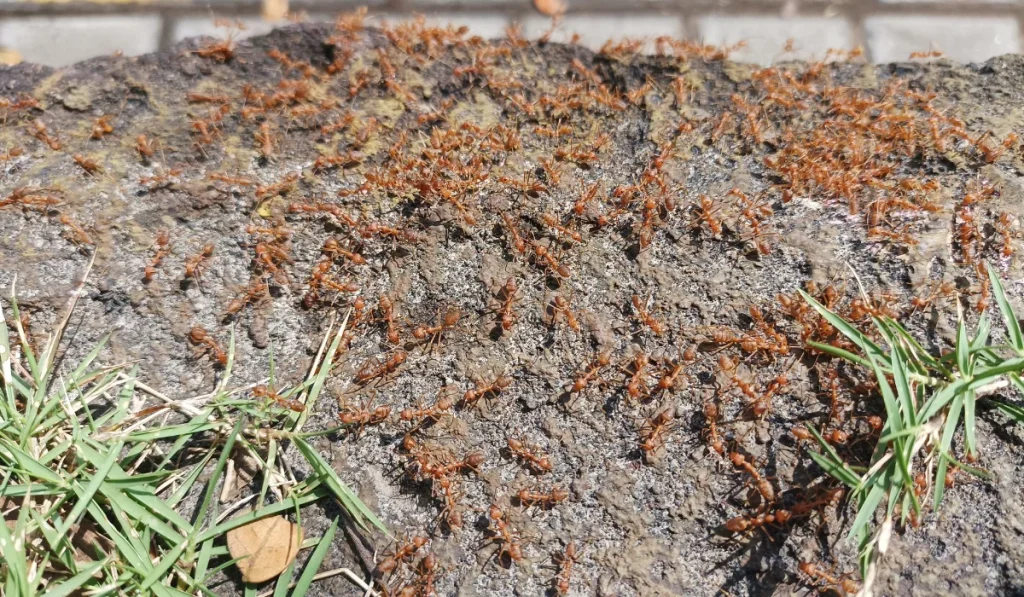
Where do fire ants live? In North Carolina, red imported fire ants commonly build underground nests in sunny lawns, pastures, landscaped areas, and soil beside sidewalks and driveways. The mound is only the visible part of the nest, and workers can forage far beyond it. Understanding the places fire ants favor can help you make sense of new mounds, ants appearing away from a nest, and recurring activity across your yard.
Where Do Fire Ants Live in North Carolina Yards?
Red imported fire ants can build nests in many types of soil, but they tend to favor open, sunny ground. NC State Extension identifies lawns and pastures as common nesting areas and notes that mounds often appear beside sidewalks, driveways, and other surfaces that absorb heat.
Around a home, suitable habitat can extend well beyond the center of the lawn. Fire ants may build around tree stumps, landscaping materials, stonework, pavement edges, and other areas where soil remains accessible. Young colonies may also be present before enough excavated soil collects above ground to form an obvious mound.
Fire ants are one of several ant species found in North Carolina, so seeing ants outdoors does not automatically identify the species. Red imported fire ant workers vary in size within the same colony, typically ranging from about 1/8 to 1/4 inch long, and their mound-building behavior provides another useful clue.
| Area Around the Property | Why Fire Ants May Be Found There |
| Open lawns | Direct sunlight warms the soil and commonly supports mound development |
| Sidewalk and driveway edges | Heat absorbed by pavement can warm nearby ground |
| Landscape beds | Accessible soil can provide space for underground nests |
| Around tree stumps | Colonies can develop in soil around stumps and decaying wood |
| Stonework | Fire ants can nest within or around soil and landscaping materials |
| Other sunny ground | Fire ants can establish colonies in many soil types when conditions are suitable |
Why Fire Ants Favor Sunny, Open Ground
Sunlight is one of the clearest patterns associated with fire ant habitat. Open turf receives more direct heat than heavily shaded ground, and red imported fire ants commonly build mounds where sunlight can warm the soil.
Their mounds do more than mark the location of the colony. NC State Extension’s research on red imported fire ant biology explains that the mound helps regulate temperature within the nest. Ants and developing brood can move higher or lower within the colony as conditions change.
This also helps explain why fire ants frequently nest beside pavement. Driveways, sidewalks, curbs, and patios absorb solar heat, creating warmer soil along their edges. When checking a property for activity, these boundaries between turf and hard surfaces can be as relevant as open sections of lawn.
Sun exposure is a strong clue, but it is not a strict requirement. Fire ants can build in many soil types and locations, so a colony should not be ruled out simply because part of the property receives shade.
How Soil Affects the Look of a Fire Ant Mound
There is no single mound color or shape that appears in every yard. The surrounding soil influences what homeowners see above ground.
NC State Extension reports that fire ant mounds built in clay soils tend to look rounded and symmetrical, while mounds in sandy soils can be more irregular. Their color also reflects the soil workers excavate from below the surface.
That matters in North Carolina, where soil conditions can vary considerably by location. A mound does not have to be a tall pile of red dirt to belong to fire ants. Sandy or lighter soils can produce a mound that looks much different from one built in clay.
Young colonies may be even harder to recognize because they do not always have a noticeable mound. A lack of large mounds therefore does not guarantee that no colony is present.
How Much of a Fire Ant Nest Is Underground?
The mound is only a small part of the colony. Much of a fire ant’s habitat consists of underground chambers and tunnels that homeowners never see.
NC State Extension reports that large red imported fire ant colonies can contain as many as 500,000 workers. Galleries and tunnels associated with some large mounds can extend up to six feet underground, although another NC State homeowner resource notes that typical nests may be closer to three feet deep.
Below the surface, workers tend developing ants, maintain the nest, gather food, and defend the colony. Some colonies have one queen, while others contain multiple queens and can spread across networks of mounds.
That underground structure is why knocking down a mound does not remove the colony. Flattening the loose soil leaves the queens, workers, brood, and much of the nest below ground. Disturbing the mound can also trigger workers to rush out and defend it.
Why a Mound Can Seem to Appear Suddenly
A new mound does not always mean fire ants arrived overnight. Young colonies can develop underground before they produce enough excavated soil to become obvious from the surface.
Colonies can also move. NC State Extension reports that fire ants may migrate from one mound location to another and establish new nests several hundred feet away. In colonies with multiple queens, several mounds may be connected to activity across a wider area.
For homeowners, the pattern matters more than one mound. When new mounds keep appearing in different parts of the lawn, the activity may involve more than a single isolated nest.
How Far Do Fire Ants Travel From Their Mound?
Fire ant workers spend part of their time away from the mound searching for food. They can move through underground tunnels before reaching the surface, then continue across the surrounding landscape.
NC State Extension reports that workers can forage up to roughly 80 yards from a mound. That distance is enough for ants from one colony to appear near a patio, garden, driveway, or another part of a residential property without an obvious mound nearby.
Workers search for small insects, dead animals, and sugary materials such as plant secretions. Once a worker locates food, it can lay a pheromone trail that helps other workers reach the same source.
This foraging behavior is why following a few visible ants does not always lead directly to a mound. The nest may sit in another part of the yard or beyond the property line.
Why Fire Ants Build Near Driveways, Sidewalks, and Patios
Pavement edges combine two conditions fire ants frequently use: accessible soil and added warmth. Sunlight heats concrete, asphalt, stone, and similar materials, which can raise temperatures in the soil immediately beside them.
These locations also place colonies close to everyday activity. A mound along a driveway can sit where people step out of vehicles. One beside a sidewalk, patio, garden path, or play area can be disturbed by foot traffic, pets, lawn equipment, or outdoor projects.
Fire ants react quickly when their nest is disturbed. Workers can move to the surface in large numbers, grip skin with their jaws, and sting repeatedly. Avoid kicking, poking, stepping on, or mowing directly over a suspected mound as a way to identify it.
Mound location is therefore about more than where the ants prefer to nest. It can also determine how likely people or pets are to come into contact with the colony.
How Fire Ants Reach New North Carolina Yards
Fire ants do not need to move from one neighboring mound to the next to reach a property. Established colonies produce winged reproductive ants that leave the nest to mate. After mating, a queen lands, sheds her wings, and can begin a new colony underground.
NC State Extension reports that winged reproductive fire ants can fly roughly three miles under their own power and may travel farther when carried by wind. That helps explain why new colonies can establish themselves away from an existing mound.
Winged fire ants are part of the broader group of flying ants found in North Carolina. Their narrow waists, elbowed antennae, and unequal wing lengths help separate winged ants from termite swarmers, which have straighter antennae, broader waists, and wings of roughly equal length.
Fire ants can also move with materials transported by people. Soil, sod, plants with attached soil, hay, straw, and soil-moving equipment can carry imported fire ants into new areas.
How North Carolina’s Fire Ant Quarantine Limits Their Spread
North Carolina regulates certain materials that can transport imported fire ants from established areas into places where they have not yet spread.
The North Carolina Department of Agriculture & Consumer Services reports that the state’s imported fire ant quarantine includes portions or entire areas of 81 counties. Davie, Forsyth, and Iredell counties were added in full when the quarantine expanded in 2026.
The quarantine does not mean every property in those counties contains fire ants. It regulates the movement of materials that may carry them. Nursery stock, sod, soil, hay, straw, logs or pulpwood with soil attached, and soil-moving equipment are among the items covered by the state’s rules.
This human-assisted movement helps explain why fire ants can turn up on properties without a nearby known colony. Natural mating flights and transported materials both give these ants ways to establish new nests.
For homeowners around Charlotte, Greensboro, Raleigh, and surrounding North Carolina communities, the quarantine also reflects how broadly imported fire ants have become established across the state.
What Makes One Part of a Yard Better Fire Ant Habitat?
A single yard can contain several different conditions within a relatively small space. An open strip of turf beside a driveway may receive direct sun for hours, while soil beneath mature trees stays cooler and shaded. Landscape beds, hardscape, drainage, and disturbed soil create further differences from one part of the property to another.
Fire ants do not need their food source directly beside the nest. Workers can forage well beyond the mound, so the colony can use food found elsewhere while maintaining its underground nest in a favorable location.
Recent landscaping can also change available nesting space. Installing sod, moving soil, creating beds, or changing hardscape does not cause a fire ant infestation by itself. These projects can, however, change the soil conditions around the property, and infested soil or plant material can transport ants from another location.
The most useful way to assess habitat is to look at the property as a whole. Sun exposure, soil, hard surfaces, available nesting space, and nearby fire ant activity all influence where colonies may become established.
What Fire Ant Activity Can Tell You About the Nest
The ants you see can provide clues about what is happening underground. A mound in an open lawn or beside pavement marks a likely nest, while workers appearing farther away may be following a foraging route.
Several mounds across the same yard can indicate a wider colony network, particularly when multiple queens are present. A single small mound, on the other hand, does not necessarily mean the colony itself is small because much of its structure remains hidden underground.
Recurring activity deserves a wider look at the property. Check open turf, pavement edges, landscape beds, and other likely nesting areas rather than focusing only on the first mound you notice.
Avoid disturbing suspected nests during that inspection. Fire ants defend their colonies aggressively, and the number of workers above ground before a disturbance does not show how many are below the surface.
Managing Fire Ant Habitat Around Your North Carolina Home
Where do fire ants live around a North Carolina home? Most colonies remain underground in sunny or otherwise suitable soil, with mounds commonly appearing in lawns, landscaped ground, and along heat-absorbing surfaces such as sidewalks and driveways. Workers can forage far from the nest, while winged queens and transported materials allow new colonies to establish in other parts of the landscape.
Recurring mounds are easier to understand when you consider the entire property rather than treating each pile of soil as a separate problem. Mound locations, worker activity, nearby pavement, and repeated nests across open ground can all help show how fire ants are using the yard.
Fire ants require specialized coverage outside Sage Pest Control’s standard general pest plan. Sage Pest Control offers fire ant coverage as an add-on for qualifying pest control plans, and homeowners dealing with active or recurring mounds can contact Sage Pest Control to discuss service options for their property.
