
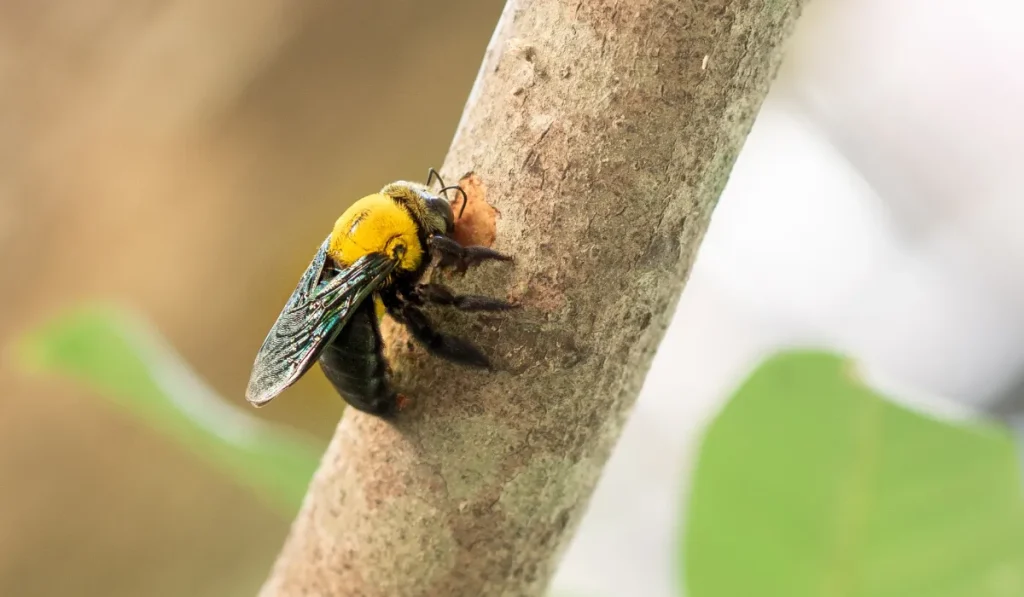
Carpenter bees in Virginia are native pollinators, but nesting females can damage decks, fascia, porch ceilings, railings, and other exposed wood. A clean round hole, coarse wood shavings below it, or a large bee repeatedly entering the same opening can indicate an active gallery. Knowing how to identify carpenter bees, separate them from similar bees, and recognize repeated nesting can help you protect vulnerable wood without treating every bee in the yard as a pest.
What Are Carpenter Bees in Virginia?
The Eastern carpenter bee, Xylocopa virginica, occurs across eastern North America. Adults are about 3/4 to 1 inch long, with yellow hair on the thorax and a smooth, dark abdomen. That relatively shiny abdomen is one of the clearest features separating a carpenter bee from a bumble bee.
Carpenter bees collect nectar and pollen from flowers. Females also use their mandibles to excavate dead wood for nesting, but they do not eat the wood. Inside each gallery, developing young are supplied with pollen for food.
Their role as pollinators is substantial. Research summarized by the University of Georgia IPM profile of Eastern carpenter bees examined 23 X. virginica nests and estimated that the bees collected 8.6 billion pollen grains during 7,150 foraging trips from May through June. The same nesting behavior that makes them useful pollinators can become a property issue when the chosen nest site is part of a house.
Carpenter Bees vs. Bumble Bees
Carpenter bees and bumble bees are easy to confuse at a glance. Both are large-bodied bees that may be active around the same flowers, but their abdomens and nesting habits provide useful identification clues.
| Feature | Carpenter Bees | Bumble Bees |
| Abdomen | A large portion is shiny and relatively hairless | Abdomen is covered more extensively with hair |
| Nesting Habit | Females excavate galleries in wood | Colonies occupy existing protected cavities |
| Common Sign Around a Home | Round openings in wood with excavated material nearby | Do not excavate carpenter bee-style galleries |
| Colony Structure | Do not form worker colonies like bumble bees; more than one female may sometimes share a nest | Social colonies with a queen and workers |
| Behavior Near Nest | Males may hover or rush toward people but cannot sting | Workers can defend the colony if the nest is disturbed |
Carpenter bee identification guidance from Cornell Integrated Pest Management highlights the shiny portion of the carpenter bee abdomen as a practical field mark. Virginia yards also support many bee species that do not excavate structural wood, and Sage’s overview of bees in Virginia provides more context for distinguishing those visitors from wood-nesting carpenter bees.
Why Male Carpenter Bees Hover Near People
The bee that seems most confrontational around a nest is often a male. Males patrol nesting areas and may hover close to people or fly toward someone approaching a porch, railing, or eave.
Despite that behavior, male carpenter bees cannot sting. Females can sting, but Cornell describes them as reluctant to do so unless they are threatened or trapped. Avoid handling the insects or reaching into an active gallery, especially when you have not confirmed what species is using the area.
Carpenter bees are also frequently grouped together with wasps and hornets simply because all three may be seen around rooflines or outdoor living spaces. Body shape, nesting material, and behavior provide better clues, as outlined in Sage’s comparison of bees, wasps, and hornets.
Signs of Carpenter Bees Around Virginia Homes
The entrance to a carpenter bee gallery is usually close to 1/2 inch across and distinctly round. Because the female chews away wood rather than consuming it, coarse wood material may accumulate directly beneath a fresh opening.
Bee traffic provides another clue. A carpenter bee moving between flowers is behaving like a pollinator. A bee repeatedly disappearing into the same hole in a fascia board, porch ceiling, deck rail, or other wooden surface is showing nesting activity.
Where Carpenter Bees Build Galleries
The University of Maryland Extension guide to carpenter bees identifies eaves, siding, decks, and outdoor furniture among common nesting locations. Similar exposed wood around Virginia homes can include porch trim, railings, fence posts, soffits, fascia, and other exterior components.
Females are especially attracted to raw, unfinished wood and weathered or stained surfaces. Well-maintained painted wood is less attractive, which makes the condition of exterior finishes relevant when carpenter bees return to the same part of a home.
Sawdust beneath a hole is not the only sign to watch for. Yellowish or moldy staining can appear around established nest openings, and repeated spring activity around old holes can indicate that an existing nesting site is being reused.
How Carpenter Bees Damage Wood
A carpenter bee entrance may look shallow from outside, but the gallery continues inside the board. After making a roughly 1/2-inch opening, the female usually excavates 1 to 2 inches into the wood before turning and following the grain.
Typical galleries may extend another 6 to 12 inches. The female divides the tunnel into brood cells where developing bees receive stored pollen and nectar.
Why Repeat Nesting Matters
A single new gallery is not the same as widespread structural damage. The concern increases when the same suitable wood is used repeatedly over multiple seasons.
Old galleries can be reused and lengthened. Several females may also establish nests in the same general area. Over time, repeated excavation can leave more internal tunneling than the small entrance holes suggest.
For homeowners, the pattern matters. One fresh hole in otherwise sound wood calls for a different response than a railing, fascia board, or porch component with numerous old and active entrances.
Woodpeckers Can Make the Damage More Visible
Carpenter bee larvae provide food for woodpeckers. Birds searching for them may open the face of the wood to expose a gallery, creating larger and more irregular openings than the carpenter bees make themselves.
That secondary damage can become one of the most visible effects of an established nesting area. Preventing repeated carpenter bee use of structural lumber can reduce both new galleries and the attraction those galleries create for woodpeckers.
When Are Carpenter Bees Active in Virginia?
Carpenter bee activity becomes easy to notice in spring. University of Maryland Extension places much of the search for nest sites in April and May, when overwintered adults become active and females begin establishing or reusing galleries.
During summer, larvae develop inside brood cells. New adults appear later in the season, feed, and may use existing tunnels for overwintering before activity resumes the following spring.
For a homeowner, the most useful seasonal signs are practical ones: bees inspecting exposed wood, males hovering around the same section of a structure, fresh wood debris, or renewed traffic into an existing round hole.
How to Prevent Carpenter Bees in Virginia
Prevention works best when it focuses on the wood rather than on keeping pollinators out of the entire yard. Carpenter bees can continue visiting flowers while wooden parts of the home are maintained to make them less inviting for nesting.
Painted, sound surfaces are less attractive to nesting females than raw or weathered wood. Cracks, nail holes, splintered areas, and deteriorating finishes should be repaired as part of normal exterior maintenance.
Maintain Vulnerable Wood Surfaces
Before spring nesting activity increases, inspect areas that have attracted carpenter bees before as well as other exposed wood around the home. Fascia, porch ceilings, railing undersides, trim, deck components, siding, and fence posts are reasonable places to check.
Pay particular attention to worn finishes and old gallery openings. Keeping those surfaces in good repair removes some of the conditions carpenter bees favor when selecting nest sites.
Time Repairs Around Nest Activity
An active carpenter bee hole should not be treated like an empty nail hole. If bees are still using the gallery, simply covering the entrance may not address the nest.
University of Maryland Extension identifies late summer, after the season’s new adults have emerged and before overwintering, or early spring before nest construction, as useful periods for treatment and repair. The goal is to address active nesting appropriately, then repair and finish the damaged wood rather than leaving an attractive gallery in place.
Be Skeptical of Carpenter Bee Home Remedies
Carpenter bee traps, scented repellents, and other home remedies are widely promoted, but evidence for infestation control is limited. The University of Georgia IPM review notes that objective, peer-reviewed evaluations have not established the effectiveness of repellents or carpenter bee traps for managing infestations.
Catching an individual bee does not necessarily stop other females from using suitable lumber. Maintaining exposed wood and addressing active galleries focus directly on the conditions that allow structural nesting to continue.
When Carpenter Bee Control Makes Sense
A carpenter bee feeding on flowers is not a reason to treat the yard. Control becomes relevant when bees are excavating part of the structure, returning to the same wood over multiple seasons, or creating galleries where inspection and repair are difficult.
Professional help is especially useful when several active entrances are present or galleries are located in rooflines, fascia, overhead beams, or other areas that would require unsafe ladder work. Correct identification also matters because carpenter bees, bumble bees, honey bees, and wasps call for different responses.
How Sage Handles Carpenter Bee Activity
Sage’s current Virginia bee guidance states that carpenter bee activity falls under its general pest plan for non-honey bees. Technicians inspect the affected wood, treat active tunnel openings, and provide recommendations intended to discourage return nesting.
That focus keeps treatment connected to the actual problem: active galleries in wood. It also avoids treating carpenter bees elsewhere on the property simply because they are present and visiting flowers.
Protecting Your Virginia Home From Carpenter Bee Damage
Carpenter bees in Virginia are useful pollinators until repeated nesting starts affecting wood around the home. Round entrance holes, coarse wood debris, reused galleries, and recurring spring activity can help you tell the difference between a bee passing through the yard and one nesting in the structure.
Keeping exterior wood painted and in good repair can make future nesting less attractive, while established galleries may need targeted attention before repairs are completed. Sage Pest Control provides carpenter bee service in communities within its North Carolina and Virginia service areas. If active galleries are appearing around your deck, porch, fascia, or other exterior wood, contact Sage Pest Control to have the activity assessed.
