
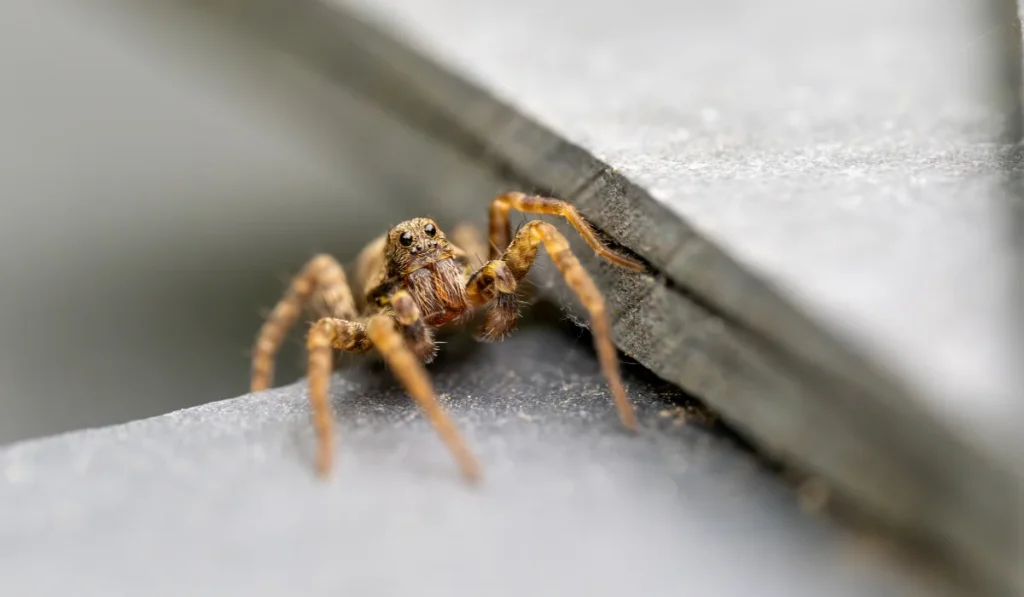
North Carolina has a remarkable variety of spiders, from ground-hunting wolf spiders to large orb weavers stretched between shrubs. The Arachnids of North Carolina project reports nearly 700 spider species in the state, but only a small number are considered medically significant to people. Understanding the spiders of North Carolina can help you tell common outdoor hunters from species that deserve more caution, recognize why spiders keep appearing around your home, and decide when simple prevention is enough or professional spider control makes sense.
Common Spiders in North Carolina to Know
You do not need to identify hundreds of species to make sense of the spiders around your property. A few groups account for many of the noticeable spiders homeowners encounter in yards, garages, basements, and other sheltered areas.
One of the easiest ways to narrow down an identification is to look at behavior. Some spiders build recognizable webs and wait for prey. Others actively hunt across the ground or other surfaces.
Wolf Spiders
Wolf spiders are large, brown or gray hunting spiders that move across the ground rather than building prey-catching webs. NC State Extension identifies wolf spiders among the spiders that commonly wander into homes while hunting.
Their size and speed are often what get a homeowner’s attention. A wolf spider may turn up in a garage, basement, or other ground-level area, but its appearance alone should not be confused with a medically significant species.
Homeowners who want to distinguish these active hunters from similar-looking spiders can use behavior, body shape, and web presence as useful clues. Sage’s guide to wolf spiders in North Carolina covers these identification points in more detail.
Fishing Spiders
Fishing spiders are another group of large, brown hunting spiders found in North Carolina. NC State Extension describes fishing spiders and wolf spiders as the state’s largest non-webbing spiders.
Fishing spiders in the genus Dolomedes are often associated with water and can move across the water’s surface. They prey mainly on insects, although larger individuals can sometimes capture small aquatic animals.
Because they are large and do not sit in a familiar circular web, a brief encounter can make them look more threatening than they are. NC State does not consider their venom dangerously toxic to people.
Yellow Garden Spiders and Other Orb Weavers
Orb weavers create the round, patterned webs many people picture when they think of a spider web. One especially recognizable North Carolina species is the yellow garden spider, Argiope aurantia, also called the writing spider.
According to NC State Extension’s guidance on spiders around homes, the yellow garden spider is a large black-and-yellow spider often seen in gardens, yards, and along roadsides. Its web commonly contains a conspicuous zigzag band of white silk through the center.
These spiders feed on insects and are considered beneficial around landscapes. A yellow garden spider outdoors generally does not require control unless its web is directly interfering with a doorway, walkway, or another frequently used area.
Grass Spiders and Funnel Webs
Not every web is circular. Some spiders build flat sheets of silk with a funnel-shaped retreat along one edge, often close to vegetation or buildings. The spider waits near the funnel and rushes out when prey crosses the web.
These webs can become especially noticeable when moisture collects on the silk. Sage’s guide to grass spider webs in North Carolina explains how these sheet-and-funnel webs differ from orb webs and why grass spiders are sometimes mistaken for wolf spiders.
The web itself is one of the best clues. Wolf spiders hunt without a prey-catching web, while grass and other funnel-weaving spiders stay closely associated with theirs.
Joro Spiders
Joro spiders are a newer addition to North Carolina’s spider population. NC State Extension documented their first detection in western North Carolina in fall 2021.
Mature females are large and brightly colored, and their expansive outdoor webs can make them difficult to overlook. Despite their appearance, NC State Extension reports that Joro spiders do not pose a significant threat to people.
They remain most relevant as an outdoor identification issue, particularly in western parts of the state. Sage’s updated guide to Joro spiders in North Carolina covers their appearance, spread, and outdoor web-building behavior.
How Common North Carolina Spiders Compare
The spider’s location, web style, and behavior can often tell you more than size alone. This comparison can help narrow down some of the types homeowners are most likely to notice.
| Spider Type | Helpful Identification Clue | Common Setting | Medical Significance |
|---|---|---|---|
| Wolf spider | Brown or gray active hunter with no prey-catching web | Ground, garages, basements | Not considered medically significant |
| Fishing spider | Large brown hunting spider, often associated with water | Wooded and damp areas | Not considered medically significant |
| Yellow garden spider | Black-and-yellow body with a large orb web | Gardens, shrubs, open landscape areas | Not considered medically significant |
| Grass or funnel-weaving spider | Flat sheet web leading into a funnel | Lawns, vegetation, near structures | Not considered medically significant |
| Joro spider | Large, colorful orb weaver with conspicuous outdoor webs | Primarily outdoor areas | NC State reports no significant threat to people |
| Black widow | Adult females often have a dark, rounded abdomen with underside markings | Protected, undisturbed areas | Medically significant bite |
| Brown recluse | Six eyes arranged in three pairs; brown coloration alone is not enough for ID | Uncommon in North Carolina | Medically significant bite |
A photo or quick glance is not always enough for a confident identification. Life stage, lighting, and the spider’s position can change how markings appear, so suspected black widows or brown recluses are better treated cautiously than identified from color alone.
Which Spiders in North Carolina Can Cause Medically Significant Bites?
Most spiders use venom to subdue prey, so describing every venom-producing spider as “dangerous” is misleading. For North Carolina homeowners, black widows and brown recluses are the two spiders most commonly associated with bites that can produce serious medical effects.
Spider bites are generally defensive rather than an attempt to attack people. The risk increases when a spider is pressed against skin or disturbed in a protected hiding place.
Black Widow Spiders
Adult female black widows are commonly recognized by a dark, rounded abdomen and an hourglass-like marking on the underside, but markings are not identical at every life stage. Immature spiders and males can look different, which makes a single visual feature an unreliable way to identify every widow.
NC State reports black widows in protected areas such as beneath boards and rocks, in dense vegetation, and around sheltered portions of structures. That makes gloves a sensible precaution when moving stored materials or reaching into places you cannot clearly see.
A suspected black widow in a frequently used garage, storage area, or crawl space deserves careful handling. Avoid picking up or crushing the spider with bare hands.
Brown Recluse Spiders
Brown recluse spiders are widely discussed online, but they are not common throughout North Carolina. NC State Extension specifically warns that several brown-colored spiders can be mistaken for recluses.
The familiar violin-shaped marking can contribute to identification, but it should not be used by itself. A more distinctive feature is the brown recluse’s six eyes arranged in three pairs, although getting close enough to count eyes is not a practical or safe identification method for most homeowners.
A skin lesion by itself also cannot confirm that a brown recluse caused it. If you know or suspect that you were bitten and symptoms are concerning, seek medical guidance rather than trying to diagnose the spider from the bite alone. North Carolina Poison Control’s spider guidance provides information on spider exposures and offers direct assistance for poison-related questions.
Why Spiders Show Up Around North Carolina Homes
Spiders follow food. NC State Extension notes that finding a large number of spiders indoors can indicate an ample supply of insects and other prey in the area.
That connection explains why webs often appear near porch lights, windows, garages, and other places where insects gather. Removing a visible spider without addressing the insects it feeds on may leave the conditions that attracted it unchanged.
Access also matters. Openings around doors, windows, utility penetrations, crawl-space areas, and vents can give spiders or their prey a route into a structure. Spiders seen near HVAC openings do not necessarily originate inside the ductwork, but vents and other openings can be part of an indoor spider entry problem when they are not properly screened or sealed.
Sheltered areas complete the picture. Stored boxes, cluttered garage corners, woodpiles, and spaces that remain undisturbed for long periods can offer spiders places to hide while also supporting insect activity nearby.
How to Reduce Spider Activity Around Your Home
Spider prevention works best when it addresses webs, entry points, shelter, and insect prey together. NC State Extension recommends sanitation and exclusion as long-term measures for reducing indoor spider problems.
Useful steps include:
- Remove accessible webs from indoor corners, porches, garages, and other frequently used areas.
- Seal gaps and openings that allow spiders and insects to enter.
- Keep storage areas organized and reduce clutter in garages, basements, and similar spaces.
- Wear gloves when handling firewood, lumber, boxes, or other items that have remained undisturbed.
- Inspect shoes or clothing that have been stored for extended periods before putting them on.
- Reduce conditions that support other insects, since those pests provide food for spiders.
Outside, there is no need to treat every spider as a pest. Orb weavers and other outdoor spiders consume insects and can be useful parts of a landscape. Control efforts are more useful when spider activity is persistent indoors, concentrated around entrances, or creating repeated webs in spaces your household uses.
When to Call for Spider Control in North Carolina
An occasional wolf spider in a garage or a yellow garden spider in a shrub does not necessarily point to a larger problem. Repeated indoor sightings, substantial web activity, spiders in hard-to-reach areas, or a suspected medically significant species give you more reason to have the property inspected.
Sage includes spiders in its General Pest Control program. Spider service can include inspection of the areas where activity is occurring, targeted treatment around exterior entry points and active indoor areas when needed, and removal of spider webs around the structure.
For homeowners in the Charlotte, Raleigh-Durham, and Triad areas, Sage Pest Control can help determine whether the spiders you are seeing are isolated visitors or part of a broader pest issue. If spider activity keeps returning or you are unsure what species you have found, contact Sage Pest Control to schedule service and have the problem assessed at the property.
